

The memoirs of miss chie.., p.1
The Memoirs of Miss Chief Eagle Testickle, page 1


ᐅᑭᐢᑭᓯᐏᓇ ᐅᑭᒫᐏᐢᑵᐤ ᑭᐦᐁᐤ ᒥᑎᓱᐘᐩ
The Memoirs of Miss Chief Eagle Testickle
* * *
ᐅᑭᐢᑭᓯᐏᓇ ᐅᑭᒫᐏᐢᑵᐤ ᑭᐦᐁᐤ ᒥᑎᓱᐘᐩ
* * *
Copyright © 2023 by Kent Monkman and Gisèle Gordon
Hardcover edition published 2023
McClelland & Stewart and colophon are registered trademarks of
Penguin Random House Canada Limited.
All rights reserved. The use of any part of this publication reproduced, transmitted in any form or by any means, electronic, mechanical, photocopying, recording, or otherwise, or stored in a retrieval system, without the prior written consent of the publisher—or, in case of photocopying or other reprographic copying, a licence from the Canadian Copyright Licensing Agency—is an infringement of the copyright law.
Library and Archives Canada Cataloguing in Publication
Title: The memoirs of Miss Chief Eagle Testickle : a true and exact accounting of the history of Turtle Island / Kent Monkman and Gisèle Gordon.
Names: Monkman, Kent, author. | Gordon, Gisèle, author.
Description: Includes bibliographical references and index. | Contents: Vol. 1.
Identifiers: Canadiana 20230165796 | ISBN 9780771061226 (hardcover : v. 1)
Subjects: LCSH: Monkman, Kent. | LCSH: Indigenous peoples—Canada. | LCSH: Indigenous peoples—Canada—History. | LCSH: Indigenous peoples—Canada—Social conditions. | LCSH: Indigenous peoples in art. | CSH: First Nations artists—Biography. | LCGFT: Creative nonfiction. | LCGFT: Autobiographies.
Classification: LCC N6549.M646 A2 2023 | DDC 709.2—dc23
ISBN 9780771061226
Ebook ISBN 9780771061233
The authors wish to thank the Ontario Arts Council and the Canada Council for the Arts for their support.
Book design by Andrew Roberts, adapted for ebook
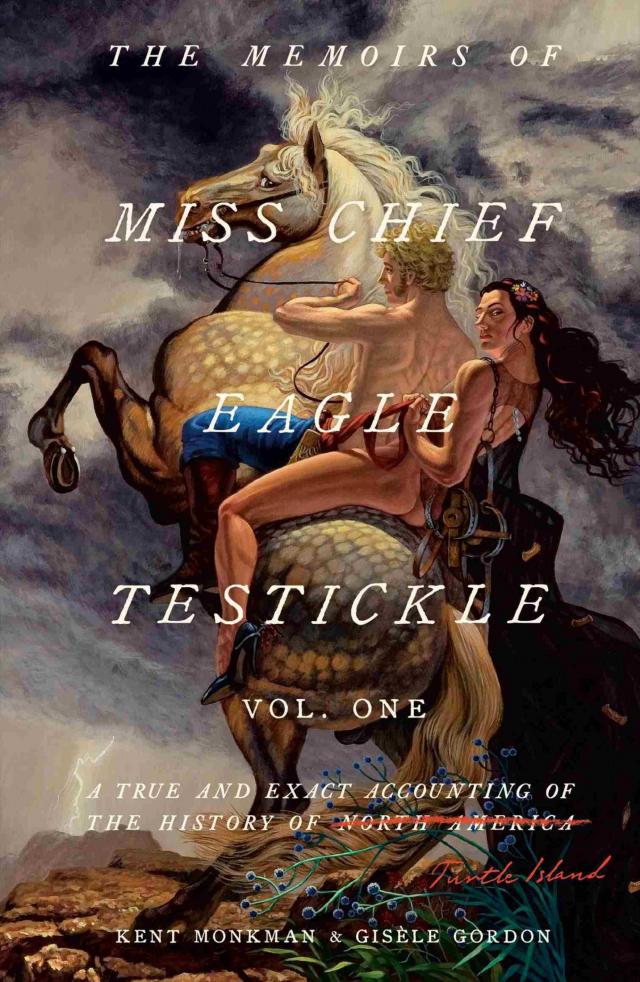
Front cover art: Kent Monkman, The Trapper’s Bride, 2006, Acrylic on canvas, 28 in. by 20 in.
McClelland & Stewart,
a division of Penguin Random House Canada Limited,
a Penguin Random House Company
www.penguinrandomhouse.ca
a_prh_6.0_145372211_c0_r4
For all the ancestors who were
once children, all the children
who are our future ancestors,
and all the children in our lives.
* * *
Gisèle would like to name her
greatest teachers, her children Carson,
Miyoteh, and Keewetin, who give us
faith in the future every day.
ᒫᒪᐘᑕᐢᒋᑫᐏᐣ
* * *
CONTENTS
Cover
Title Page
Copyright
Dedication
Author Introduction
A Note on the Use of Cree
Preface by Miss Chief
A Star Is Born
When I Dreamed What Was to Come
My First Encounter with a Newcomer
The Massacre of Our Beaver Relatives Foreshadowed What Was to Come
The Newcomers Had Much to Learn
Many Trappers Sought Freedom in Our Forests
I Summoned My Admirers to Honour Me
The Time When Many Nations Came Together
The Painter Who Could Not See
When I Travelled to the Newcomers’ Homelands
Our Ways of Seeing Were So Different
Return to miskinâhk-oministik
My Intercourse with the Crown
I Learned That They Would Steal Everything
To Help My People I Made Mischief with the Newcomers’ Leaders
Notes
Acknowledgements
Cree Language Glossary
ᑮᒁᐩ ᐆᒪ ᐁᑿ ᐊᐑᓂᑭ ᐆᐦᐃ
* * *
INTRODUCTION
All stories start somewhere.
Our connection to Miss Chief began when she first appeared in Kent’s painting Artist and Model in 2002. Since then, she has evolved and come into her own in the many works of performance art, installations, collaborative writing, and films we’ve made together. As she grew, she guided us, allowing us to tell her story, nudging us to learn more to tell it the best way we could. If we have not honoured her as we should, we ask her forgiveness, for we would never want to let her down.
Miss Chief led us here the long way. What began as a friendship over changing oil and tinkering with our mid-70s Honda motorcycles with other artist friends in Toronto in 1990 turned into thirty-plus years of partnership and collaboration. Kent is Swampy Cree, a member of Fisher River First Nation in Manitoba. He grew up mostly in Winnipeg, close to his Cree father’s extended family, including his great-grandmother, Caroline Everette, and his grandmother, Elizabeth Monkman, a survivor of Brandon Residential School. Gisèle is a settler who moved to these lands as a child from the UK. After three decades of bouncing ideas off one another, our lives and families are now intertwined.
This story begins with the paintings. Kent’s paintings of Miss Chief became our storyboard to flesh out her story. Some of the paintings confront difficult truths head on, some are sexy, many are tongue in cheek. They are all drawn from Kent’s personal experience of Cree culture and worldview as a Two-Spirit Cree cisgender man. We have made over a dozen projects translating the visual vocabulary and deeper context of Kent’s paintings into films, performance, and installation projects. This book is an extension of our longer collaboration, continuing the story in what is, for us, a new medium.
We are grateful to many people for their assistance, but will save most of those thank yous until this tale is done. There are a few, however, that we need to thank up front. Like many descendants of those who went to residential “schools,” Kent did not grow up as a Cree speaker. Before our tale begins, we’d like to honour and acknowledge the four brilliant minds who were generous enough to agree to be our main advisors on this book. Their combined knowledge and insights on the wisdom, kindness, and playfulness embedded in Cree language and culture made this book possible:
Dr. Keith Goulet, Nehinuw (Cree) from Cumberland House, who has been one of our most important teachers for the past two decades—we are deeply grateful to him and the wîcihitowin he and three generations of his family have shown us. He grew up trapping, fishing, and hunting, and is a scholar of Cree oral history, with a PhD in history on land dispossession and the Cree concept of land. The depth and breadth of his knowledge of Cree language and its connection to land and history is immense;
Floyd Favel, nêhiyaw (Cree) journalist, playwright, essayist, theatre theorist, and Cree cultural practitioner, Curator of the Chief Poundmaker Museum and Director of the Miyawata Culture Association from Poundmaker Cree Nation, is a long-time friend and collaborator whose unique artistic perspective and mâtinamâkêwin have been invaluable, hilarious, and inspirational to us both;
Dr. Belinda Daniels, award-winning nêhiyaw educator from Sturgeon Lake First Nation whose PhD dissertation is on nêhiyawêwin (Cree language) reclamation in her home community. Belinda is one of our Cree teachers—her nikwatisiwin and her help with incorporating profound concepts in a respectful way was invaluable;
And our dear friend, fluent Cree and Michif speaker, director, producer, screenwriter, and actor Gail Maurice from the village of Beauval. She helped us solve complex story problems with inspired solutions, encouraged us with her enthusiasm, and was often our muse, for, like Miss Chief, she radiates sâkihitowin with a generous dose of mischief.
Without their guidance, ideas, editing, consulting over dinners, campfires, teas, and many phone and zoom calls, we would not have been able to tell Miss Chief’s story as it needed to be told. Over the past five years, their advice, feedback, ideas, and encouragement transformed and guided this memoir. They connected us with other knowledge keepers and shared family connections to open insightful, transformative conversations. Their commitment and passion to seeing us through this project was invaluable. Their opinions reflect a fragment of the diversity of thought from community to community, and also within communities.
This is a story by two artists on a path of exploration and discovery. If we have made mistakes with our Cree knowledge or the shared histories of these lands, they are ours alone.
A NOTE ON THE USE OF CREE
* * *
Cree is an oral language that is not standardized. It has multiple dialects; we use the Plains Cree Y dialect and mostly follow the most common Cree written spelling system of Standard Roman Orthography (SRO), which does not capitalize words. We made an exception in response to a request from our publisher to capitalize the Cree proper names of people in the book in order to help non-Cree speakers. In cases where we are quoting from Cree speakers we also kept their dialects and spellings, which are not always Y dialect SRO.
We are grateful to the expert help and generosity of Dorothy Thunder, Miriam McNabb, Solomon Ratt, and Bill Cook for helping us with translations and correcting our many mistakes in Cree. If errors remain, it is entirely our fault.
* * *
My name is
Miss Chief
Eagle Te stickle
and I come
from the stars
* * *
Let me start at the beginning. Miss Chief Eagle Testickle nitisiyihkâson êkwa ohci niya acâhkosihk, my name is Miss Chief Eagle Testickle and I come from the stars. I will tell you an âtayôhkânis, a little sacred story. It is the story of this land. It is my story, and the story of my people. But it is also your story, for we are all relatives. It is the story of where we have come from. And perhaps where we are going, although that part is up to you. It is not our way to tell you how to behave, yet we may show you the way. Though perhaps it’s better for you to listen to what I say, not to what I do, and some good may come of this after all.
kayâs, a long time ago, there was only the dark fog and the one sound, a low hum that cycled through the universe. I was there, of course, but not in a way that you would understand.[2] After some time, the forces of light and dark joined together to become the great goodness, Kisê-manitow, the Great Spirit, who created all things, including us, the oldest beings. Kisê-manitow sent out a thought into the universe, which became the first acâhkos, the first star. I was still elemental; you would think of my form as hydrogen, but I was so much more. The beginning of everything was here, including you.[3]
My experience of time is different from yours. After a while, Kisê-manitow formed Grandfather Sun and Grandmother Moon, those that you see in the sky today, and also askiy, this planet you call earth. Kisê-manitow brought the elements—fire, water, air, and earth—and from these were made the land we stand on, the rock, the mountains, valleys and plains, the oceans, lakes, and rivers.
My elder siblings, the sacred beings, were created next. Wîsahkêcâhk,[4] I call him nistês, my elder brother, some of you call him trickster, but he is much, much more. piyêsiwak,[5] the thunder beings, were there, and also my dear friend and sister/brother Mistâpêw, who some of you call Sasquatch. There were others there, including those who do not wish to be named, and those who should not be named.
You haven’t brought me tobacco, blankets, horses, not even a pack of chewing gum, so I cannot tell you the whole story. I cannot tell you about Kôhkominâkêsîs, Grandmother Spider, or acâhkos iskwêw, Sky Woman, but I can reveal enough for you to understand my story.[6] What I can tell you is that after my elder siblings, the âtayôhkanak, the spirit beings, came to be, there was one more legendary being created, one most people don’t know about. That being was me. I am Miss Chief Eagle Testickle, and this is my story.
This tale was written on the rocks so far back in time that the people have long forgotten how to read them,[7] but listen, and I shall tell it to you now. I came from pakonî-kîsik, the hole in the sky that connects this world to another behind the Seven Sisters, the place Wîsahkêcâhk points to in the winter sky—what some of you call the Pleiades.[8] It is a place without what you understand as dimension, but it contains your past and your future. You can only fully comprehend it in your dreams.[9]
I shone so brightly with acâhkosak, the stars.
I Come From pâkwan kîsik, the Hole in the Sky, 2022. Acrylic on canvas. 108 in. x 81 in.
Kisê-manitow sent me blazing down to askiy, leaving a glittering pink trail in my wake,[10] transforming me as I fell. My form shifted from gas to cloud, to rain, soft kimiwan sprinkled with cosmic dust. As I hurtled to earth, I laughed, sending shock waves of sound rolling in all directions. A blur of new sensations coursed through my newly forged body. Emotions flooded through me in sharp focus one at a time and then all at once, blurred and packed in incomprehensible layers. New feelings tumbled over one another—the shock of physical awareness, primal delight and wonder, and an overwhelming feeling of love for all of creation.
I was now a being with senses, an external shape with bones, skin, muscle, and cells full of nipiy, water, carrying positive and negatively charged ions that danced within me. Every sense in my new human body was firing as I experienced them for the first time. The wind howled in my ears and my skin glowed hot. The pressure of the atmosphere sparked off my golden-brown skin as I plummeted to earth. From all four directions the winds came, working together to slow my screaming, smouldering descent, but still I sparked, glowing ever brighter until my black hair began to singe and smoke.
I opened my mouth to scream my first human sound, but before I could, a great shadow flew before me. Kisê-manitow had sent kihêw, the great eagle, to further slow my descent. The air shrieked apart as the leader of the winged ones cracked the molecules aside with his mighty wings. He flapped again and enfolded me against his breast, my body relaxing into his cool feathers.
I arched my back to press myself into his sternum, which felt so exquisitely hard underneath the softness of the downy surface. kihêw looked me in the eye and gripped me harder with his razor-sharp talons as he spread his wings ever wider. Everywhere my body connected with his, I felt new pathways burn to my brain and my loins until I became aware of another part of my body, rock hard, with intention all of its own. Things were getting more and more interesting.
As I hurtled to askiy, confusion and fear gripped my new faculties, but underneath I felt joy burbling, finding its way to the surface.
We Are Made of Stardust, 2022. Acrylic on canvas. 81 in. x 108 in.
Everywhere my body connected with his, I felt new pathways burn to my brain and my loins until I became aware of another part of my body, rock hard, with intention all of its own.
Being Legendary, 2018. Acrylic on canvas. 48 in. x 72 in.
“Do not get distracted from your path,” kihêw admonished me, seeing the desire clearly in my eyes. “We each have our role. I have been sent to tell you that there will be beings in the future, two-leggeds, who require our assistance. You are to live with them, learn their ways, hold their stories and become legend with them as they go through the times of great change that will come with visitors from across the seas. Above all, you must love them, and with this love, this sâkihitowin, keep them on their right path, for they are weak and will need our help.”
I could barely hear kihêw over the roaring of the atmosphere streaking past us. And, oh yes, I was thoroughly distracted. This tugging upon my body, emotion, and thought gave way to a new feeling. Desire. kihêw’s sharp talons released a little and, afraid that I might slip, I instinctively plunged my hands into the warm, downy space between kihêw’s legs and grabbed the first thing I could reach: the weighty balls that hung there so invitingly. kihêw’s yellow eyes widened as he glowered. “You are mischief!” I could barely hear him. “Your game with the eagle’s testicles!” With the deafening roar, what I heard was “You are Miss Chief, your name is Eagle Testickle!” I gazed into his eyes with great pride. It was kihêw himself that had given me my spirit name!
Heat spread upwards from my loins as part of this new body swelled and began to throb with a delicious ache. kihêw glared at me fearsomely, which only intensified the burning pull in my groin. The tension was exquisite; I reveled in it as we hurtled to askiy, my new home. I looked again at kihêw’s eyes; they had softened, and now held an invitation. I smiled to myself. Yes, I decidedly liked it here.
* * *
Time passes differently for us than for you—eons passed, but we did not count them.
Untitled, 2010. Acrylic on canvas. 11 in. x 14 in.
Many years from now, our peoples would find the bones of these giant creatures under the earth.[11]






