

Perma red, p.1
Perma Red, page 1
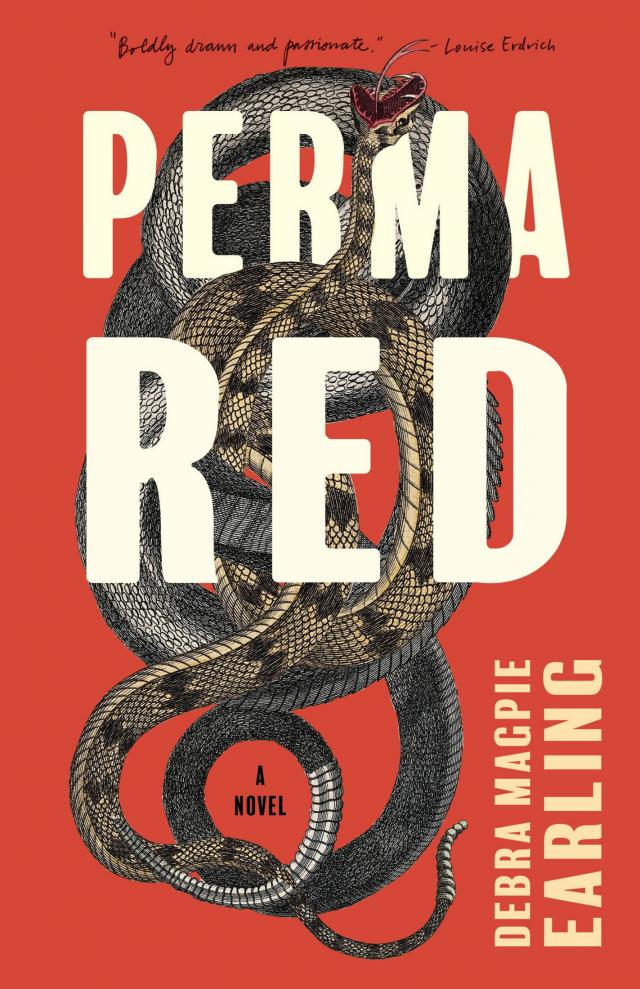


© 2002, Text by Debra Magpie Earling
Original edition first published by BlueHen Books, a member of
Penguin Putnam Inc. in New York, New York.
All rights reserved. Except for brief quotations in critical articles or reviews, no part of this book may be reproduced in any manner without prior written permission from the publisher: Milkweed Editions, 1011 Washington Avenue South, Suite 300, Minneapolis, Minnesota 55415.
(800) 520-6455
milkweed.org
Published 2022 by Milkweed Editions
Printed in the United States of America
Cover design by Mary Austin Speaker
22 23 24 25 26 5 4 3 2 1
First Edition
Library of Congress Cataloging-in-Publication Data
Names: Earling, Debra Magpie, author.
Title: Perma Red : a novel / Debra Magpie Earling.
Description: Minneapolis, Minnesota : Milkweed Editions, 2022. | Summary: “In 1940s western Montana on the Flathead Indian Reservation, Louise White Elk is determined to forge her own path despite the plans of three persistent men”-- Provided by publisher.
Identifiers: LCCN 2021057632 (print) | LCCN 2021057633 (ebook) | ISBN 9781571311467 (paperback) | ISBN 9781571317759 (ebook)
Subjects: LCSH: Salish Indians--Fiction. | Indian women--Fiction. | Flathead Indian Reservation (Mont.)--Fiction. | Montana--Fiction. | LCGFT: Novels.
Classification: LCC PS3605.A765 P47 2022 (print) | LCC PS3605. A765 (ebook) | DDC 813/.6--dc23/eng/20211129
LC record available at https://lccn.loc.gov/2021057632
LC ebook record available at https://lccn.loc.gov/2021057633
Milkweed Editions is committed to ecological stewardship. We strive to align our book production practices with this principle, and to reduce the impact of our operations in the environment. We are a member of the Green Press Initiative, a nonprofit coalition of publishers, manufacturers, and authors working to protect the world’s endangered forests and conserve natural resources. Perma Red was printed on acid-free 30% postconsumerwaste paper by Versa Press.
for Robert Stubblefield
FLATHEAD INDIAN RESERVATION
Louise and Yellow Knife
THE OLD MARRIAGE
When Louise White Elk was nine, Baptiste Yellow Knife blew a fine powder in her face and told her she would disappear. She sneezed until her nose bled, and Baptiste gave her his handkerchief. She had to lie down on the school floor and tilt back her head and even then it wouldn’t stop. She felt he had opened the river to her heart. The cloth he had given her was wet with her blood. She felt hot and sleepy. Sister Thomas Bernard pulled her up and told her to go to the bathroom and wash her face. Sister pinched the bridge of Louise’s nose. Louise kept the handkerchief pressed to her face, embarrassed by all the attention she was getting. She could feel her blood cool in slow streams between her fingers. She remembered at one point Baptiste Yellow Knife had knelt down beside her. Her head was empty. She imagined the veins in her temples quivering. Her skin draining color. Her face glowing, a candlelit egg. Suffering. A saint. Awkward Baptiste. Pigeon-toed and dusty Baptiste was kneeling beside her cradling her head with his cool, dry hands, his voice tickling her ears. He was leaning over her, whispering to her, whispering a story. His voice was in her ear. She felt Sister Bernard pull Baptiste away from her. The back of her head danced with silver stars and Louise fell back into dreaming, a snagged fish released again to water.
Grandma squeezed her hand as she blinked awake. Louise’s hands were cold. “We got this back,” Grandma said. She held up the handkerchief that Baptiste had given her. It was crumpled, stiff and black with her blood. Louise didn’t understand at first and then she remembered Baptiste standing close as the school nurse lifted her into the car. He shyly asked the nurse for his handkerchief. As they pulled out of the schoolyard, Baptiste smiled at Louise and lifted his bloody handkerchief up so she could see all he had taken from her.
Her grandmother had told her to stay away from him. He was the son of Dirty Swallow, the rattlesnake woman. Baptiste Yellow Knife’s mother could direct the rattlers to do her bidding. Last summer a rattler had tapped the back of her grandmother’s skirt as she sat on the stick game lines. Her grandmother had won too much of Dirty Swallow’s money, and she wanted it back. Now the son of Dirty Swallow wanted something from Louise.
There was something about Baptiste. Baptiste was from the old ways, and everybody hoped he would be different from his mother. He knew things without being told. He knew long before anyone else when the first camas had sprouted. He would inform his mother the night before the flower would appear and he was always right. He knew stories no one but the eldest elder knew but he knew the stories without being told. “He knows these things,” her grandmother had said, “because the spirits tell him. He is the last of our old ones, and he is dangerous.”
On the day Louise’s great-grandmother had died Baptiste foretold her death. It was in the spring, on a day so clear clouds faded overhead like wide ghosts. Louise’s great-grandfather was branding horses in the high field and, she remembered, Baptiste had come over with his grandfather to watch. Louise was six years old at the time but she still remembered Baptiste, because it was one of the few times she had seen him out of school then. But she remembered him most because of what had happened that day. And that day Louise sat up on the hillside with her mother, her grandmother, and Old Macheese—her great-grandmother. Louise thought at first Baptiste was frightened of Old Macheese and had chosen to sit away from her.
Old Macheese had survived everything, even smallpox, but her grandmother said her face had always been pitted. Louise could still remember Old Macheese’s face, places where disease had died beneath her skin, bruised places where the blood had pooled for good. Old Macheese liked to rub her knuckles down Louise’s spine, liked to laugh at her when she tripped or cried, whenever she hurt herself. And after the old woman died Louise’s grandmother had told her Old Macheese was just that way, mean.
Louise had wondered if there was something wrong with Baptiste that day, because he stared at her, and even when she made faces at him, he did not stop his watching. She had heard stories about him, how he could see and hear things other Indians could not, how his mother had the rattlesnake power. He sat away from the others, rocking back and forth, digging his slender fingers deep into the black soil while his grandfather worked. He wasn’t called down to the corral like the other boys. His grandfather had let him be alone and quiet on the hill.
Old Macheese had just started to tell a story when Baptiste stood up, so thin the dirty seat of his pants hung almost to his knees. Old Macheese spoke, saying he probably had tuberculosis. He wore a belt that had once been his grandfather’s horse bridle. He had two white splotches clouding his face and still he was the darkest Indian Louise had ever seen, a beaver-dark boy who stood with a strange certainty Louise recognized even then as trouble. When his grandfather saw Baptiste stand, he slipped the knot off the colt he was holding and headed fast toward Baptiste. Louise remembered the old man had leaned over Baptiste, listening and nodding. But Louise could not hear Baptiste.
“Baptiste has seen a salamander,” he called, “a lizard turn red.”
Louise’s great-grandfather, Good Mark, shut the corral gate and made his way up to Baptiste. Louise stood silent beside her grandmother. The other men had stopped working and had turned to see what was troubling Baptiste. The horses crowded one corner of the corral as the workers gathered at the bottom of the hill. The men crouched suddenly to the ground. They were patting the dirt, searching, feeling for something. She could see Good Mark weaving his fingers through the faded grass; his white braids were tucked in his belt. Louise’s mother shook her head, then cupped her hands together on top of her head. Louise’s grandmother tapped Louise. “Look for a lizard,” she had told Louise, half-whispering. “See if you can find the lizard.”
Louise got down on her hands and knees with the men. She combed the grass with her fingertips. She picked up a branch and brushed the ground, but she saw nothing. Baptiste Yellow Knife crept up behind her and Louise looked up to see his knife-bladed hair, his dark face. “You won’t find it,” he said. She pushed at his feet, but he did not budge. “Move,” she said. She didn’t like being told by Baptiste, a boy she barely knew, that she couldn’t do something. “You’re in my way,” she told him. She turned over stones, picked at the sage and grass, looking. She glanced at Baptiste and noticed his watching was dim. His eyes lazy. His lashes flickered and she saw the glare of black irises swirling back in his head, and then only the whites of his eyes, spooky, almost blue. “It won’t do no good,” he said, his dizzy eyes closed. “Someone will die.” Louise saw the dirt in the slim cuff of Baptiste Yellow Knife’s pants. She saw clouds bleaching to wind, a haze of dust changing light like silt changes water. She saw her great-grandmother standing on the hill, and then Old Macheese was falling back, falling, while the wind lifted her olive scarf from her head.
Louise asked her grandmother how she had gotten the handkerchief back. How did the old woman manage to snatch back her blood from Baptiste Yellow Knife’s tight fist, his ugly smile? Grandma didn’t answer her. Louise imagined many things and settled on Sister Bernard and her hard thumping knuckles. She wouldn’t let the boys play with dead rattlers or poke at the mouths of dead birds with sticks. And she wouldn’t let Baptiste keep a blood-soaked handkerchief.
Louise had a dream that followed her from a long night into morning. It was a familiar dre am. She heard a Salish voice, neither a man nor a woman’s voice. The voice did not speak to her but to the dream she cupped in her small hands like a million water-colored glass beads.
It is cold. Snakes sleep in deep holes trapped by snow. We tell our stories now. Rattlers are quiet. It is so far back your blood smells like oil in the tongues of your grandmothers. The snow is frozen so hard it can bruise. The snowdrifts are razor-edged. Snow shines. We’re locked here. Outside Grandma’s house, a naked man stands near a red fire. His face the face of a woman, smooth and deep planed. His back is lean with ribs. His hips are narrow. Flames light high on the roof of Grandma’s house. Base-blue tongues of flame burn buckskin tamarack. Black wood dust to white wood ash. The naked man blows through teeth, his cracked lips whistling to fire. His whistle calls a great wind up from snow.
Firelight becomes one small candle. It flickers, then fails white, then fails, fails white to smoke. Steady wind scatters white ash to thin choking sheets of hot dust. Snow and timber powder, hot and cold. The man stands before the white stars, the endless snow.
His white light is turning to morning.
Louise never asked her grandmother about the handkerchief again. She knew who had brought it back. She remembered stories of her great-grandfather: the secret training rituals of medicine people sent to find a single pin in a night that pressed to forty below, one pin dropped deep in snow, miles from where they stood shivering and naked. Her grandfather had saved her. Somehow he had picked her blood from the dark hands of Dirty Swallow. And she knew it had been at a great price. She would never talk to Baptiste Yellow Knife again.
When Louise was fourteen, Baptiste snuck up behind her and slipped a rattler’s tail in her hand with the slick skill of a small wind passing. She wasn’t sure what to do with it. She stared at it for a long while, then dropped it deep into her pocket, hoping it would fall out of the hole she hadn’t mended. But the tail became a power she was afraid of, a feeling she had never had before.
“Why didn’t you just get rid of that when he gave it to you?” her grandmother asked.
Louise didn’t answer. She looked at her feet as her grandmother was talking. She didn’t know how to tell her grandma that once the rattle had gotten into her pocket, it began moving, as though the whole snake was still attached. She felt the rattle twitching on her leg, like a new muscle, and she was afraid of it in a way that made her strong.
Grandma made Louise bury the rattle on the hill and mark the spot with three red-colored rocks. “That way we can avoid it,” she said. Louise took her time burying the rattle. She found the nicest spot on the hill under the shade of a juniper tree. She dug a deep hole that was sweet with the smell of new roots. She carefully wrapped the rattle with a glove she had worn thin to fool it into feeling she was near. Then she covered the hole up as fast as she could with the sweep of her arms and the clawing cup of her hands. She walked slowly away from the small rock mound, pacing her steps, careful not to look back and reveal any desire to stay.
All that night dreams swallowed her. She was falling. Tall grass shot up around her and whispered with heat. Smooth flat rocks near Magpie Hill were shining with sun. She felt the warm breath of her mother and curled down into a dark sleep.
Louise found a power in ignoring Baptiste Yellow Knife. He no longer existed for her. She pretended she did not hear or see him. She stopped listening for the whisper of scales beneath the thin slat steps of her grandmother’s house. He had less presence for her than the ghost of her sister’s dead cat. Sleep was good, and she began to feel at ease. When he came close behind her from any direction, she sidestepped him and talked as if he wasn’t there. The only time Baptiste could secure her attention was when he rode his horse Champagne. He had even named the horse for her when he had overheard her say she wanted to try champagne. When she had stopped to pet the horse, Baptiste began telling everyone at the Ursulines’ that he was going to marry Louise. “Stay away from her,” he would say. “She belongs to me.” The more she denied him, the more he would follow her. She would look for him, she told herself, so she could stay clear of him.
At the stick games in Dixon she hid beneath Charlie Kicking Woman’s tribal police car for almost an hour with everybody staring at her, because Melveena Big Beaver had told her Baptiste was looking for her. She lay half under the engine-hot car in a stain of oil that ruined her good dress, only to find Baptiste walked past her holding hands with Hemaucus Three Dresses. When Louise stood to shake the dry grass from her hair, Baptiste did not look at her or even shift a glance her way. Only his mother, Dirty Swallow, eyed Louise. Dirty Swallow sat in the dirt of the stick game line without a blanket. Her eyes were small and steady, and though she kept playing the game, she kept her eyes on Louise, opened her palm to reveal the black-rimmed bone.
Baptiste was animal and dark, and when he smiled at Hemaucus, he almost looked handsome. Louise felt relieved and pulled breath deep into her lungs, but the moment of relief came to her with the feeling she had lost something. She lit a cigarette and tried to attend the scar of juniper trees near the road. She looked over at the both of them. Baptiste rubbed the back of Hemaucus’s brown hand on the side of his thigh then led her to the stick game line. Louise saw the two of them smiling at each other.
She didn’t know how to feel. She wondered if everyone was feeling sorry for her because Baptiste Yellow Knife had managed to find someone new, someone better. She knew she didn’t want Baptiste Yellow Knife and his attentions, had run from him for years. She had dodged his every whisper, averted his every glance. She stood next to the dusty trees feeling dry-handed. The oil stain bloomed on her dress. Louise thought the people were looking at her because they were thinking she should be jealous of Hemaucus. And in the stinging light of a summer day passing, Hemaucus’s hair hung heavy, so shiny it seemed to be water. Hemaucus was an older woman but she quieted her laughter with her hands when she looked at Baptiste. Her waist was full and her smooth arms were tight-lined with muscle.
Louise felt small. She could feel the hard lines of her ribs. Her stomach was sinking and hollow. The bones of her pelvis caught the thin fabric of her dress. She had heard the old women telling her grandmother to watch her. “Make sure she hasn’t got TB,” they said. And, standing in the field, the grass white and brittle at her ankles, she felt her big-boned knees. She felt tired and foolish. Maybe she had fooled herself into thinking she looked better than she did. When Melveena Big Beaver walked by with her sister Mavis, when they both looked at Louise and turned their heads covering their smiles, Louise kicked dust at them.
Louise realized she had kept no distance from Baptiste. All of her focus, all of her attentions had been and were still directed toward Baptiste. Ignoring him had only made him present in her life. Now that he had given up on her she began to wonder if he had really chased her. He was in love with someone else, and she saw him only on occasion, but he no longer looked at her. She told herself she may have been the problem all along. She had nothing to worry about. And when Louise saw Baptiste Yellow Knife alone again, she was in the safety of Malick’s store, safe among rows of peanut butter and preserves, crates of fresh eggs. She walked down the main aisle, passing him. He said her name as she was heading for the counter, and for the first time in years, she turned to him and smiled. She had no way of knowing the power she had given him again, not until she glanced at him from the smoke-stained window as she was leaving. He stood just outside the store, his arms lank at his sides. Louise watched him for a long time, but he did not move from his place. He would not surrender his vigil. She wondered if he was waiting for Hemaucus but she realized too late her grandmother had been right. He was waiting for her. She should have ignored him forever.
Louise had only one nightmare in all the months she had denied him. In her dream, Baptiste was an old man swimming against river water. His shoulders were harnessed, pulling something she could not see. He estimated each swell, each hesitant wave. Watching. She heard the slap of water against the pockets of his body, to rock, to water, to rock. Up from a swell of water, silver as winter rain, he reached for her. He had not gotten her then and he would not get her now. Louise swallowed a deep breath of stale grocery air and stepped outside to face the hot sun and Baptiste Yellow Knife.






