

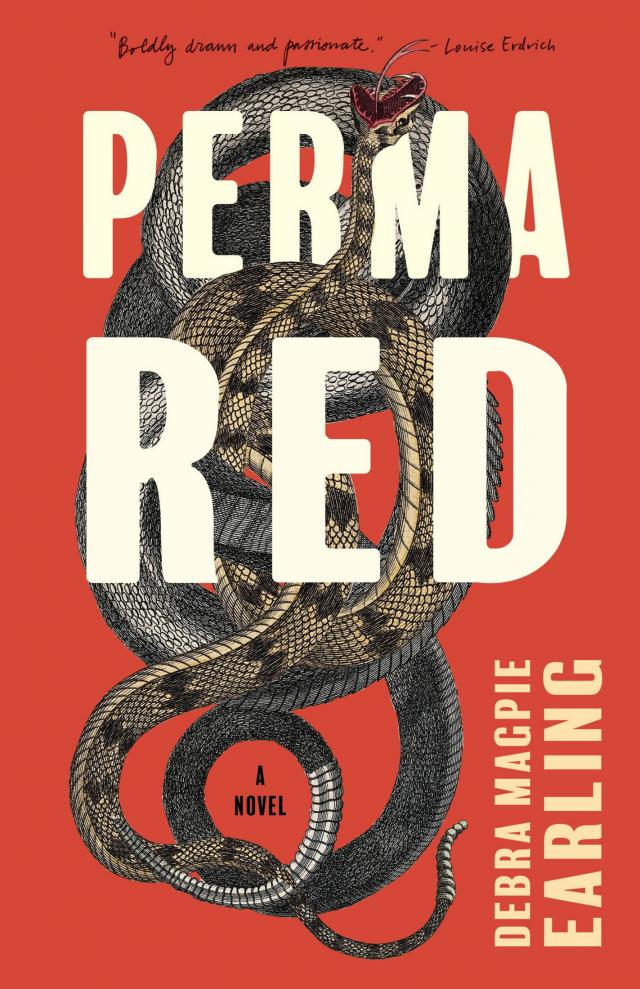
Perma red, p.15
Perma Red, page 15


But there had been other times, rare times when I didn’t have a single drunk to chase away. Only dancing. Only laughter. I’d just been the chaperone who’d come to eat fry bread and watch. I hoped for the best but knew better.
I suspected Stoner would come for Louise. And he did. He didn’t just drive past the powwow grounds. He got out of his car to have himself a look. He stood over the stick game squatters with his new hard luck. Since he’d started seeing Louise he hadn’t been looking too good. His face was haggard and drawn.
Stoner sat too close to Eneas Victor and got a mouthful of dust when Eneas started digging down in the dirt, started throwing up thick handfuls of dust, raking dust through his hair with his fingers, and rubbing dust on his big, naked belly like he was washing himself. Eneas put his head down to snort and chase the other players a little. He’d always growl and shake his head to make all the other bettors forget the bones he held. I saw him growl at Stoner and I saw Stoner just standing there, fists deep in his smooth leather pockets, shoulders tight to his ears, looking around slyly at all of us. And I knew deep down he was wondering about Louise, about her bronze skin and cedar-red hair, how her beauty somehow came from all that he was not and all that he could never be. And he was afraid, I think.
I saw him standing over by the pop stand, smoking, squinting hard. He looked out back past the dance circle, past the bead and candy stands, past the cooking tents to the dozens upon dozens of teepees, the canvas stretched taut over the ribs of lodge poles, the mystery of canvas or buckskin doors draped for just a small heat opening. And I wondered what we looked like to him, all these Indians, some of us in deer hides and feathers, the stick game lines, Pendleton blankets, our old women in bright kerchiefs, the young girls with long hair and the young women with their short, black hair and red lipstick who stood back from the games aloof as deer, the toothless, the drunks, the beautiful, and everywhere the small sound of bells.
I wondered what Harvey Stoner thought of the dancers, the sawdust arena, and the high clear voices clipping the drumbeat, the drums, the singing voices that weaved the dancers. I wondered what Harvey thought about Baptiste as he entered the arena because Harvey stood for a long while, watching him. I wondered because I, myself, had always stood back from Baptiste when he was sober and dressed for dancing, far back, baffled by the muscle-sleek call of his dress, the dark, chalky silks close to his neck, the white elk bones laddering the bones of his own chest, the brittle sound of his ankle bells dulled by the beat of kicked dancing dust, his quill scalp spined upward toward all of us like the needles that stitched our blood, a thousand cut-glass beads glaring on the wings of his shoulders. We all focused on Baptiste by keeping our distance. A circle formed around him by the absence of other dancers.
Baptiste would begin dancing like a great, hawking bird. He would lift his arms and we would all, all of us cower forward to watch the quick spin, the dipswoop, his head cocked smooth and sudden, so close to the arena floor, we imagined his ear could hear the whisper of quiet dust. A bird, we would say, naming crow, magpie, eagle, hawk. Then he would straighten in his dance, the music his own, and we would see the magic of deer, the elk, or the buffalo, all the animals he had become.
The children would cry sometimes or bury their faces into the chests of their laughing parents. But I remember feeling the tingle along my spine when my cousin Baptiste would turn to face me from the dance floor, Baptiste in the heat of dance would lift his open palms like a prayer, his face painted a black mask, the whites of his eyes, then blackness again. And all the dancers stopped dancing, I think, because they recognized power, not medicine power nor the power we all have now and again to strike someone with the snake of our image. The dancers stopped to recognize the clear light that surrounded Baptiste when he chose to honor the old ways. We looked at him in the dust of that dancing day, everyone, it seemed, in love with all that Baptiste was in lightning seconds.
I thought of Stoner, of all the things he’d probably seen, but I didn’t think he’d ever seen dancers like that, or was ever likely to see anything like it again in his life. I’m sure he didn’t have a clue what it meant. And the saddest realization I’ve had was that I wasn’t sure what it meant either.
The strangest thing happened when Harvey was watching the dancers. Baptiste had entered the arena and he was moving very slowly, not to the direct beat of the music, I guess, but somehow still in time. Baptiste held a staff of hawk feathers that I recognized but had never known him to dance with. I remember a sudden furious wind of dust in the center of the dance floor, a winding column that turned a single time with wiry force and I had an urge to draw my gun. Some of the elders had stopped dancing but I noticed Baptiste kept dancing as if nothing had happened. Some of the young kids kept dancing too. There was a kind of small drama unfolding that no one was talking about and I began to wonder if the event was all in my head. Still, something curious seemed to be happening. And then it happened.
From the open end of the arena a large mule deer entered. It was strange how nobody saw it at first. I watched the deer run headlong into the dance ring. The great deer lowered its head and kicked up at the other dancers and they were laughing and trying to keep dancing. It bucked and we could all see its antlers, and there was a small roar and clapping from the audience. The buck seemed confused and was bleeding at the nostrils. I tugged at my holster and entered the dancing arena. The dancers were beginning to clear the dance floor, all the dancers but Baptiste.
I unsnapped the top of my holster. I felt the eyes of the audience and the dance-stopped dancers. There was a low drumming and the people were singing a sad prayer. My ears felt hot and I wondered how the hell I had found myself in this situation. My gun felt heavy on my leg, the gun I had no intention of using. I was the dangerous one here. Out of my element. Snagged like a squawfish. Useless. The deer began to circle Baptiste and Baptiste lowered his head. And in the second that it took for me to notice Baptiste, the deer had bounded to the end of the arena area and I caught just a glimpse, the strange silver shine of its tail and then it was gone.
I turned to see Stoner again. I was more aware of him than anybody because I could feel him smiling at me. He had a long grin. And he clapped his hands without noise, letting me know he thought the deer was staged, a show we had worked out as Indians. I began to really look at him. I cocked my head at him and for a moment I felt like laughing. He had bigger problems than me. I looked at his face, dry as dirt at the end of summer. And I’d say he wasn’t long for this life, at least not if Louise left him. But a man can live a long time on desire, an old man’s lifetime. He left the powwow, his big car clipping chuckholes. If he had looked back all he would have seen was me, my hands on my holster, the powwow grounds behind me, the teepees lighting one by one a deep yellow fire he couldn’t get near.
I hadn’t seen Louise. Hemaucus had been dancing earlier and then I saw her go back to the campground. It was still afternoon, but a heavy afternoon over the powwow grounds. Heat pressed the sky down upon us. A sling cloud hung low and purple. If you looked south, in the distance you could see blinding sun raining. I kept waiting for the wind to rush the camp tents and teepees. The wind to chase the candy wrappers and paper cups. But no wind came.
If the river could tick it was ticking. There was a smell I recognized in the air, a smell like wet paper and fire, and a deeper smell that was not good, deeper than the dry leaves falling, deeper than the barrow pits. I sat in my car and listened for incoming calls. But there was nothing but static, a hundred miles of it.
Louise
BLIND SPOT
She had agreed to meet Harvey Stoner secretly. She sat in the tall weeds, waiting for the sound of his car. It reminded her of the times she had hidden from Charlie, only this time she would get to punch the radio keys in Harvey’s car, drink an ice-cold beer.
Harvey Stoner smiled at her as he opened the car door and leaned far over to her. “You’re a sight,” he said.
She had seen the men at the Dixon Bar glance away from their stares when she looked at them. Some of the men in Thompson Falls had looked in her eyes for a moment too long when they counted back change to her. Baptiste only smirked at her. But no man had looked at her like Harvey Stoner. He eyed her like a waterfall. Harvey drove her up behind Dixon, far up a road she had only walked with her grandmother and sister when they searched for huckleberries. She could smell the sweet light of autumn.
They sat in the car and listened to the radio. She drank her beer fast to feel the quick sleepiness settle in her chest, the drift of a good time. They rolled down the windows and watched the sky. It was dark as an Easter shroud but it did not rain. They sat for a while not talking. Louise liked the afternoon, the slow lazy sun hovering. She liked the purple belly of the clouds over their heads. Harvey Stoner drove her home, telling her next time he would surprise her. Next time. She was surprised by him this time, surprised he had not tried to kiss her or touch her. He seemed to enjoy her company. He lit her cigarettes and uncapped her beers. She was happy he wanted to see her again. Happy to have a man drive her home and pull right up next to her grandmother’s house like she was a lady.
Louise couldn’t have imagined the sun slanting so suddenly through the windshield of Harvey Stoner’s car. She couldn’t have imagined her husband would be hiding in the blind spot of her watering eyes. Harvey had just stepped out of the car to open her door. It had been Harvey Stoner she had expected to see open the car door and hold out his hand to her. But she had looked up, shielding her face from the sun, and it was Baptiste who hauled her from Harvey Stoner’s car, Baptiste pinching her elbow so hard she felt the sting of her funny bone. She was almost smiling, almost glad that Baptiste had come for her. When she entered her grandmother’s house her eyes pulsed blind in Baptiste’s shadow.
She remembered Baptiste had closed the kitchen door and had fisted the hook to latch it. She heard the low rumble of Harvey Stoner’s car leaving. Even Harvey Stoner could not save her. She said nothing to Baptiste. She knew there was nothing to say. In her grandmother’s house she could hear the ragged pull of Baptiste’s breath. She stood still, hoping her stillness was a remedy for the tremors that heaved Baptiste. She felt the blunt darkness of the room, the coffeepot dulled by fire, the round lip of the sink, the small thick scissors her sister used to cut catalog paper dolls.
Baptiste cracked his hand to the crown of her skull with a heat that resembled comfort. She saw a crackle of light falling to her knees. She saw the ink-pen cross and then her name on Baptiste’s brown hands. She was able to bite him hard enough to taste the liquor of his blood. When Baptiste kicked her wrist she realized she was still holding the beer Harvey Stoner had given her. She saw the splat of gold as beer bubbled out of the bottle, arching over Baptiste, striking him, spilling on the floor around him like sour light. Baptiste was drunk, drunk to falling, his eyes smoke-hazed, hard-squinting, fixed on her as if she were a distant object. She saw Baptiste holding the broken bottle by the neck, lifting and jabbing, weaving. Mean.
A crazy stillness settled in her thinking. She remembered a barn boxing match she had once witnessed in Dixon. It was so dark in the barn they had surrounded the boxers with their trucks to light the event. The stark headlamps had made the boxers seem like movie stars to her, the skin of the men so white in the white lights their whole bodies haloed a soft glow. The boxers had held each other’s keen stares with a tenderness like love. Even when they were pulled apart they did not break their gaze. There was a silence she had not known before, a humid silence so heavy the only sound she heard was the sound of the boxers’ heavy fists hissing at all of them. And when one boxer fell to the floor she witnessed the brutal ache of his sweat shimmering above his head.
She reached up to the sink. She pulled herself up and had turned toward Baptiste to back out of the room when he lunged at her. She felt a dull ache in her chest. The beer-splattered floor shined like the eyes of ten thousand snakes. A red sleep whispered to Louise, soles of hard shoes on slick floors, her dead mother’s hair in the jar by the juniper, Arliss’s white socks on wire in the wind.
She wasn’t sure how long she lay on the floor listening to Baptiste’s lung-hissing sobs. She told her grandmother to shut Baptiste up. “Stop, Baptiste,” she said. And her sister, Florence, grabbed her hand, told her Baptiste was gone, had been gone for hours. Baptiste had run away like a coward.
“You can stop crying now,” her sister said. “Baptiste won’t hurt you.”
Louise remembered the floor grit on her cheek, the new crack in her head where the wind howled now. She began to feel the weak flesh of her tender head. It was sore and wet. She could feel the slit. She tried to get up but her left leg was asleep. She could see the boot mark, the swollen blood-blue egg on her shin. Her left side felt heavy and oddly weak. She had the sensation that her breast was being pinched hard.
She looked down to see the scowl of wet blood tightening to her chest. She tugged at her sticky blouse to keep the blood from drying to her skin. She could see the open moon, curved up around one side of her nipple, banking off the side of her head, and Baptiste’s hands again, Baptiste’s hands hitting, Baptiste’s hands shining with snatches of her hair, Baptiste’s hands slapping her face. He had hit her hard, hard enough to wake her up and set her to sleep again. Her teeth rattled and Louise thought Baptiste was at the window.
Her sister draped a small pink sweater over her shoulders and Louise imagined Florence was praying, whispering for help. Florence placed a cool washcloth at the back of Louise’s neck and Louise felt dizzy.
The light in the room was yellow and so bright she could only keep her eyes open for pinched seconds. She was aware that the days of summer were mostly gone. The purple sky had delivered only the smell of rain. A bright wind scorched the cottonwoods, so dry the dust and the boards of her grandmother’s house made a whispery sound like the voices of old women. To Louise it seemed to be winter. When she closed her eyes she saw snow falling, snow sifting through the guardrails, lighting on the thick tongues of cattle, slow ice growing at the windows.
The winter before Louise had married Baptiste Yellow Knife her grandmother had told Louise a story of her first marriage. At the age of thirteen her grandmother had married a son of the chief, but not the first son. The man she married was not destined to be the chief. The man her grandmother had married was an old man. His breath smelled like tobacco and old corn and he stunk up their teepee with his bad wind. Still, her grandmother had told Louise, he wanted to leave a long legacy.
This old man had chosen to sleep with another Indian woman and had gone to her teepee. Louise’s grandmother had followed him, knowing he was up to no good, knowing he was going to rut like a buffalo with another woman. Her grandmother had heard him with this woman. She knew his voice, because most of his teeth were cracked and he sounded like he was whistling when he talked. Louise’s grandmother lifted the flap of the teepee and had smelled them. She saw the droopy sack of her husband’s balls as he mounted the smooth, flat ass of the other woman. She stood back from the teepee opening and waited. She had taken her dressing knife to this woman’s lodge. She was going to kill her husband. Her grandmother had told Louise she had dreams of being free again, of being without this old man and his old ways. But she had looked at Louise as she told the story. She had looked hard at Louise and she had said, “Even when you don’t love them, that is when they get you, because you think they should love you. They have you then.”
As her grandmother stood next to the other woman’s teepee she had felt the flush of her heart. She could hear him inside with this woman and he wasn’t doing so good. The woman was laughing at him and telling him his man thing was dead and ugly like a lizard. Louise’s grandmother stood in the fine silt dust of that day as the evening fanned the trees to coolness and she felt ashamed for her husband and for herself. She was so caught up in her husband’s shame she didn’t hear him as he sneaked from the teepee. When he saw Grandma he tried wrestling the sharp knife from her hands. He had a big smile on his face. They kicked around in the dust awhile, Grandma and the old man, until finally the old man looked up at Grandma and said, “If you want to kill me because you’re so jealous then here I am.”
Grandma had taken a long look at her husband, the black pigment in his knees, the sag of his pierced earlobes, his face swollen with sixty years of buffalo fat, and she never let him know she could have laughed at him. I hated him, her grandmother had told Louise. Louise let this story drift in her. She thought she understood and then she closed her eyes. She heard her grandmother and Charlie Kicking Woman. She could hear the stiff soles of Charlie’s boots and she pulled her sister’s sweater over her face.
There was a sudden light inside her that made her cup her hands over her face so she wouldn’t see the bruises on her arms, so she wouldn’t see just how dark she really was in a well-lit room with a blue-eyed white man. She noticed the man’s nails shined and he smelled like clean alcohol, the kind of alcohol that didn’t come from a breathless voice, the kind of alcohol that didn’t wheeze in his lungs but shined on his hands when he sewed up the cut on the back of her arm. He sat her down in front of his pressed trousers, so close she could see the first three notches of his zipper. She leaned back on the damp heels of her hands and looked at the floor.
The nurse entered, carrying a large, white porcelain bowl of alcohol and gauze. Louise looked up at the doctor but he only smiled at her. The nurse set the bowl down on a small table near her knee. The doctor leaned close to her. She could smell his licorice breath as he pulled her head eye-level with his waist. She tried to jerk back.






