

Systems, p.1
Systems, page 1


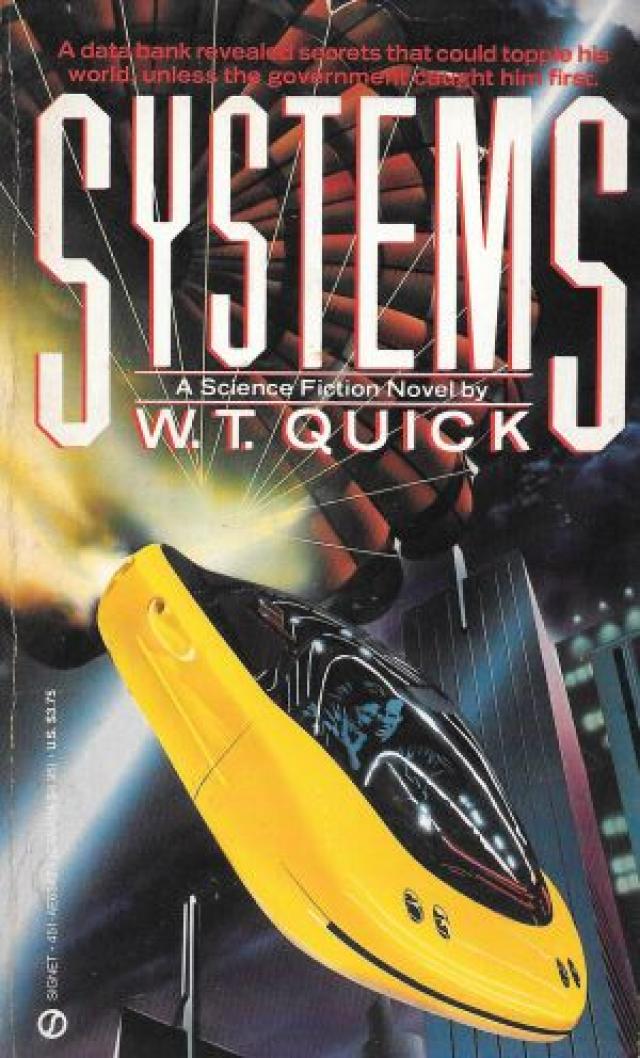
Systems
W. T. Quick
This book is dedicated to Desmond Mong Seng Tan, for all the right reasons.
Acknowledgments
I would like to acknowledge the work of Dean Ing who, to the best of my knowledge, first described the Club under the guise of the Cold Gas Launcher in his book Firefight 2000 (Baen Books, 1987). Also, thanks are in order to Ben Bova, who created Moonbase and graciously threw it open to those who wished to write about it: Certain aspects of Moonbase are incorporated in Kennedy Crater. Finally, hats off to the killer duo of Mary Ann Murphy, proofreader and copy editor without compare, and Bill Stoshak, who has kept my battered computers running, provided loaners and good advice, and generally been an excellent fellow. My heartfelt thanks to all of you.
Chapter One
He opened his eyes. Pain blasted across his face. At first he thought he was blind. Bloodshot haze throbbed where his brain said vision should be. After a time the crimson fog diminished, and faint, vaguely human shadows appeared. Something cool touched his forehead.
“Joshua? Mr. Tower? Can you hear me? Can you see?”
It was a woman’s voice—soft, reassuring, and unfamiliar. A professional voice. He tried to put things together. Pain. A woman’s soothing voice. Concern.
Finally he had it. A hospital. There must have been an accident of some kind and he’d been injured. Now he was in a hospital. He tried to shape words, but he’d misplaced his lips, his tongue.
“I think he’s aware,” said the feminine voice. “Maybe he can hear us.”
“Don’t push it,” a masculine voice rumbled gently. “We don’t know about nerve damage yet.”
“No. I checked for response, but it’s too early to tell. Later, maybe. I’m going to put him back under now.”
He heard a hissing noise and felt a dull pressure beneath his right ear. Hypospray? Suddenly it didn’t matter. The bloody clouds receded, turning gray and slow.
One last thought.
Julia… Julia?
The waiter flicked up their menus like a man raking in cards, bowed slightly, and turned away. Tower fumbled in the pocket of his suit, found the lumpy shape, and took it out. He handed the small package across the table. Julia looked away from his face as she worked the distinctive Cartier bow with long, graceful fingers.
“Josh, my god! A diamond ring.”
She was in her early thirties, almost ten years younger than him. Her hair was the real black that few achieved without artificial means, falling smooth and straight to her shoulders, framing a face that was all cheekbones and wide, gray-black eyes. She wore a simple white dress that exposed her shoulders. He thought she was the loveliest woman he’d ever seen.
He luxuriated in the chill smoke of her voice and wondered what strange karma, what unknown bonanza of luck, had gifted him with her. Silently he mouthed the syllables of her name. Julia. The three syllables sounded like chimes in the bell of his skull.
She raised her eyes, and he wanted to laugh aloud. His spine ached with happiness so pure it was almost pain.
“You always wanted a ring,” he said. “I couldn’t think of a better time.”
The perfect blue-white solitaire glittered like a mislaid star on her hand. He watched her lips, her eyes.
“Do you like it?”
She nodded slowly.
“Hey, don’t start crying now. This is the happiest moment of my life. It’s only a diamond. A little thing. You’re giving us a son.”
Slowly her fingers crossed the space between them and came to rest on his cheek. The jewel glinted at the corner of his eye in silent premonition.
The world rolled slowly.
“I love you.”
“I love you.”
It was dark when he woke up. His vision had returned. The throbbing, bloody haze across his eyes was gone, taking the pain with it. Now he felt cold and frightened. Random synaptic connections tried to kick-start memory, but the mnemonic engine wouldn’t catch. For the moment he was stuck with the present. He shivered. His bones told him the past was a pit, the future hell.
After a while he slept again.
“What should we call him?” he asked.
Maxwell’s Silver Hammer was one of the oldest restaurants in San Francisco. Patrons fought to make reservations weeks in advance, hoping for a Bay-side table with a view of the great tankers sliding into port. Tower called in every minor favor he had and gimmicked entrance on two days’ notice. He thought about the cost only peripherally: two weeks’ pay for a single meal. Cheap at twice the price, he decided, watching the chandeliered light dance in her thick, night-shaded hair. Their first child deserved a parade. He was sorry he couldn’t do better than diamonds and dinner.
“Josh,” she asked, “what did you think when I told you?”
He grinned. He wanted to reach across the table, knock over the fine crystal, and take her in his arms in front of the shocked stares of other diners. “I thought it was about time. Didn’t you?”
A faint shadow crossed her face. “You did? I wondered… Sometimes you seem so distant. As if… I don’t know. It’s hard to tell what you’re thinking. Did you know that?”
He realized she was serious. It was a failing of his He assumed that his own feelings were so pervasive she shared them automatically.
He started to speak, then shook his head. “I wish you could read my mind. I wish that was possible. Then you would know. Can’t you feel it? Really?”
The shadow went away and her features relaxed. The peculiar gray-black shade of her eyes lightened somewhat, and the beginning of a grin tickled the corner of her lips. She glanced at the bright stone in the ring. “You can also be very persuasive.”
“I could prove it, I guess. Right here on the table, if necessary.” He made sweeping motions, as if to clear the linen, the china, and make a bed right there.
She shook her head and smiled. “We’ll call him Joshua, of course. Drink your champagne.”
He felt light on his face before he opened his eyes. For a moment, wild vertigo gripped him. He was lost in a morass of dread, without the guideposts of memory to direct him. Hospital. Accident. Fear. It was all he had.
What had happened to him?
He sat bolt upright, his eyes stretched wide, his lips cracked around a shout.
“Hey. It’s all right. You’re okay.”
Her face was a stranger’s but comforting. A strong, youngish face with lines beyond its age. A face that had seen things, faded blue eyes full of knowledge. Short, neatly cut blond hair protruded in a gold rim beneath her starched white cap. She wore a white uniform that fitted her well-formed body closely. The room was full of machines that made breathing noises. He smelled sharp chemical incense, the odor of pain.
“You’re a nurse,” he said.
She nodded. “Call me Kelly. Nurse Kelly.” She put down the magazine she’d been reading and rose from her chair. Briskly she checked the readouts on a monitor at the foot of his bed. He watched her movements. She looked down at him. “You’re awake, then. You made it. I wondered there, for a while.” She watched him carefully. Her face was quiet and serious.
A dull, pounding ache surged behind his eyeball—so. The light seemed very bright. Slowly, he turned his head and saw a window. Outside, the day was blue and clear. A few cauliflower clouds ambled across the sky, and a hill, crowded with toy-box houses cream and turquoise and jade, slouched down and away. A flat blade of the Bay glittered knifelike in the hazy distance.
He tasted his lips. The skin was dry and scabby.
“Here. Wait a second.” She turned to a table and lifted a pitcher. After a moment she raised his head with one hand while she gently placed a water glass to his mouth. “Go slow,” she said. “It’s been a while.”
He was astonished at how powerfully these small, mundane things affected him. A woman’s touch, the taste of water. There was something potent about helplessness, something attractive. Deep inside his skull a knot of darkness chittered, but another part of him, equally insistent, pleaded acceptance: Relax, sink back into the pillows, let somebody else do it. Let anybody else take responsibility.
She moved away, still watching his face. “Okay. Try again. By the way, you are a very lucky man, Mr. Tower.”
He moved his tongue and words stumbled out. “When… can I see my wife?”
Kelly stared at him silently. He watched faint wrinkles form at the edge of her blue eyes. Something huge and empty opened its mouth and yawned inside him.
“My wife…” he tried again.
Slowly, she shook her head.
The maw widened; he fell into it, screaming.
They had to walk down Russian Hill to the taxi platform.
“I want to fly. I feel like flying. How about you?”
Julia glanced at the uniformed doorman and held tightly to Tower’s arm. The champagne had spread a flush across the bridge of her nose. “Flying. Aren’t we doing that already?”
He stared into her face and felt an answering grin shiver across his teeth. “The real thing, lover. An air taxi back to Marin. How about that?”
She frowned thoughtfully. “So expensive…’ She spoke slowly, enunciating each word, and he realized she was more than a little drunk.
“Who cares? We’re not broke. There’s three of us now, and this night won’t ever happen again. Unless…” The thought stopped him. “Are you all right?”
She squeezed his arm more tightly. “I’m fine. You worry too much.” She took a deep breath. “Hell, yes. Let’s fly.”
The night was ful
Their heels made sharp, pistol sounds on cracked concrete. They laughed and walked on.
“You have a lot of surgery left,” Kelly said flatly. “Your face, for instance, is a mess.”
He knew it was a game of some kind, but his abraded memory gave him no clue what kind of game it was. There was a pull to it, as if he were expected to answer, but he had no answers. The question and the answer were the same. Julia was dead.
“Not going to say anything? Listen, buddy, I’ve got better things to do than hang around your room. I run this whole ward—just me, all by myself.” She paused, glancing at the encircling machines. “A little mechanical help, maybe.”
He stared at her. What did she want? For a moment he almost had it, but it ghosted away when he tried to concentrate. Lots of things did that now. All he had were a few facts, small spiky hard things that ripped where he touched them. Accident. Julia. Dead.
Was there more? He was terribly afraid there was.
The air-taxi platform was on the Wharf, where the cable-car turnaround once had been. He was just old enough to remember those cars, rickety and roaring with happy tourists, swooping from the hilly peaks like runaway metal dreams. It was late; the Wharf was nearly deserted. The platform rested on a calm pool of golden light next to dark water, its circular guide ring floating like a halo overhead. It was a shame the cable cars had gone, but he understood. Air taxis were noisy. The turnarounds were relatively isolated and thus good places to shelter the new technology. San Franciscans didn’t want the expensive peace of their priceless condos disturbed.
They walked up a short, wide flight of steps to the main area, holding hands like children. He scanned sleek oval shapes that rested like complicated eggs in their chromed baskets. The silver Hyundai-USX star logo glittered on each taxi like a tiny birthmark.
“Good. I was afraid all the twin taxis were gone.”
“What?”
“You know. A four taxi costs more. Maybe we could squeeze into a mono. What do you think?”
She laughed. “There’s three of us, remember.”
“So a twin taxi is better. Don’t want to crowd us. We’re a crowd already.” He felt slightly lightheaded, and he couldn’t decide if it was happiness or champagne. Maybe both.
He saw the street warrior before she did. Old reflexes died hard. He turned to face the shambling, slope-shouldered gargoyle who lurched from a darkened corner, his hand outstretched.
“Hungry,” the man growled. His eyes were manic pools. His arms flexed and rippled beneath a glowing patina of high-charge electric tattoos.
“Josh…”
“Don’t worry, Julia. I’ll just talk to him. You go over to the taxi stand.”
He felt her hand slide away. “Be careful,” she said.
Be careful. She always said that. He knew part of it was fear for him, but a portion was for herself, as well. Security meant a great deal to her. She’d been terrified of his old job, of the possibility that he might not come home some night. He shook his head. That was all over.
Nevertheless, a weird kind of exultation came as both his hands were freed. He stepped forward, meeting the forward movement of the panhandler.
“Hey, buddy, what’s up?”
“I’m hungry,” the larger man said. “You got any money? I bet you do. So you give it to me, okay?”
Tower understood. It looked like a simple conversation—he hoped it did, for Julia’s sake—but it was a strong-arm job, plain and simple. To this thug he probably looked like easy meat. His slender body didn’t hint of a threat. He knew this gorilla saw the mask of what he tried to be: a small, brown-haired man with gray-blue eyes, wearing a suit, living a quiet, ordered life. The thug saw prey.
Once, in another life, he’d found that useful.
The man’s huge, broken-knuckled fist came up to Tower’s chest, and Tower took the fingers in a gentle grip. Something prickly and tense coursed through his muscles. He moved his hand in a certain way and watched the surprise in the street monster’s eyes turn to glittering pain.
“Hey.” The man’s vice was soft with agony. “I’m just… let go.”
“You’re just hungry,” Tower agreed quietly. “Right?” He stepped back and reached into his pocket. “Here. Go somewhere and eat. Somewhere else. You understand?”
The man took the money without looking at it. He kept his eyes on Tower’s face as he backed away.
“Sorry, mister,” he mumbled. “I’m sorry.”
Tower watched him until he reached the foot of the steps, turned, and started running.
“What did he want?” Julia asked.
“He was hungry. I gave him money.” Consciously he willed forgotten memories to subside. He hated what he’d once been, what Julia had saved him from. He didn’t want her to see the spectral remnants of those times on his face.
“Two taxis,” he said. “Red or blue. You pick.”
He smiled, and after a moment, she did.
“At least you’re talking,” Kelly said. “You don’t have much to say, but you’re talking.”
Her words bounced off him like soft birds, drifting without meaning. “I don’t remember. I don’t remember the accident. Did I tell you that?”
“Uh huh. You did. And I told you that’s normal. You suffered major head injuries. Concussion. Maybe some nerve damage. It will heal. Whether you remember…” She shrugged. “Maybe you won’t. Maybe you won’t want to. That happens, sometimes.”
He was propped on a cloud of pillows. Some of the machines were gone. Maybe he was getting better. She moved around the room, picking aimlessly at bits of plastic, at screens, at enigmatic metal boxes.
A slow thought began to crest behind his eyes. “I want to remember,” he told her. As he spoke, he knew he’d crossed a bridge he hadn’t even suspected was there. She turned and stared at him.
“Your choice,” she said.
He punched in his home address quickly. The twin taxi’s computer confirmed a flight window within ten seconds. Tower turned to his wife. “Now we fly,” he whispered and leaned over to brush her cheek lightly with his lips. He turned back to the console, noting the flight specs: a twenty-second boost, followed by a minute of free fall, and finally another twenty seconds of brake time. Simple ballistic trajectory, the army part of his mind informed him. Forty miles in less than three minutes.
“Like a roller coaster,” Julia said. “Josh, are there any roller coasters left?”
“Of course there are,” he said absently. Then he realized what she was trying to say. She was frightened.
“Julia.” He swiveled toward her and took her hands in his. “I forgot. You’ve never ridden in a laser cab before.”
Her eyes gleamed in the dark. She shook her head.
“There’s nothing to be scared of, darling. These things are absolutely safe. Even if something happens to interrupt the beam—wait a sec. Do you know how this works?”
“It flies,” she said simply.
He laughed. “Well, yes. But not like an airplane. No wings, right?”
She glanced out the window on her side. “No. No wings.”
“Look up.”
Obediently, she tilted her head. “What am I looking at?”
“Nothing, really. You can’t see it. But in orbit up there is a mirror, a big one. The Consortium built it. It’s part of what pays the dividends on our Consort stock. Anyway, in a few seconds a ground-based laser is going to shoot a beam up into that mirror. Then the mirror will focus it and shoot it back down to us. Right here.”
She thought about it. “Seems like a roundabout way of doing business.”
He nodded. “Just like the real world. Anyway, when it gets here, we catch the beam on a grid—you can’t see it, it’s in back—and boom! Off we go.”
“Boom?”
“Well, more like a real loud hum. Or a fast string of firecrackers. We’ll wake up the neighbors when we get home.”
“Mrs. Sansibutti…”
“Do her good.”
“You don’t have to deal with her.”
“Thank God,” he said and touched her ear with the tip of his tongue.









