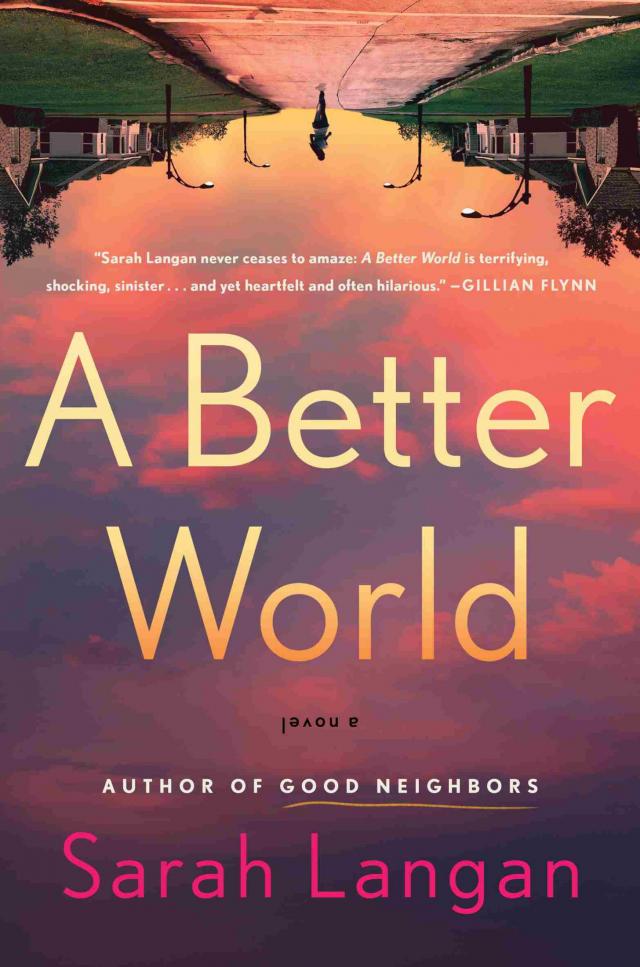
A better world, p.1
A Better World, page 1


Thank you for downloading this Simon & Schuster ebook.
Get a FREE ebook when you join our mailing list. Plus, get updates on new releases, deals, recommended reads, and more from Simon & Schuster. Click below to sign up and see terms and conditions.
CLICK HERE TO SIGN UP
Already a subscriber? Provide your email again so we can register this ebook and send you more of what you like to read. You will continue to receive exclusive offers in your inbox.
For Frances Carolina Petty
PART I
The Sinking Ship
Resident Guidebook for Greater Plymouth Valley
*Designed by Mr. Share’s Kinder Class
Plymouth Valley at a Glance:
• PV is BetterWorld’s crown jewel, named the most beautiful place to live in North America three years in a row!
• Population: 4,501
• PV’s K–12 school system is a blue-ribbon winner!
• Town mascot: the caladrius, of course.
• Once the main producer and exporter of Omnium©, the multipurpose synthetic that launched BetterWorld into the global corporation it is today, PV shuttered its mill and is now a home base for high-level executives. But the Omnium keeps flowing. There are now over 1,000 Omnium production facilities worldwide!
• PV boasts a self-sustaining farm.
• The local customs in PV are collectively referred to as Hollow. So, holla, Hollow!
• PV’s survivor shelter boasts the only private nuclear reactor in the country.
Holla, Hollow!
The Sinking Ship
“Some people aren’t suited. It’s nothing personal,” Jack Lust said. “They’re simply a wrong fit.”
This guy was a clown. The creepy kind. Linda Farmer didn’t like him, but she smiled at him because she had to.
“For instance,” Jack said. He enunciated every syllable like a disappointed preschool teacher. “Character is paramount. When we hire people who are going to live in our town, mix with our top-level executives, become top level, we need to know they’ll behave.”
Linda nodded as if to say: We have character! We ooze character!
“You’ll have no cause for concern with us,” Linda’s husband, Russell, said. They were sitting together on the sunken couch, looking up at Jack Lust in the high wingback chair like a couple of kids who’d been caught doing something bad.
“Our community is small and like minded. We prefer collaborative types. It’s counterintuitive: to get to this place that you’re at today, an interview for a coveted company job in a jewel like Plymouth Valley, you must outshine all your competition,” Jack said. His bespoke black suit hugged his bony body like shrink-wrap. Linda pegged him at a vim and vigorous seventy-five years old. Cosmetic surgery, healthy living, clean air—company town people kept it tight. Nobody in their seventies looked this good on the outside.
Jack was accompanied by a small entourage of likewise elegant men, none of whom he’d introduced. Two appeared to be taking notes and two were security, waiting outside the Farmer-Bowens’ apartment door. Linda hadn’t checked—this had all moved too fast—but she suspected that the leather straps across their chests held pregnant holsters.
“But once you’re in Plymouth Valley, you must be a team player,” Jack said. His primness, his perfect posture and absence of expression, vibed to her like contained rage. This was a huge leap in all logic—it definitely wasn’t true—but he reminded Linda of one of those guys you hear about on the news streamies, who murder people in weird, excessively neat ways. They lure the random unhoused into their lairs, then exsanguinate and store their blood in jars on their freezer doors. They sneak incrementally larger arsenic doses into a friend’s tea over months and years, just to watch with secret pleasure as their hair and teeth fall out. But she was thinking this only because she was nervous. This three-piece-suited company shill had a lot of power over her life. Her family needed for Russell to land this job. My God, they needed this job.
“Your record is the strongest I’ve seen in a decade. You must have worked night and day to get to this place. Am I correct?” Jack asked.
“Yes,” Russell agreed. He was nervous, trying too hard. She didn’t blame him. “I had days off, but I didn’t take them. My inbox was always too full.”
“The next step is to bring you to Plymouth Valley to interview with our science department. This is a rare opportunity. We almost never open our doors to outsiders. Even when we outsource, it’s typically through other company towns.”
“I’m so honored,” Russell said.
“It is an honor. But it’s an honor you’ve earned,” Jack said.
Linda grinned at the compliment despite its smugness. “What’s it like inside a company town?” she asked.
“They’re all different. Plymouth Valley is the best. Very safe. Very happy,” Jack answered. His beady eyes connected with hers. He didn’t smile. She pictured the shining, bright kitchen in his perfect company town house, maybe a severed head or two in the subzero freezer. It was a game now. A tension release that made this interview less horribly momentous. “If you’re lucky, you might see for yourself. If you’re even luckier, you might get to stay. The reason I’m here, that I asked to meet you in particular, Linda, is that these hires can get tricky. Relocating and housing entire families is costly for the company. We avoid it when we can.”
“Totally,” Linda said. She waited for him to say something like: But we’d be glad to have you! The more, the merrier! This didn’t come, so she elaborated. “We’re a very happy family. The twins are practically grown. They’ve never been in trouble. None of us have been in trouble.”
“We know that from the background check,” Jack agreed.
“Thank you…” she said, flustered. Had she and Russell agreed to a background check? They must have.
“What I’d like to impress upon you both is that Plymouth Valley is a privilege. We have many customs. To an outsider, they might seem peculiar. But you’ll understand them with time. The longer you live in Plymouth Valley, the clearer the picture.”
“We’re prepared for anything that comes,” Russell said.
Linda nodded, suppressing a cough. She’d heard that company people thought outsiders carried disease and didn’t want to give anybody the wrong idea, even though this year’s super bloom was hell on her allergies. “We’re easy people. We get along. We can adapt to any culture,” she said. She had no idea whether this was true. They’d only ever lived in Kings.
Jack leaned forward, talked even more slowly. Did he think they were half-wits? Yes, she realized. He did. And it probably wasn’t personal. He likely thought everyone he knew was a half-wit, and that went double for outsiders. “The first year is the hardest. But if you make it in our town, if you’re accepted, you’re set for life.”
“Great,” Linda said.
“Your children will be set for life.”
“We’ll be the luckiest people in the world,” Linda said, smiling big, eyes wide, voice enthusiastic but not flirty. “I’m so glad you’ve come, Mr. Lust, so I have the opportunity to tell you in person. We’re all in. One hundred percent.”
Jack surveyed the apartment for the first time. He’d avoided this before, made a point not to look at all, as if to spare them the shame. Now, he didn’t compliment their framed kid-art hung askew, or the rack over the dining room table, from which she’d hung long spoons that, in moments of whimsy, they all played like an instrument. It wasn’t a nice place to live. The furniture was threadbare, the big screen cracked. Josie’s dirty soccer crap had migrated to the corners of this living room like rats’ nests. Still, you had to admit: their apartment on Bedford Avenue had character. The Farmer-Bowens had character.
“Our predictions show that this part of town will be underwater in ten years,” Jack said.
“That soon?” Linda asked.
Jack nodded. “We’re not worried about that in Plymouth Valley. We’ve thought of everything. We have everything. We think of PV as the last lifeboat.”
“I’d like to emphasize how hard I’ll work to make this happen. To make myself and my family an asset,” Russell said.
“No need to emphasize anything,” Jack said as he stood. He didn’t grunt like most seventysomethings. He was creepily graceful. Exsanguinator, she thought. Heads in a freezer.
“Thanks for your time. Someone will be in touch.”
His entourage preceding him like they’d choreographed this, he was at the door. He shook both their hands, firm and with eye contact, but still didn’t smile.
From their window, Linda and Russell watched the men in tight black suits cross the weed-broken sidewalk and city detritus–sprayed lawn: paper waste, dead tricycles, rusted tires. Jack stepped high and wide like all of it was dogshit.
The black van pulled away.
Linda hacked four wet, pent-up coughs to clear her lungs, then asked, “Does this mean you’re getting a second interview or not getting a second interview?”
* * *
This happened in a different but nearly indistinguishable world.
It was the Era of the Great Unwinding. The institutions, laws, and even the bridges and roads that people had come to depend upon were falling apart. Everything got automated, but broken-automated. You called your health insurance to ask why they’d dropped coverage despite cashing your check, and your complaint got fed into a system that took three months to process it. By then you no longer needed the surgery because your appendix had burst. The on-cal l doc had saved your life, but they’d done so without getting prior approval from said insurance company, which was using that as a reason to deny your claim. You appealed this denial, which took six months. In the meantime the hospital’s collection agency repossessed your car. This was a thing. It happened in banking, hotels, libraries, schools, the IRS, and every other bureaucratic system. Some version of it happened to everyone.
The weather stopped making sense. Fires and storms raged. Blackouts rolled through the country like waves at a Kings’ Stadium Dodger game. A lot of people stopped making sense, too. They were angry and mad and sad all the time. They were indignant over all they’d lost. They were indignant over what they’d never had. In the absence of knowing how to fix any of what had gone wrong, anger spread like a virus, building from one person to the next. Its expression was a delicious release that felt like action.
This unwinding had been happening for decades, accelerating with every passing year. Then a hydrogen bomb accidentally detonated in the Middle East. For two days all over the globe, smoke blocked the sun. The anger went still. Everything went still.
But humanity is resilient. It recovered from this nearly fatal wound, and it persisted, even as it carried its pain with it. The anger returned. The sound returned. The light returned. People ventured out again, resuming the same arguments they’d been having, only the tone was one octave more panicked.
No one could say whether or how things would get better. They wanted to believe that they would. But the organism, the human condition, was sick. There arose no healer to guide them. No strong, honest Prometheus. Alone, they saw no obvious path to health.
Linda Farmer had been a part-time pediatrician at a free clinic for almost fifteen years. Russell Bowen had been a science adviser with the regulatory department at the EPA. They’d lived in the same Kings apartment all that time, hoping to save up money to move to one of the gated communities over the bridge in Jersey, but never managing it.
Mostly, heads down, they stayed positive. The world was falling apart, but they were okay. They had a home, they loved their kids and one another, and their work had value.
Their marriage was typical, in that it was unlike any other marriage and utterly idiosyncratic. She talked when she was happy, and also sang, and maintained ongoing monologues with herself when alone. He talked when nervous but was otherwise laconic. She felt things deeply and expressed those emotions. He held his feelings so close he often wasn’t aware that he had any. For instance, if asked a simple question like “Did you like your father when you were growing up?” Linda would have beamed happily and said she’d loved him very much, then described all the good memories she had about him and a few bad ones, too. There were plenty of bad ones. Russell would have looked at the person who’d asked, thought for a moment, and replied with sincerity: “I don’t know. I’ve never thought about it,” and been very happy once the subject was changed.
Opposites attract. Linda and Russell complemented one another, each fulfilling a need. And then the kids came along, and life happened faster. They spent less time together. Their differences became a problem.
The years accumulated small crimes between them—words spoken in anger, dismissive behavior, rolled eyes. Sometimes, Linda picked fights. After long, exhausting days at the office, where he was treated badly, Russell didn’t have it in him to fight back, and ignored her. This made her angrier. She teased in a mean way to get his attention. (You’re awkward, nerdy. And once, during a very hot argument that she still regretted: You’re weak.) He retreated deeper. Days later, licking their wounds, needing the house to function, the food to be cooked, the bank statements to stay black, and the kids to feel safe in an unsafe world, they came together. They still loved one another, after all. This love was apparent and deep. So, they pretended the fights had never happened. They left resentments behind them, like a dirty river.
Then Black Friday came.
The news streamies were clever for once, likening Congress to a mad King Solomon, who’d made good on a bad promise and cut the baby in half, rendering both parts useless. The federal government slashed more than a million jobs.
Russell showed up to work and found his entire department weeping like mourners at an Irish funeral. At his desk, he found a box, his name misspelled in Sharpie: Bussel Rowen. No severance. No unemployment. No nothing.
In the face of such an emergency, they put aside their resentments and got along better than they had in years. They were still a team. They were the Farmer-Bowens.
Six months after Black Friday, they were sitting at the dining room table beneath the hanging spoons, itemizing unpaid bills on a yellow legal pad. It had been weeks since their “pre-interview” with Jack Lust, and despite Russell’s many follow-ups, they’d heard nothing.
“We could sell my engagement ring,” Linda said.
“I looked it up already,” Russell admitted. “Even the good places won’t pay more than a few hundred dollars for a half-carat diamond.”
“Oh,” she said, twisting the diamond around her finger, imagining him calling pawn shops, which should not have felt like a betrayal, but nonetheless did. “I talked to Fielding about more hours. She said next month I can do seven days a week, which’ll give me overtime. But it’s only temporary. The clinic can’t really afford overtime.”
“How much is that?” Russell asked. His voice was flat, his movements slow. He’d tried to use his time effectively, sending résumés, making calls, cleaning the house, engaging the kids for the first time since… ever? But he’d lost weight since Black Friday, his button-down shirt hanging off scarecrow shoulders. Without work, there was a hole in him.
“Hmm… an extra two grand next month, but then back to my regular salary—four grand a month. Plus, we’ll all need to be on my health care, so that’ll take us back down to… twenty-five hundred?”
Dutifully, methodically, Russell wrote this out with his mechanical pencil.
“The Jam?” he asked.
With all the trains down from so much flooding, the Jam was their only way out of the city. More practically, a car is a kind of house, with four walls and a roof. You can live in a car.
“Naw,” she said. “It’s worth more to us than the cash.”
“College fund?”
“We’ll get killed on the taxes if we cash that in,” Linda said, trying hard to greet this logically. But more than her ring, or her winter coat, or even her hair, she loved that college fund. It represented every ice-cream cone never bought, every vacation never taken. It meant they’d done at least one thing right.
“Forty percent penalty. It’d be a huge waste,” Russell agreed. Then again, that money might float them. The Legal Aid lawyer had told them not to waste another dime on rent—just wait for the eviction. Then use this college fund to rent something smaller and deeper into the messy part of town. But what then? That money would run out, too, eventually.
People were dropping out all over this city. One day, they were your coworker or neighbor or that harried parent at drop-off with the crazy hair. The next, they were squatting in abandoned buildings. They were the disappeared.
She’d been denying it for a while now, but the inexorable weight of it hit her right then: her family might become the disappeared.
“Russell,” she said, her voice cracking. She was trying not to cry, but it was happening. He didn’t react right away, and she knew it was because this was too much for him. He felt too bad about how things had turned out.
“Don’t mind me. Ignore me,” she said.
“It’s okay,” he said, soft. “Let’s just get through this.”
That was when his device rang. Instead of an area code, the screen blinked a steady stream of rolling names. A scam, she assumed. Another grifter offering water rights in Siberia or sham iodine pills for radiation. Russell answered it anyway, probably for the distraction.
“Yes, this is Russell Bowen,” he said. His spine perked, his voice coming to life. “That’s right. I met with Jack Lust… Really? That’s great. Thank you. Thank you. Thank you. That’s great.”