

The science fiction hall.., p.1
The Science Fiction Hall of Fame Volume Two-A (The Great Novellas), page 1
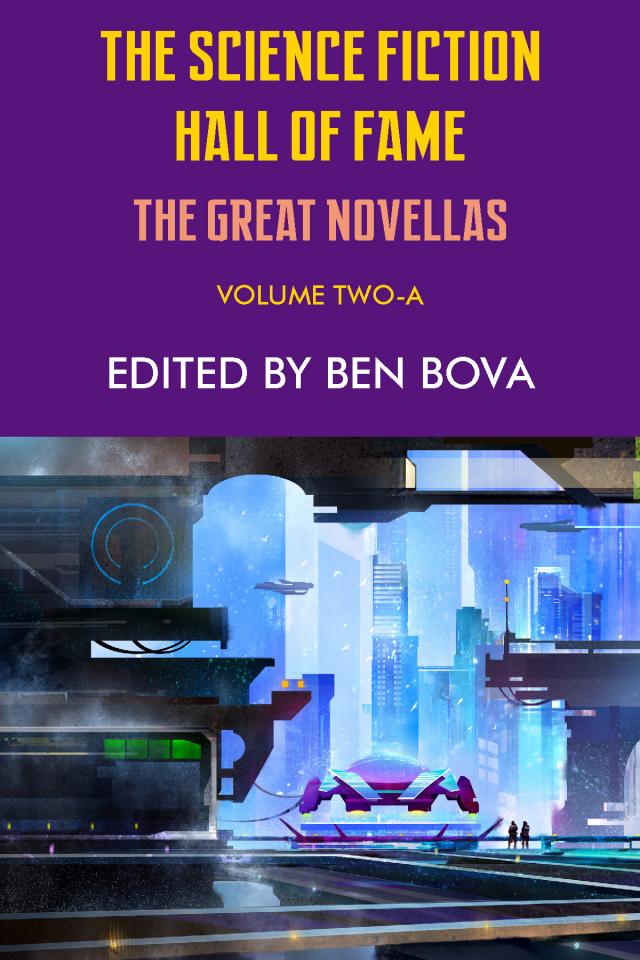


THE SCIENCE FICTION
HALL OF FAME
VOLUME TWO-A
The Greatest Science Fiction Novellas of All Time, Chosen by the Members of The Science Fiction Writers of America
Edited by BEN BOVA
Table of Contents
COPYRIGHT
INTRODUCTION
CALL ME JOE by Poul Anderson
WHO GOES THERE? by John W. Campbell, Jr. (as Don A. Stuart)
NERVES by Lester del Rey
UNIVERSE by Robert A. Heinlein
THE MARCHING MORONS by C. M. Kornbluth
VINTAGE SEASON by Henry Kuttner and C. L. Moore (as Lawrence O’Donnell)
...AND THEN THERE WERE NONE by Eric Frank Russell
THE BALLAD OF LOST C’MELL by Cordwainer Smith
BABY IS THREE by Theodore Sturgeon
THE TIME MACHINE by H. G. Wells
WITH FOLDED HANDS by Jack Williamson
Landmarks
Table of Contents
Cover
COPYRIGHT
The Science Fiction Hall of Fame, Volume Two A: The Greatest Science Fiction Novellas of All Time, Chosen by the Members of The Science Fiction Writers of America. Copyright © 1973 by The Science Fiction Writers of America.
Call Me Joe, by Poul Anderson, copyright © 1957 by Street & Smith Publications, Inc. All rights reserved. Reprinted by permission of the author and his agent, Robert P. Mills.
Who Goes There?, by John W. Campbell, Jr., copyright © 1938 by Street & Smith Publications, Inc. (renewed 1966 by The Condé-Nast Publications, Inc.). All rights reserved. Reprinted by permission of the author’s agents, Scott Meredith Literary Agency, Inc.
Nerves, by Lester del Rey, copyright © 1942 by Street & Smith Publications, Inc. (renewed 1970 by The Condé-Nast Publications, Inc.). All rights reserved. Reprinted by permission of the author’s agents, Scott Meredith Literary Agency, Inc.
Universe, by Robert A. Heinlein, copyright © 1941 by Street & Smith Publications, Inc. (renewed 1969 by The Condé-Nast Publications, Inc.). All rights reserved. Reprinted by permission of the author and his agent, Lurton Blassingame.
The Marching Morons, by C. M. Kornbluth, copyright © 1951 by Galaxy Publishing Corporation. Reprinted by permission of Robert P. Mills on behalf of the author’s estate.
Vintage Season, by Henry Kuttner and C. L. Moore (as Lawrence O’Donnell), copyright © 1946 by Street & Smith Publications, Inc., in the U.S.A. and Great Britain. All rights reserved. Reprinted by permission of the authors’ agent, the Harold Matson Company, Inc.
…And Then There Were None, by Eric Frank Russell, copyright © 1951 by Street & Smith Publications, Inc. All rights reserved.
The Ballad of Lost C’mell, by Cordwainer Smith, copyright © 1962 by Galaxy Publishing Corporation. Reprinted by permission of the author’s estate and their agents, Scott Meredith Literary Agency, Inc.
Baby Is Three, by Theodore Sturgeon, copyright © 1952 by Galaxy Publishing Corporation.
The Time Machine, by H. G. Wells, copyright © 1934 by Alfred A. Knopf, Inc. Reprinted by permission of Collins-Knowlton-Wing, Inc., on behalf of the author’s estate.
With Folded Hands, by Jack Williamson, copyright © 1954 by Street & Smith Publications, Inc. All rights reserved. Reprinted by permission of the author’s agents, Scott Meredith Literary Agency, Inc.
All rights reserved. This book may not be copied or reproduced, in whole or in part, by any means, electronic, mechanical or otherwise without written permission from the publisher except by a reviewer who may quote brief passages in a review.
This is a work of fiction. Any resemblance to any actual persons, events or localities is purely coincidental and beyond the intent of the author and publisher.
Tarikian, TARK Classic Fiction, Arc Manor, Arc Manor Classic Reprints, Phoenix Pick, Phoenix Science Fiction Classics, Phoenix Rider, The Stellar Guild Series, Manor Thrift and logos associated with those imprints are trademarks or registered trademarks of Arc Manor, LLC, Rockville, Maryland. All other trademarks and trademarked names are properties of their respective owners.
ISBN DIGITAL: 978-1-61242-427-9
ISBN TRADE PAPERBACK: 978-1-61242-426-2
Phoenix Edition May 2019
www.PhoenixPick.com
Great Science Fiction & Fantasy
Free Ebook Every Month
Published by Phoenix Pick
an imprint of Arc Manor
P. O. Box 10339
Rockville, MD 20849-0339
www.ArcManor.com
INTRODUCTION
This two-book set is the second volume of the Science Fiction Hall of Fame, and consists of stories of longer lengths than those published in the highly acclaimed Volume One.
These stories have been selected by the members of The Science Fiction Writers of America (SFWA), the organization of some four hundred professional science fiction writers. Thus, the Science Fiction Hall of Fame is the definitive anthology in this field, the collective choice of the practitioners of the science fiction art themselves.
Founded in 1965, each year since 1966 SFWA has given achievement awards for the best stories of the year. The awards are called Nebulas, and are chosen on the basis of a vote by SFWA’s members. The purpose of the Science Fiction Hall of Fame anthologies is to bestow a similar recognition on stories that were published prior to 1966, and thus never had a chance to earn a Nebula.
Like the annual Nebula awards themselves, election to the Hall of Fame anthology is based on a poll of SFWA’s members. Volume One was restricted to short stories; Volume Two is devoted to novelettes and novellas.
The voting procedure began with recommendations. For nearly a full year, SFWA members sent in suggestions for stories that were worthy of inclusion in the Hall of Fame. As editor, I quickly began to see that it was going to be a heartbreaking job to rule out any of these fine tales. Almost every title recommended brought back a powerful memory of the first time I had read that particular piece. And the authors! H. G. Wells, John W. Campbell, Jr., Robert Heinlein, Cyril Kornbluth…how could any of them be ruled out?
A ballot was finally prepared, consisting of seventy-six recommended stories. The SFWA members were asked to vote for ten stories out of the seventy-six. Since many authors had more than one story on the ballot, and we didn’t want any individual author to be represented more than once in the anthology, the members were further asked to vote for only one story per author.
Many of the ballots came back with screams of despair and frustration scribbled over them. “How can I pick only ten of ’em?” was the typical cry. Most of the members wanted most of the recommended stories to go into the final anthology.
When the votes were counted, the top ten stories were:
WHO GOES THERE? by John W. Campbell, Jr.
A CANTICLE FOR LEIBOWITZ by Walter M. Miller, Jr.
WITH FOLDED HANDS by Jack Williamson
THE TIME MACHINE by H. G. Wells
BABY, is THREE by Theodore Sturgeon
VINTAGE SEASON by Henry Kuttner and C. L. Moore
THE MARCHING MORONS by C. M. Kornbluth
UNIVERSE by Robert A. Heinlein
BY HIS BOOTSTRAPS by Robert A. Heinlein
NERVES by Lester del Rey
Since several authors had more than one story on the ballot, and thus were in the unhappy position of competing with themselves, I sliced the pie in the other direction, too, and looked for the ten most popular authors:
Robert A. Heinlein
Theodore Sturgeon
John W. Campbell Jr.
Walter M. Miller, Jr.
Lester del Rey
C. M. Kornbluth
Jack Williamson
H. G. Wells
Poul Anderson
Henry Kuttner & C. L. Moore
The procedure for picking the stories to go into the anthology, then, was fairly straightforward, since most of the top authors were also represented among the most popular stories. I prepared a list of stories that included the highest vote-getters among the stories and the most popular authors. For any individual author, I picked the story of his that had received the most votes.
It was much easier to start the list than end it. There was always the temptation to sneak in just one more story—after all, I would tell myself, this one’s really too good to be left out. I ended with a list of twenty-two stories, totaling more than 400,000 words. Far too much for a single book.
I took my problem to Larry Ashmead, the editorial mastermind who presides over Doubleday’s science fiction publications. It was a shameful dereliction of duty, but I didn’t have the heart to cut out any of those twenty-two stories. Thankfully, neither did Larry. After one look at the list, he suggested making a two-book set so that all the stories could be included.
Unfortunately, two of the stories—Miller’s A Canticle for Leibowitz, and Ray Bradbury’s The Fireman—were unavailable for this anthology. Both are currently available in book form, however.
So here is the second volume of the Science Fiction Hall of Fame, with stories ranging from H. G. Wells’s The Time Machine (published 1895) to Cordwainer Smith’s The Ballad of Lost C’mell (
One final note of acknowledgment and thanks. Much of the onerous work of tracking down publication dates and magazines, toting up wordage lengths, and finding copies of the original stories, was done by Anthony R. Lewis. Without his aid, this volume might still be little more than an unfulfilled promise.
CALL ME JOE
by Poul Anderson
The wind came whooping out of eastern darkness, driving a lash of ammonia dust before it. In minutes, Edward Anglesey was blinded.
He clawed all four feet into the broken shards which were soil, hunched down and groped for his little smelter. The wind was an idiot bassoon in his skull. Something whipped across his back, drawing blood, a tree yanked up by the roots and spat a hundred miles. Lightning cracked, immensely far overhead where clouds boiled with night.
As if to reply, thunder toned in the ice mountains and a red gout of flame jumped and a hillside came booming down, spilling itself across the valley. The earth shivered.
Sodium explosion, thought Anglesey in the drumbeat noise. The fire and the lightning gave him enough illumination to find his apparatus. He picked up tools in muscular hands, his tail gripped the trough, and he battered his way to the tunnel and thus to his dugout.
It had walls and roof of water, frozen by sun-remoteness and compressed by tons of atmosphere jammed onto every square inch. Ventilated by a tiny smoke hole, a lamp of tree oil burning in hydrogen made a dull light for the single room.
Anglesey sprawled his slate-blue form on the floor, panting. It was no use to swear at the storm. These ammonia gales often came at sunset, and there was nothing to do but wait them out. He was tired, anyway.
It would be morning in five hours or so. He had hoped to cast an axhead, his first, this evening, but maybe it was better to do the job by daylight.
He pulled a dekapod body off a shelf and ate the meat raw, pausing for long gulps of liquid methane from a jug. Things would improve once he had proper tools; so far, everything had been painfully grubbed and hacked to shape with teeth, claws, chance icicles, and what detestably weak and crumbling fragments remained of the spaceship. Give him a few years and he’d be living as a man should.
He sighed, stretched, and lay down to sleep.
Somewhat more than one hundred and twelve thousand miles away, Edward Anglesey took off his helmet.
He looked around, blinking. After the Jovian surface, it was always a little unreal to find himself here again, in the clean, quiet orderliness of the control room.
His muscles ached. They shouldn’t. He had not really been fighting a gale of several hundred miles an hour, under three gravities and a temperature of 140 absolute. He had been here, in the almost nonexistent pull of Jupiter V, breathing oxynitrogen. It was Joe who lived down there and filled his lungs with hydrogen and helium at a pressure which could still only be estimated, because it broke aneroids and deranged piezoelectrics.
Nevertheless, his body felt worn and beaten. Tension, no doubt—psychosomatics. After all, for a good many hours now he had, in a sense, been Joe, and Joe had been working hard.
With the helmet off, Anglesey held only a thread of identification. The esprojector was still tuned to Joe’s brain but no longer focused on his own. Somewhere in the back of his mind, he knew an indescribable feeling of sleep. Now and then, vague forms or colors drifted in the soft black—dreams? Not impossible that Joe’s brain should dream a little when Anglesey’s mind wasn’t using it.
A light flickered red on the esprojector panel, and a bell whined electronic fear. Anglesey cursed. Thin fingers danced over the controls of his chair, he slewed around and shot across to the bank of dials. Yes, there—K-tube oscillating again! The circuit blew out. He wrenched the face plate off with one hand and fumbled in a drawer with the other.
Inside his mind, he could feel the contact with Joe fading. If he once lost it entirely, he wasn’t sure he could regain it. And Joe was an investment of several million dollars and quite a few highly skilled man-years.
Anglesey pulled the offending K-tube from its socket and threw it on the floor. Glass exploded. It eased his temper a bit, just enough so he could find a replacement, plug it in, switch on the current again.
As the machine warmed up, once again amplifying, the Joeness in the back alleys of his brain strengthened.
Slowly, then, the man in the electric wheel chair rolled out of the room, into the hall. Let somebody else sweep up the broken tube. To hell with it. To hell with everybody.
Jan Cornelius had never been farther from Earth than some comfortable Lunar resort. He felt much put upon that the Psionics Corporation should tap him for a thirteen-month exile. The fact that he knew as much about esprojectors and their cranky innards as any other man alive was no excuse. Why send anyone at all? Who cared?
Obviously the Federation Science Authority did. It had seemingly given those bearded hermits a blank check on the taxpayer’s account.
Thus did Cornelius grumble to himself, all the long hyperbolic path to Jupiter. Then the shifting accelerations of approach to its tiny inner satellite left him too wretched for further complaint. And when he finally, just prior to disembarkation, went up to the greenhouse for a look at Jupiter, he said not a word. Nobody does, the first time.
Arne Viken waited patiently while Cornelius stared. It still gets me too, he remembered. By the throat. Sometimes I’m afraid to look.
At length Cornelius turned around. He had a faintly Jovian appearance himself, being a large man with an imposing girth. “I had no idea,” he whispered. “I never thought.… I had seen pictures, but…”
Viken nodded. “Sure, Dr. Cornelius. Pictures don’t convey it.”
Where they stood, they could see the dark broken rock of the satellite, jumbled for a short way beyond the landing slip and then chopped off sheer. This moon was scarcely even a platform, it seemed, and cold constellations went streaming past it, around it. Jupiter lay across a fifth of that sky, softly ambrous, banded with colors, spotted with the shadows of planet-sized moons and with whirlwinds as broad as Earth. If there had been any gravity to speak of, Cornelius would have thought, instinctively, that the great planet was falling on him. As it was, he felt as if sucked upward, his hands were still sore where he bad grabbed a rail to hold on.
“You live here…all alone…with this?” He spoke feebly.
“Oh, well, there are some fifty of us all told, pretty congenial,” said Viken. “It’s not so bad. You sign up for four-cycle hitches—four ship arrivals—and believe it or not, Dr. Cornelius, this is my third enlistment.”
The newcomer forbore to inquire more deeply. There was something not quite understandable about the men on Jupiter V. They were mostly bearded, though otherwise careful to remain neat; their low-gravity movements were somehow dreamlike to watch; they hoarded their conversation, as if to stretch it through the year and a month between ships. Their monkish existence had changed them—or did they take what amounted to vows of poverty, chastity, and obedience because they had never felt quite at home on green Earth?
Thirteen months! Cornelius shuddered. It was going to be a long, cold wait, and the pay and bonuses accumulating for him were scant comfort now, four hundred and eighty million miles from the sun.
“Wonderful place to do research,” continued Viken. “All the facilities, hand-picked colleagues, no distractions—and, of course…” He jerked his thumb at the planet and turned to leave.
Cornelius followed, wallowing awkwardly. “It is very interesting, no doubt,” he puffed. “Fascinating. But really, Dr. Viken, to drag me way out here and make me spend a year-plus waiting for the next ship—to do a job which may take me a few weeks…”
“Are you sure it’s that simple?” asked Viken gently. His face swiveled around, and there was something in his eyes that silenced Cornelius. “After all my time here, I’ve yet to see any problem, however complicated, which when you looked at it the right way didn’t become still more complicated.”






