Terminus, p.1
Terminus, page 1
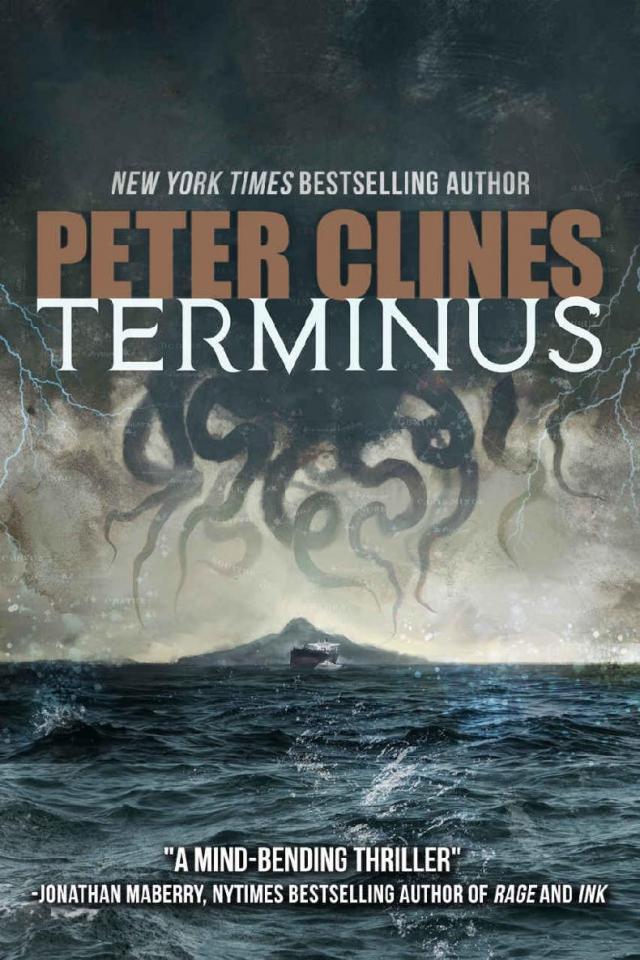


A KAVACH PRESS Book
TERMINUS © 2020
by Peter Clines.
All Rights Reserved.
Cover art by Cliff Nielsen
This book is a work of fiction. People, places, events, and situations are the product of the author’s imagination. Any resemblance to actual persons, living or dead, or historical events, is purely coincidental.
No part of this book may be reproduced, stored in a retrieval system, or transmitted by any means without the written permission of the author and publisher.
Also by Peter Clines
Paradox Bound
Dead Moon
14
The Fold
Ex-Heroes
Ex-Patriots
Ex-Communication
Ex-Purgatory
Ex-Isle
The Eerie Adventures of the Lycanthrope Robinson Crusoe
The Junkie Quatrain
Dead Men Can't Complain and Other Stories
Table of Contents
1
2
3
4
5
6
7
8
9
10
11
12
13
14
15
16
17
18
19
20
21
22
23
24
25
26
27
28
29
30
31
32
33
34
35
36
37
38
39
40
41
42
43
44
45
46
47
48
49
Afterword
1
Murdoch still wasn’t sure how he felt about this new congregation, even though he’d had a lot of sex with the minister when they were both younger.
He leaned against one of the big rocks and looked at the minister across the moonlit beach. She talked with a few of the folks up at the front of the crowd, clasped her hands and laughed at something one of them said to her. The nighttime surf caught their words and dragged them out to sea with a faint hiss.
She still wore her hair long, letting it hang in a straight, dark sheet down the back of her robe. A robe that couldn’t hide the fact she’d stayed slim and toned. She looked good enough to make him think fondly of the old days. Back when they’d been teens. When he could still pass for human, and she was just Anne, not the minister.
As Murdoch watched, she detached herself from her latest bit of small talk and moved to stand in front of the congregation, the ocean behind her. They quieted down and focused. Almost three hundred members altogether. Some had brought beach chairs, while others lounged on blankets. A few at the back, like him, stood or slumped against one of the beach’s big stones.
“This is probably a bad way to start this,” Anne-the-minister said, just loud enough to be heard over the surf, “but, to be honest, I lost my faith years ago.”
An awkward chuckle worked its way through the crowd. Murdoch smiled with them.
“I was a typical kid,” she explained as she strolled back and forth across the sand. “Thought I knew everything. Thought my parents were idiots.”
Like every typical kid, she’d found someone to hang out with her parents wouldn’t like. Murdoch had been her friend in grade school. Then her boyfriend in junior high. And then—in the awkward, fumbling way of overenthusiastic teens trying to get it right—they’d become lovers.
It had been one of the happiest points in Murdoch’s life.
“The one thing I knew for sure, though,” continued Anne, “that I knew for a fact, was that the Great Ones weren’t real.”
This time an uneasy murmur crept through the congregation. The Todwings prided themselves on being more progressive than many of the various sects, notably the one Murdoch had grown up in. They’d accepted a female minister, after all. But the casual joke about the Great Ones still made their skin crawl. Their discomfort was clear, even in the dark.
“I’d lost my faith,” Anne repeated. “Truth be told, maybe I never had any faith at all. I went to Sunday school. Listened to the sermons. But I didn’t believe.”
She stopped pacing for a moment to look out at the midnight ocean.
“I ran away,” she confessed, turning back to the congregation. “Left my parents. My brother. My boyfriend.”
In the dark, her eyes flitted up and met his. Just for an instant. A quick smile graced her thin lips.
So she did know he was here.
The ugly truth was he’d done the abandoning. She’d left the Family, yes, but they’d made secret plans for months to run off together. Get married in Vegas. Maybe settle down somewhere on the East Coast, as far from the Family as possible.
Then the Change had come. Later than most, for both of them. It brushed across Anne, enhancing her eyes and hair and skin, turning her from a skinny girl to a lustrous woman. Murdoch, though …
It had hit him hard. Hard enough to make him question their plans. And his lack of faith. Anne begged him to leave with her anyway, but years of Family conditioning had its teeth back in him. No amount of pleading or young love or enthusiastic sex could convince him to leave. Not looking like he did. Not with what it implied.
“I cut all ties and wandered off,” said the minister. “I supported myself as best I could. I tried acting, like everyone in Los Angeles. Ended up waiting tables. Got a temp job doing data entry at a magazine that stretched on for almost a year.”
She stuck her hands deep into the pockets of the robe and swept its hem back and forth across the sand. “And then one day my brother called. He said he had proof. That he’d done it. He said he’d found the damned Machine.”
Another ripple across the crowd, partly for the curse, partly for what she’d attached it to. Murdoch echoed this one. Even when they were all kids, Andrew had been kind of a sanctimonious prick. He’d only gotten worse as they got older.
“I think we all remember that night,” Anne told the congregation, “and how it turned out for the Olmstead side of the Family.”
A rumble of acknowledgement and approval. Murdoch echoed this one too. It’d been dumb luck he hadn’t been rounded up with the surviving members of his congregation. He’d been on an errand up in Oakland, collecting a lost heirloom with the standard double-blind rental truck. Nothing in the vehicle tying it or him to the Family. Nothing with the Family tying them to him or the truck.
He’d taken his time driving home from Oakland, though, reconsidering the idea of running away. The thought of it had never completely left him, and over the years Anne had been gone it’d grown strong again. Sunglasses could hide his eyes. If he kept his hands in his pockets, out of sight, no one would ever suspect a thing. He could do it. He could run away and live somewhere else.
Then he’d made it home to see Family members in handcuffs being loaded into black vans, and the idea had withered again. He drove by without slowing. Without more than a casual, curious glance. Got back on the freeway and headed back up to the Bay Area to hide for a month.
“I was supposed to be with them,” said Anne. “I was supposed to be there. But I didn’t believe. So my brother found his destiny, one way or another, and I—” She looked out at the congregation and gave a big theatrical shrug. “I moved to San Diego and got a job as a receptionist.”
They all laughed. Murdoch chuckled at the thought of his wild high school girlfriend sitting at a front desk and answering phones.
“I’d been doing that for almost two years when it happened. There was an emergency in one of the buildings in the complex I worked at. I pitched in, was helping with some malfunctioning equipment. And then suddenly, right in front of me, one of the holy vanguards appeared.”
Murmurs and gasps rolled through the crowd like breakers across the sand.
“A seraph. Not five feet from me. He fixed his eyes on me. Judged me. Spoke to me in the old tongue. Asked me if this world was ready for the Great Ones.
“I told him it was ready. Swollen with its ripeness.” She paused and gave the congregation a quick, shy smile. “At least, I think I did. Like I said before, I wasn’t the best Sunday school student, and I hadn’t uttered a word of the old tongue in years at that point.”
Another nervous chuckle from the crowd. Embarrassed they were giggling at something they knew should be heresy. It amazed Murdoch how well she played them.
“It went to speak to me again,” she continued, “and the humans killed it. They gunned the holy one down right in front of me. I heard it breathe its last. Watched it die.”
Gasps of horror now. A few sobs that mixed with the gurgle of the incoming tide. A man off to Murdoch’s left balled his hands into fists and muttered an angry prayer.
“I was in shock for the better part of a day,” Anne told them. “But when I could think straight again, I realized how wrong I’d been. About everything.
“And that’s why I’m here, talking to you. It’s why I rejoined the Family. It’s why I’m so glad you’ve accepted me after Father Jacob’s death, may he rest with the Great Ones.”
The Todwing congregation echoed the p hrase back to her, all smiles again. Murdoch muttered the empty words and stared down at his bare feet. He flexed his toes in the sand.
“But you need to understand something—I never found my faith again.” Anne let the murmur build, then raised her voice to speak over it before it had a chance to die down. “I don’t speak to you from a position of faith, but from one of knowledge. I’m talking to you about inarguable facts as I’ve experienced them. The seraphs are real. The Great Ones are real. Our mission is real.
“We will end the tyranny of the Machine. We will open the door for the Great Ones. And we will save this world from itself.”
She’d stretched her arms out, her fingers spread wide as if she was funneling her message to the crowd. They applauded. They loved her.
Murdoch watched from the back as the congregation lumbered forward, all wet cheeks and outstretched arms. Anne grabbed hands, accepted hugs, exchanged agreeable words and nods. She bent to greet some of the elders who’d been wheeled to her at the water’s edge but couldn’t rise from their chairs.
And once, during a free moment, her eyes flitted back and found him against the rocks.
He couldn’t read her eyes at all.
2
As someone who’d spent most of his life in the city, surrounded by office buildings and apartment high-rises, Chase kept being surprised by how hypnotic he found the huge expanse of nothing. Especially at sunset.
He settled against the Makara’s railing, felt the wind and spray pepper his face, and just looked out at the rolling ocean. The water stretched to the horizon in every direction he could see. Always the same, always different. Endless possibilities and a huge lack of options at the same time.
Or maybe he was projecting just a bit.
He’d been traveling with no destination for almost a year now. Eleven months, two weeks, and a day. The Makara was the eighth cargo ship he’d booked passage on in that time. Not the nicest captain or crew, but far from the worst.
A lot of times, traveling on these ships almost felt like staying in a small, floating hotel. Good rooms. Good food. Rec rooms. Gyms. Nightly movies. A few of them even had shops.
The Makara felt more like a floating bed-and-breakfast. Or like an old-fashioned boarding house. The crew was polite and offered conversation over meals, but for the most part they just left him alone. If not for the other passenger, there would’ve been three or four days when he never spoke to anybody.
“Hey! Chaser!”
He looked up from the railing and saw the first mate—a man with the too-good-to-be-true name of Katanga—strolling across the deck toward him. Over the past two weeks, he’d gotten the sense the first mate also doubled as a sort of hospitality director. They’d had four or five pleasant bouts of small talk over dinner and breakfast.
“Just Chase,” he reminded the first officer. He stepped to the side, making space for the other man on the vast open railing.
Katanga had jet-black skin and a rolling accent that touched on Scottish with an occasional Brooklyn twang. He set his hands on the railing and smiled out to sea. “A man like you needs a more dynamic name. Chase is a boy’s name. Spoiled rich kid’s.”
“It’s my name.”
“Change it. I did.”
“Yeah?”
“Yes.”
A wave crashed up against the side of the Makara. The boat didn’t even shudder. It plowed on through the sea, heading for the sunset.
“So,” said Katanga, “who is waiting for you in Johannesburg?”
“Nobody.”
“A business trip?”
Chase shook his head.
“Sailing the world?”
“Sort of.”
Katanga rubbed his chin. “I see. So it’s the great journey of self-discovery, then.”
“What?”
“Travel from ship to ship. No real destination. Mull over your life, wonder about the decisions you made, figure out where you’re going with your life.”
“Captain told you my sob story, huh?”
Katanga made a rude noise and shook his head. “He doesn’t tell me anything.”
“Christ, am I that much of a stereotype?”
The first mate shrugged. “Believe it or not, there aren’t many types of people who pick us over a Carnival cruise.”
Chase laughed. “Makes sense.”
“So?”
“So what?”
“Are you going to tell me your sob story?”
“Seriously?”
“Yes.”
“Why?”
“Because I forgot to sync my Kindle before we left port. I finished my last new book three days ago.”
“So you want my life as entertainment?”
Katanga shrugged. “I need my stories.”
Chase turned and stared back out at the waves.
“About two years ago, a hurricane hit my hometown. Houston. I lost everything.”
Katanga clucked his tongue. “Everything?”
“Everything.” Chase took a slow breath and arranged the story elements in his mind. He’d told the big lie a few times now, enough that he’d gotten very good at it. He’d learned which parts of the truth to tell, which to leave out. And which ones to gloss over. “I’ve got an engineering degree, but I couldn’t get a job anywhere big. Ended up opening my own shop. I’d repair electronics. Or buy stuff and refurbish it.”
“Good money?”
“Good enough. Mostly I’d fix televisions for people. Sometimes entertainment systems in cars. People think electronics are all super-complex these days, that it’s easier to throw them out than repair them. A lot of the time, though, it’s just a bunch of simple systems working side by side. Like picture-in-picture? It isn’t some high-tech thing. It just means your television’s got two tuners. One for one image, one for the other.”
“So you lost your business?”
Chase rapped his knuckles on the railing. The big lie always started with a lot of boring truth. It put the listeners in a certain mood. “I gambled on the hurricane. Everyone saw it coming, but I figured lots of storm damage meant lots of business for me. Sank a lot of money into parts and supplies. Had it express shipped so I’d get it before the storm. Even made an awful television commercial that ran on the Houston channels for three days before the storm. Emptied our savings and maxed out the cards. Pissed off my ex-wife.”
“Ex then or ex now?”
“Now. But we were already on the way out then. I thought a nice solid payday might let us ignore some things, stretch it out a while longer. Worst-case scenario, our marriage falls apart anyway and I sock some extra money away for our daughter, Deena. Start a college fund or something.”
Katanga gripped the railing and leaned back, stretching his back and legs.
“That what happened?”
“No. The hurricane hit hard. Caused more flooding than anyone expected. A lot more. Wiped out my shop. And my inventory. And the house we were renting.”
“Your family?”
“Elisabeth … wasn’t happy. There was some insurance money, but by the time we got it in our hands we’d racked up more debt just trying to stay alive. A few months after the storm she ended up going to stay with her mom in Dallas. A lawyer showed up with divorce papers about two weeks later.”
“Damn. That’s cold, man.”
“Like I said, the writing was already on the wall. It burned, but I couldn’t say I was surprised.” He took his hands off the rail and shrugged. “I got a crappy apartment and a job installing cable for Spectrum.”
“She take your daughter too?”
“Yeah,” said Chase. “Yeah, she did.”
He turned from the sea to meet Katanga’s gaze. Unlike the Makara’s other passenger, who came back to the topic every three or four days, the first mate understood this part of the story was over.
Katanga turned around to lean against the railing and inspect a stack of shipping containers.
“How did you end up here, then?”
Chase shrugged. “I just did it once, at first. Houston to Belgium. Just wanted to do something to feel alive. I’d gone through almost a year of getting beaten down by everything. I just wanted to get away from everything, do something impulsive. But I liked it.”
“So you did another trip?”
“It’s all I’ve been doing. The Makara’s my eighth, counting that first one.”