Ghost ranch, p.1
Ghost Ranch, page 1


EARLY BIRD BOOKS
FRESH EBOOK DEALS, DELIVERED DAILY
LOVE TO READ?
LOVE GREAT SALES?
GET FANTASTIC DEALS ON BESTSELLING EBOOKS
DELIVERED TO YOUR INBOX EVERY DAY!
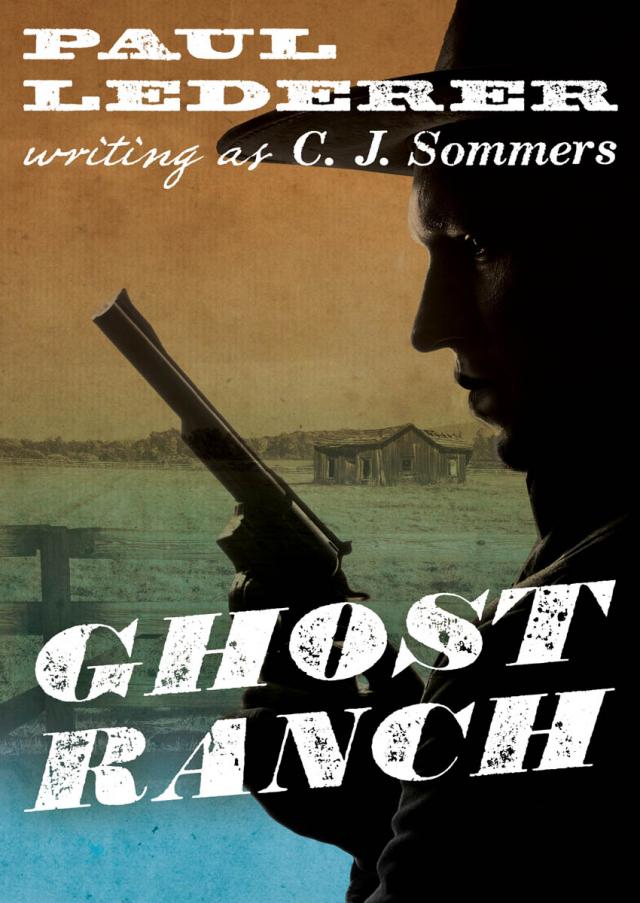
Ghost Ranch
Paul Lederer writing as C. J. Sommers
ONE
They spotted the first casualty lying in the dirt road leading the Bar-D Ranch which was still about ten miles distant across rugged, red country.
‘Who in hell do you s’pose would do that?’ Billy Raglan muttered, swinging down from his gray to take a closer look.
‘There aren’t many rules in war,’ Trinity answered. He sat his piebald horse, hands crossed on the pommel, while his older companion crouched over the victim of violence, his hat tilted back.
‘Damned shame, damned waste,’ Raglan muttered, looking up at his tall companion.
‘Most death is,’ Trinity said philosophically, popping out his canteen cork to take a drink of tepid water. The sun was riding high in the pale sky. ‘But there isn’t much we can do about it. Not when we’ve hired out to do what we’re doing.’
Raglan was still concerned and confused. ‘They just cut her throat, Trinity! Left her lying in the sun. Hell, a Comanche wouldn’t do that.’
‘No.’ Trinity was tired of the conversation. The day was sweltering. Mirages danced before his eyes across the long flats all the way to the far-distant red hills that seemed to ripple in the heat haze.
‘Damn!’ Raglan said once again before he roughly kicked the bloated body of the white and red heifer that someone had left along their road.
‘Think she had calves?’ Raglan asked, swinging into the saddle, tugging down his hat to shield his eyes against the sun-glare.
‘Too young by the look of her,’ Trinity guessed, ‘Besides, we don’t have the time to search around for them if she did. Supposing we found calves? What would we do with them?’
‘I don’t know,’ Raglan said, sniffing. ‘You’re right, I know. It’s just the waste.… Sometimes I hate our line of work, Trinity.’
Which was that of hired guns, to put it as bluntly as possible.
As Trinity sat his pony, watching the long land, the dry wind drifted over him and outside of the constant scent of sage and lightly drifting sand, there was no sound or smell across the prairie, no evidence of anything you’d expect to see and hear around a working ranch: cattle bawling, men shouting to one another, woodsmoke hanging in the air.
‘Kind of eerie, isn’t it?’ Billy Raglan commented.
‘What’s that?’ Trinity asked, as if he hadn’t noticed it himself.
‘Even out on the open range … all we seen so far is one dead cow. Who are we supposed to be fighting, anyway? And what does Boss Clark even want with this dead country? He’s already got about a million acres.’
‘Ten thousand,’ Trinity corrected. And even that was not considered a lot in west Texas where an acre of land could barely support two or three steers.
‘All right, ten thousand!’ Raglan said as they started their horses forward again. ‘This here spread,’ he commented, waving a dismissive hand, ‘won’t add much of use to his holdings.’
‘There’s water here,’ Trinity replied.
‘Yeah.’ Billy snorted dismissively. ‘I know – Shamishaw Creek. I’ve heard it described as the ‘Shamishaw Trickle’. Tell me, Trinity, do you see any green grass anywhere around us?’
‘I suppose it’s a seasonal creek,’ Trinity said as they crossed a dry arroyo, dotted with dry willow brush and stands of flat-paddled nopal cactus. ‘Besides,’ he continued as they achieved the flat once more, ‘It’s not our business to figure out why Jefferson Clark wanted the land. The fact is that he bought it and now these people won’t move off it.’
Billy sniffed and wiped his cuff across his nose. ‘It sure looks to me like they moved.’
‘Taking the cattle and still owing Boss Clark the title for the land,’ Trinity reminded his saddle mate.
‘I can’t figure how a canny man like Boss Clark could have let that happen,’ Billy said. ‘I’d hate to deal with him myself – or play poker with him!’ Billy chuckled.
‘It was a woman who sold the property to him,’ Trinity said, as if that explained a lot.
‘Oh,’ Billy said, understanding. ‘They do have their ways.’
In silence they rode across the land which was barren, dry, clumped here and there with greasewood and stands of mesquite, nopal and always sage. Once they passed a blackened cottonwood tree; it was the only sign of healthy vegetation they had seen, and now it stood barren and black as wrought iron against the pale sky.
‘Those hills,’ Billy said nodding toward the distant sawtooth range on the horizon ‘– that’s up in New Mexico, isn’t it?’
‘I don’t know,’ Trininty responded. ‘We’re near to the line. That’s for sure.’
‘I’d like to see that territory,’ Billy said with some wistfulness.
‘What for? The land’s not going to look any different from what it does on this side of the line.’
‘I don’t know,’ Billy Raglan answered. ‘Just to say I’ve been there, I guess.’
Trinity reined in sharply. Billy looked a question at him. Then Trinity shook his head.
‘It’s nothing – I thought I heard some cattle lowing over to the west. I must be starting to imagine things.’
‘Well, keep on looking sharp,’ Billy advised. ‘If we run across anyone who knows who we are, they might just go to sniping at us.’ He fell silent as the horses plodded on toward where the Bar-D ranch house was supposed to be situated. ‘A woman foxed old Boss Clark, did she?’ Billy asked with a chuckle.
‘I wouldn’t know – that seems to be what the old man thinks.’
‘Well, a man can get silly around them, even the shrewdest of us.’
Trinity smiled. ‘Is that what happened to you, back in Topeka? I know you were carrying a lot of gold when we rode in and didn’t have the money to pay for stabling your horse when we rode out again.’
‘Oh, that!’ Billy answered. ‘It wasn’t anything like this. You mean Gloria?’
‘I don’t think I ever knew her name – you two were always off alone somewhere.’
‘Well,’ Billy insisted, ‘she wasn’t one of those gold-diggers or cheats. We just didn’t get along.’
‘Why was that?’ Trinity asked, trying to keep the irony out of his tone.
‘My God, Trinity, didn’t you ever hear her talk! She had that squeaky mouse voice, like fingernails on a slateboard. Maybe it was a little amusing at first, but a weary man wants to hear a soothing voice to comfort him in the evening. When I was a schoolboy … did you ever go so school, Trinity?’
‘There was none where I grew up.’
‘Well,’ Billy said, ‘we had a little red schoolhouse. Dad made me go there when I was not needed at home. I guess I did not so much get any schooling, but used school as a place to act up, and learn about girls,’
‘What did you learn?’ Trinity asked.
‘I’ll tell you another time,’ Billy said with a flip of his hand. ‘Anyway, when I was in school there was a smug little girl with pigtails seated behind me named Marcia … Marcia something, and she dragged her fingernails across her slateboard. It put my teeth on edge, that sound, and I told her so. So she continued to do it forever after, every day. It about drove me crazy.
‘So you see, when I met Gloria back in Topeka, I thought I had struck gold. But she had this voice.…’ Billy made a fist and shook it, ‘I tell you, I couldn’t take it.’
‘So that was the reason you gave up on her?’
‘Sure – what were you guessing?’
‘I don’t try to guess about women,’ Trinity said. Then he dropped the subject as they crested a hillrise topped with golden-dry wild oats and came upon the Bar-D ranch house. ‘Check your loads, Billy,’ he advised. ‘We might be about to raise some hell.’
They saw no one, heard no animals or voices as they trailed down the long dry-grass slope toward the log ranch house, but they rode cautiously, wary of a trap. Trinity described a circle in the air with his finger and motioned toward the rear of the house. Billy Raglan nodded and started that way, rifle across his saddlebow.
The place was as silent as the fine blowing dust. By the time Trinity swung down at the hitch rail in front of the small ranch house and tied his piebald, Billy had finished circling the place.
‘There’s no one around,’ Billy said, tipping back his hat from his sweating brow, ‘And it makes no sense.’
‘No, it doesn’t.’ There were only two ways to look at it: either the former owners of the Bar-D had decided just to give it up and ride off, leaving the place to Boss Clark, or they were hiding out somewhere, determined to fight Clark off. Either way, they were going about this wrong. Boss Clark had paid good money for the Bar-D and the owner had failed to deliver the property deed to the county courthouse as agreed upon. It was starting to look as if the woman who owned the Bar-D had indeed bested Jefferson Clark – or was trying to. Trinity knew his employer well enough to know that he would not accept the slight. He would fight for what he believed to be his.
Which was why Billy and Trinity were here on this hot, dry day. To do a little fact-finding and warn off anyone still occupying the land that they had no choice – they had to leave.
‘Who the hell pulls out and slaughters his own cattle along the way?’ Billy grumbled to the sky as he swung down from his horse. He was still thinking about the dead heifer they had come across.
‘Maybe they did get attacked by Indians,’ Trinity suggested. ‘That would explain why no one’s on the ranch.’
‘No it wouldn’t,’ Billy said with some heat. He was thirsty and trail-beat. ‘They’d stay right here behind these log walls and fight. Besides,’ he added, ‘why would an Indian kill a perfectly useable cow and leave it to bleach in the sun?’
‘A warning?’ Trinity suggested for the sake of conversation.
‘No, sir! Wasn’t no Comanches involved in this,’ Billy said positively. ‘Can we get out of this sun now, Trinity? I reached my limit about an hour back.’
‘All right,’ Trinity said, slicking his Colt revolver from his holster. ‘Do you want to go in first, or you want me to do it?’
Billy Raglan seemed for the moment to have forgotten that they had no way of knowing if the house, abandoned as it appeared, was empty. ‘You go,’ he muttered, drawing his own pistol.
Trinity approached the door, holding his revolver high. He looked at Billy, tapped three times on the door, then nudged it open with his boot toe. Finally he administered a healthy kick, entered, and crouched beside the open door. He and Billy fanned out through the musty-smelling house, searching for inhabitants. Trinity already knew there was no one there. An empty house always feels that way – empty. Absent is all warmth of human bodies, scents of cooking, echoes of long-ago laughter. You can tell when a house is empty even from the outside.
Nevertheless, this was no time for taking chances.
They met back at the living room with its low-beamed ceiling and open-mouthed native stone fireplace. Billy shook his head. ‘No one living or dead.’
‘I wonder what we’re supposed to do in a situation like this?’ Trinity said, seating himself on a broad chair covered with natural leather.
‘Do? We rest up and ride back and tell Boss Clark that he can move his cattle and men on anytime he likes; the place has been deserted.’
‘There’s the matter of legal claim to the land, Billy,’ Trinity said. ‘Say Boss Clark mounts a cattle drive and comes out here with thirty or so drovers and some sheriff demands to see the deed to this property, which he happens to know belongs to Mrs … what was her name? Polly Travers?’
‘If you say so,’ Billy said, glumly, taking Trinity’s point.
‘That’s a lot of expense and time. Boss Clark won’t like finding he still has no clear title to the land.’
‘What do you suggest we do?’ Billy asked wearily.
‘I only see one way – we find Mrs Polly Travers and settle this.’
‘I saw a well out back, Trinity. I have to have some water. Maybe you could see if there’s something left around here to eat. I knew we were packing too light.’ But then, a thunderstorm had settled in as they were crossing Heeler’s Canyon, forcing them to shelter up for the day and the following night, and a lot of their provisions had been tapped while they waited for the rain to stop.
Billy Raglan walked out of the house, squinting against the glare of the white sun, and trudged around to the back of the house where he had seen the well on his earlier circuit of the ranch grounds. On his way he nearly stepped on a spotted brown hen. A small light flickered on in Billy’s skull – dinner! Or so he thought, but as he lunged to his right, the chicken darted to his left. When he moved left, the hen ran right. It stood still for a moment then, feathers ruffled, craning its neck. Billy tried approaching stealthily, his hand stretched out as if offering food. The chicken watched his approach with cocked head and bright eyes, and just when Billy thought he could catch its neck, the chicken fluttered away, clucking with alarm.
It was too hot for this game. Billy went to the well, drew a bucket of water and poured it over his head and shoulders. Then he drank deeply.
Trinity was at the rough plank table in the kitchen when Billy returned. There were two plates set. ‘Found something?’ Billy asked curiously.
‘These.’ Trinity had found a tin of sardines hidden away in the furthest corner of a high cupboard. The tab meant to be used to open the tin was broken off, but prodding and prying with his sheath knife, Trinity had finally managed to peel back the top of the tin to reveal a dozen sardines packed head to tail, tail to head.
‘Looks like Philadelphia,’ Billy said, sitting and leaning far back in his chair.
‘I’ve never been there,’ Trinity said.
‘Neither have I, but that’s how I imagine it.’ He wanted nothing to do with the sardines. ‘How do they get them packed in that tight?’
‘Practice, I guess,’ Trinity said. ‘It’s all we have at the moment, Billy. Have some?’
Billy studied the small fish again. They still wore their tails and their heads. Small dead, silver fish eyes stared up at him.
‘I can’t eat nothing that’s looking at me,’ Billy Raglan said with disgust.
‘Then I hope you don’t mind if I help myself,’ Trinity said and he slid the sardines on to his plate where almost fastidiously he began separating tails and heads from their bodies. Billy watched with ill-restrained disgust.
‘How can anybody eat such as that?’
‘How can anybody eat nothing? We can’t go grazing in the grass.’
‘I got me a chicken,’ Billy said with subdued truculence. ‘And I’m going to invite him to be my guest at an old-fashioned turkey shoot.’ So saying he drew his revolver from his holster. ‘It’s got to be a better meal than fish eyes, even if I blow it to feathers.’
Trinity did not respond. If Billy wanted to go hunting chickens with a pistol, let him. He glanced up as Billy Raglan stomped angrily across the floor toward the front door of the house. Billy opened the door, allowing a thin wedge of sunlight into the empty room.
As he did so, the rifles outside opened up and Trinity dove for the floor, stretching his arm out to recover the two rifles they had left propped in the corner. Billy, on his back, heeled the door shut violently. Trinity tossed him his Winchester. Shots from beyond the house splatted against the walls, rang off the stone fireplace and broke the windows.
‘I think you’d best forget about that chicken, Billy.’
TWO
The rifle shots peppered the house for at least ten minutes, Trinity and Billy keeping their heads down. Now and then they would fire some off-hand shots out into the distance to let whoever was out there know that they were ready should the raiders have thoughts of rushing the house. Billy chanced an occasional peek over the sill from the corner of the broken window, but never spotted a target. When there was a lull in the firing, Trinity sagged back against the wall and reloaded his revolver.
‘Spot anything?’ he asked Billy, who was risking another look out the window.
‘Nothing. No one at all. I once thought I saw a shadow moving over near that big oak tree, but it vanished.’ Billy said grimly, ‘It’s almost like we’re fighting an army of ghosts.’
‘I’ve never seen a ghost army,’ Trinity said, rising to his knees. ‘Not any armed with rifles, anyway.’
‘What are we going to do about the horses?’ Billy asked, his voice slightly shaky. ‘If they get our animals, we’re done.’
‘My piebald will stand,’ Trinity said firmly.
‘Well, so will my gray,’ Billy said, growing defensive. ‘But I don’t like having them out in the open like they are.’
‘I’m not bringing them into the house,’ Trinity said with a smile. ‘It sets a bad precedent.’
‘I knew a gunny over toward Oklahoma City who always took his horse into the saloon with him.’
‘Must have made him welcome there,’ Trinity muttered.
‘No, it didn’t.’ Billy Raglan crouched down and replied, ‘His name was Toby Shoop. Now old Toby.… Say, Trinity are there any of those damned sardines left?’
‘Only heads and tails,’ Trinity said, moving to the window to take a peek outside himself. Shadows were deepening; evening was arriving rapidly.
‘I wouldn’t feed heads and tails to cats!’ Billy grumbled.
‘But you’d eat a cat if we had one, I’ll wager.’
‘Maybe. You know, one time old Carson Browne—’
Trinity interrupted him. ‘I hope I never live long enough to gather all of the stories you have about the old times,’ Trinity said.
‘You learn by living, Trinity. But I ain’t ready to check out just yet, are you?’