

Frighten the horses, p.1
Frighten the Horses, page 1


Also by Oliver Radclyffe
Adult Human Male
New York
Copyright © 2024 by Oliver Radclyffe
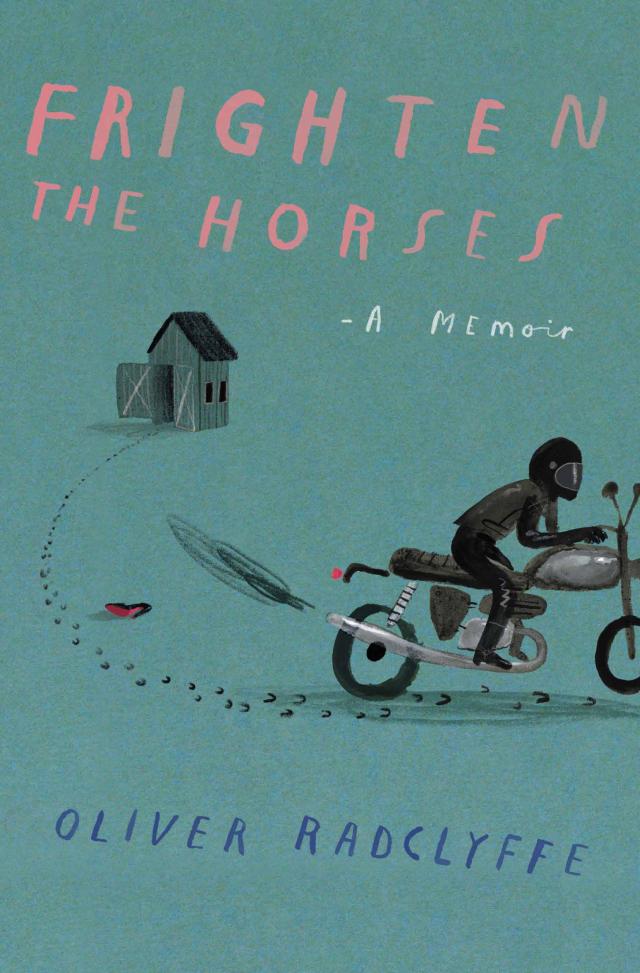
Jacket artwork © Oliver Jeffers
All rights reserved. No part of this book may be reproduced in any form or by any electronic or mechanical means, including information storage and retrieval systems, without permission in writing from the publisher, except by a reviewer, who may quote brief passages in a review. Scanning, uploading, and electronic distribution of this book or the facilitation of such without the permission of the publisher is prohibited. Please purchase only authorized electronic editions, and do not participate in or encourage electronic piracy of copyrighted materials. Your support of the author’s rights is appreciated. Any member of educational institutions wishing to photocopy part or all of the work for classroom use, or anthology, should send inquiries to Grove Atlantic, 154 West 14th Street, New York, NY 10011 or permissions@groveatlantic.com.
Any use of this publication to train generative artificial intelligence (“AI”) technologies is expressly prohibited. The author and publisher reserve all rights to license uses of this work for generative AI training and development of machine learning language models.
Note from author:
The names and identifying features of some individuals in this memoir have been changed to protect privacy.
“In Praise of Limestone,” copyright 1951 by W. H. Auden and © renewed 1979 by The Estate of W. H. Auden; from COLLECTED POEMS by W. H. Auden, edited by Edward Mendelson. Used by permission of Random House, an imprint and division of Penguin Random House LLC. All rights reserved.
Copyright © 1948 by W. H. Auden, renewed.
Reprinted by permission of Curtis Brown, Ltd.
All rights reserved.
Published simultaneously in Canada
Printed in the United States of America
This book is set in 12-pt. Bembo by Alpha Design & Composition of Pittsfield, NH.
First Grove Atlantic hardcover edition: September 2024
Library of Congress Cataloging-in-Publication data is available for this title.
ISBN 978-0-8021-6315-8
eISBN 978-0-8021-6316-5
Roxane Gay Books
an imprint of Grove Atlantic
154 West 14th Street
New York, NY 10011
Distributed by Publishers Group West
groveatlantic.com
For my four children
The blessed will not care what angle they are regarded from,
Having nothing to hide
—W. H. Auden
Chapter One
I was in my favorite spot, relaxing in a chair in a downtown barbershop with my feet propped up on the footrest. A hot towel covered my face, reggaeton pulsed through the speaker in the corner of the room, and the scent of cologne sprayed from Juan’s recycled Jack Daniels bottle hung in the air. It was Friday and all the chairs were full; beards were being clipped, eyebrows trimmed, cheeks shaved, and hairlines etched with meticulous precision. Indulging in the luxury of a hot-towel shave was my favorite way of getting ready for a night out, although I didn’t just come here for the shave and haircut. It was the company I enjoyed, the chance to unwind in a masculine space, to enjoy the affectionate banter in the conversations of the men around me.
Tito, who was trimming a beard on a customer to my left, was teasing Raffiel, the older man sweeping the hair off the floor.
“How many girlfriends you got now, Raff? Three?”
“Nah, only one.”
“Three, my man? You old devil, you’ve got three, haven’t you?”
Raffiel chuckled. “Nah, only one, T. Only one. All I can take.”
Juan peeled the towel from my face, and I looked at myself in the mirror, my head floating above the black barber’s cape as if someone had lopped it off. A few years ago, such a disembodied reflection would have unnerved me, but now my face seemed reassuringly familiar. Juan smiled at me as he patted aftershave onto my cheeks. Then he reached into his back pocket and pulled out his phone. “It’s okay if I get a couple of photos?” he asked.
“Sure, go ahead,” I replied, hoping he wouldn’t notice how flattered I was by the request.
Juan swiveled the chair round, capturing me from all angles. As he scrolled through the shots, I stood up and pulled off the barber’s cape, catching my full reflection in the mirror and momentarily seeing myself through Juan’s eyes: a smallish white dude with a British accent, laughter lines around his eyes and a slightly receding hairline, tattoos covering his forearms, toned chest visible beneath a white T-shirt, faded blue jeans hanging off his hips. My general style suggested someone who’d got stuck somewhere in the Jimmy Somerville era of the eighties and hadn’t updated his wardrobe since, and my fade was razor-sharp, a testament to Juan’s skill with the clippers. There was nothing special about me, nothing exceptional about my body, except this wasn’t quite the shape it had always taken.
“Looking good, bro,” Juan said, handing me his phone. I felt something catch in my throat as I saw my face, framed in a simple square, blending seamlessly with all the other headshots. I was man enough to have made it onto my barber’s Instagram page.
Leaving Juan with a fist bump, I drove through town and out into the suburbs, where I shared a house with my four teenage children. In the kitchen Lily was making scones, covering the counter with a mess of flour and pastry. I opened the back door and let the dogs out into the backyard, where my younger son, Alfie, was playing volleyball with some friends, and then yelled upstairs to Fred, my eldest, to check that he was out of the shower. Lily’s twin sister, Rose, was in the living room, lounging on the sofa, chatting on her phone. “Nice haircut,” she mouthed as I walked past.
I’d just had time to change into a fresh pair of jeans and a clean T-shirt when there was a knock on the front door. I opened it to find a tall, lanky teenager standing on the porch, next to a middle-aged man wearing a polo shirt and a baseball cap.
“Fred! Nathan’s here!” I yelled up the stairs as the teenager loped past me. “Hi, I’m Oliver,” I said to the man on the porch.
“Adrian, Nathan’s dad,” he said, shaking my outstretched hand. “What time should I pick him up?”
“I’ll get Fred’s father to text you—he’s taking them out for pizza.”
“Oh, I’m sorry. I thought you were Fred’s dad?”
“I am.”
“So . . . you’re his . . . stepdad?” He peered past me, searching for a wife.
“No, I’m his biological father. Charles is Fred’s other dad. He lives downtown.”
“Oh, I see,” Adrian said, clearly not seeing at all.
“We’re divorced,” I offered kindly.
“Ah. Okay.”
I watched the possibility that I might be gay dawn on Adrian’s face. At that moment Charles arrived. “Charles, this is Adrian,” I said.
Adrian hesitated briefly and then extended his hand in response to Charles’s greeting, while he tried to make this whole equation work. From the suburban perspective, where stereotypes prevailed, nobody could look much less gay than Charles. For a moment I almost felt sorry for Adrian. The old me would have made him feel more comfortable—would have gone out of my way to do so—but the old me was gone.
Adrian had almost arrived back at the safety of his car when Fred came charging down the stairs, Nathan at his heels. “See ya later, Mom,” he said as he headed down the front path.
I caught a glimpse of Adrian’s bewildered expression as he closed his car door, his fingers fumbling with the ignition key. My mouth twitched. I should probably have put the poor man out of his misery, but I really didn’t have the time.
Chapter Two
Few people can live in denial for their entire life without eventually reaching a breaking point. Unfortunately, we don’t get to choose when we break, because if we did, I wouldn’t have chosen September 11. It was a date far too important in the collective American consciousness. But however unintentional, the tenth anniversary of the day the two planes hit the twin towers happened to be the day when my own past collided with my present, creating a surge of energy that would propel me into an entirely different future.
It was a Sunday afternoon in 2011 and we were sitting in the corner booth of our local diner on the outskirts of a small Connecticut town, waiting for the commemorative rally of motorbikes to ride by. Opposite me, across a sea of decimated pancakes and spilled maple syrup, sat my husband, Charles, safely hidden behind a copy of the Financial Times. Next to him, five-year-old Alfie was using the seat as a trampoline, holding on to the back of the booth for support as his little bottom bobbed up and down, while under the table Lily and Rose, my three-year-old twins, were hiding in a camp they’d made by draping a jacket over their father’s knees. In the corner was Freddie, perched on the shelf behind the banquette with his nose pressed against the diner window. The eldest at six, he’d been on the lookout since we’d arrived, a sweetly redundant act of dedication since it was unlikely we might accidentally miss the sight of two thousand motorbikes roaring through the middle of town.
On the other side of the diner a family I knew from the children’s school was getting ready to leave; the husband was wearing a pair of pressed khakis, the wife a quilted jacket, her hair shaped into the sort of neat shoulder-length bob
A pudgy hand appeared from under the far side of the table, groped around on top until it found a knife, and then disappeared again. I twisted down and rescued the knife from Lily’s grasp before she cut through one of Charles’s shoelaces. Rose had got bored of the camp and was lying on the floor on her belly, making swimming motions. I pulled her up by the armpits and plopped her down on the seat beside me, but she immediately slithered off again like a cartoon jellyfish. Charles sighed, stretched his arms, cricked his neck, and then went back to his newspaper.
“Mummy, what did your motorbike look like?” Freddie asked from the top of the banquette.
“Which one?”
“The fastest one.”
“It was red. An Italian classic.”
“Will you get another one?” Alfie asked.
“I don’t think so, darling.”
“Why not?”
“I can’t take you to your soccer games on the back of a motorbike, can I?”
“I’m going to get a bike when I grow up,” Freddie announced.
“No, you’re not,” Charles said without looking up. “No motorbikes, no drugs, no tattoos.”
“No tattoos?” Alfie asked.
“Or I won’t pay for college.”
I squirmed in my seat, remembering the guys I hung out with before I met Charles, the oil-stained, leather-clad bikers who needled their own tattoos, set their own speed limits, and laughed at the cops with the invincible confidence of white boys in a country where police don’t have guns.
“I wish I had a bike,” Freddie sighed. “Then I’d be cool.”
“I wish I had a bat,” Alfie said in sympathy. “Then it could bite me and I’d turn into Batman.”
Charles reached over and absentmindedly picked a piece from Alfie’s waffle, licking the syrup off his fingers before returning to his newspaper. Freddie started drawing circles in the fog his breath left on the windowpane. For a moment the whole scene—with Charles as the father and husband and me as the mother and wife—felt like a performance, as if I’d accidentally walked into the wrong play and picked up the wrong script and got stuck here playing the wrong part for all eternity. I didn’t know why it all felt so wrong; all I knew was that I missed motorcycling so much that sometimes I still dreamed about it. Sitting astride my bike, using my weight to push down aggressively on the kick start, vainly pulling back on the throttle, my frustration mounting as the bike refused to move.
“Mummy, they’re coming!” Freddie cried, pressing his hands against the windowpane.
I looked over at Charles. He didn’t seem to be in a hurry.
“Shall I take them outside?” I asked.
“Sure,” he replied, turning the page of his newspaper. “I’ll wait for the check.”
Out in the parking lot I lined the kids up on the low wall that bordered Main Street, standing behind them to make sure they all stayed safe. We heard the rumble of the engines in the distance, then glimpsed the first glint of sunlight on chrome as they appeared round the corner, a sea of black leather and bronzed skin thundering towards us. The children were awed into silence by the deafening noise, polished metal flashing as the motorcycles sped past. I felt the longing rise up and wedge in my throat, as if I’d just accidentally bumped into someone with whom I’d once been deeply in love. Alfie climbed to his feet on top of the wall and was trying to say something over the din of the motorcycles. “What darling?” I asked, putting my arm out to steady him.
He put his hands on my cheeks and yelled into my ear. “They’re so LOUD!”
He turned back around to watch the bikes and I put my chin on his shoulder, my arms around his waist, hugging him tight. The bikers drew to a halt in front of us as the lights turned red, full beards and thick forearms, meaty shoulders and muscular thighs. Amid the smell of exhaust fumes they turned to signal to each other or to check on their wives and girlfriends, occasionally revving their engines, the growl of the motors a soundtrack to the show.
I waited for the light to turn green, for the moment when they’d kick their bikes into gear and roar forward with a twist of the throttle, the rumble of the engines, and the smell of burning grease and oil pulling me back in time. I could still remember when that had been me: my legs clad in black leather, my torso hard and muscular like theirs, skin tanned, biceps tightening under a T-shirt, shoulders flat and wide, my motorbike taking the place of the only thing they possessed that I didn’t. I was one of them, I was meant to be out there among them, a boy among men, nothing separating us except for a few inches of road. I could feel the spring coil of the throttle through the leather glove of my right hand, the fingers of my left hand resting lightly on the front brake, the heels of my boots wedged against the foot pegs, toes tensed under the gear, the vibration of the bike through my groin, the rev of the engine sending a secret code to the rest of the bikers: I am with you, I am one of you, let’s go, let’s go, let’s go . . .
And suddenly we were all out on the road together, a symphony of men and muscle and machines. The heavy weight and throb of the engine between my legs as my thighs contracted on the chassis to maneuver the bike around the bends; chest down, shoulders back, neck tense, wind whistling through the gaps in my visor, the dull roar of the engine in my ears. And then the featherweight figure of a woman’s body behind me, her helmeted head just behind my right shoulder, her fingers looped through my belt hooks, her knees lightly touching the sides of my thighs.
I sank deeper into the dream until it almost felt like a memory, the outside world disintegrating, the pieces of my life spinning in circles around me until I wasn’t riding a motorbike anymore, I was falling through the air. For a moment I panicked—my life flashing before my eyes—until I realized that I wasn’t falling, I was floating, and as the world came back into focus, I could see exactly who I was: a man on a motorbike, in love with a woman.
For a moment it was as clear as the calm in the center of a storm. And then it was gone. The cyclone of my past moved off into the distance with the bikers, and my children reappeared on the stone wall in front of me. But the salience of the moment lingered, like a sharp, metallic tang in the air.
Chapter Three
The secret was contained in the car as I drove down Main Street towards Henry’s a few days later. It was hovering around somewhere among the empty chip packets and crushed water bottles, over by a half-eaten Fruit Roll-Up that had melted onto the dashboard. I balanced my palms lightly on the steering wheel, trying to lessen the pain in my fingers. The secret drifted into my head and I let it float away like the meditation guide had instructed: Fly away, little dark cloud. A strand of hair released itself from my scalp and drifted slowly down the front of my sweater. Two hundred and sixty-seven, I counted as another strand sloughed off. Two hundred and sixty-eight.
Henry’s building—the destination I half hoped I’d never reach—was only a couple of miles away. Henry had once told me a story about how he used a rock hidden below the surface of the water as his base when he went surfing; as long as he could swim back to the rock, he knew he was safe. I assumed he meant it as an allegory. I couldn’t picture him in a wet suit, so instead I imagined him sitting on the rock in his armchair, his yellow legal pad on his knee, his wire-rimmed glasses balanced on his nose. Waves thrashing around him, a storm brewing in the sky, and Henry calmly taking notes.






