

Helpmeet, p.1
Helpmeet, page 1


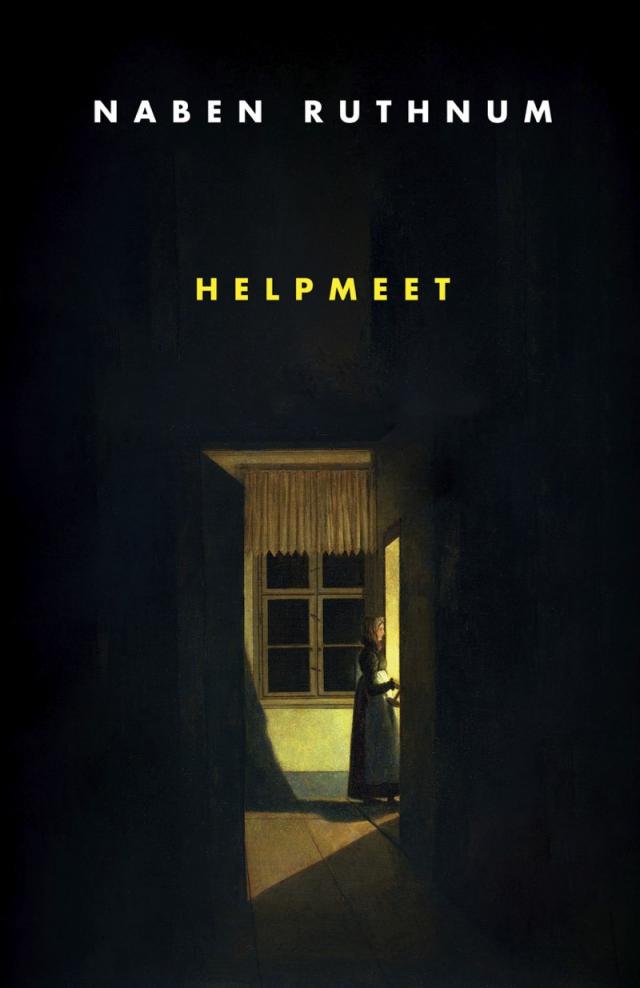
Helpmeet
Praise for “Helpmeet”
“Naben Ruthnum’s Helpmeet is a remarkable throwback. The style, the precise prose, the lush imagery, the dreadful sense of wheels turning just past the reader’s sightline—I devoured it in a few delighted hours and it took me back to my teenage years, to afternoons squirreled away in the corner of my local library reading Clark Ashton Smith, Robert Chambers, Algernon Blackwood and the other great elder wordsmiths I cut my horror teeth on.”
— Craig Davidson, Author of The Saturday Night Ghost Club
* * *
“Through hauntingly concise prose, Helpmeet both acutely disturbs and captivates. This outstanding novella is a morbidly engrossing exploration of moral and physical decay and the shifting boundaries of love and devotion. The tight, incisive narrative is a chilling dive into mysterious forces that transcend the basic binary of good and evil, and the inherent depravity that humans themselves can’t comprehend until it’s too late. ”
— Waubgeshig Rice, Author of Moon of the Crusted Snow
* * *
“An everyday tragedy spirals into a medical mystery and then into something much darker and more disquieting, executed in prose that glitters like candlelight on an open wound. I loved this intensely claustrophobic study of a complicated marriage twisting itself into something monstrous.”
— Premee Mohamed, Author of the Beneath the Rising trilogy
* * *
“In a wholly unique spot between the New York society novels of Henry James and Edith Wharton and the best body horror of David Cronenberg lurks the strange, disturbing and ultimately transcendent novella Helpmeet. Naben Ruthnum’s pitch-perfect pastiche is as all-consuming as the disease at its heart, a fever dream of a story as original, elegantly written and chilling as anything I’ve read in recent memory.”
— Pasha Malla, Author of Fugue States, and Kill the Mall
* * *
“Naben Ruthnum’s succinctly brilliant Helpmeet finds the thin line between intimacy and body horror, and blurs it to create a unique love story that is as moving as it is disturbing.”
— Indrapramit Das, Author of The Devourers
Also by Naben Ruthnum
A Hero of Our Time
Your Life is Mine (as Nathan Ripley)
Find You in the Dark (as Nathan Ripley)
Curry: Eating, Reading, and Race
Helpmeet
NABEN RUTHNUM
HELPMEET
Copyright © 2022 by Naben Ruthnum
Cover art by Caspar David Friedrich, “The Woman With the Candlestick” (circa 1825)
Cover design by Vince Haig
Interior cover art © Rawpixel
Interior design and layout by Michael Kelly
Proofreader: Carolyn Macdonell-Kelly
First edition
All rights reserved.
Library and Archives Canada Cataloguing in Publication data is available upon request
ISBN: 978-1-988964-38-6
This book is a work of fiction. Any resemblance to actual events or persons is entirely coincidental.
Undertow Publications, Pickering ON, Canada
No part of this book may be reproduced in any form or by any electronic or mechanical means, including information storage and retrieval systems, without written permission from the publisher, except for the use of brief quotations in a book review.
Typeset in Crimson Pro
For Ian Worang, my friend
Does not all the blood within me
Leap to meet thee, leap to meet thee,
As the springs to meet the sunshine,
In the Moon when nights are brightest?
HENRY WADSWORTH LONGFELLOW
Contents
Chapter 1
Chapter 2
Chapter 3
Chapter 4
Chapter 5
Chapter 6
Chapter 7
Chapter 8
Chapter 9
Acknowledgements
About the Author
1
When their knock summoned a hired caretaker, and when this caretaker told them he did not know if the Wilks would return, they would say Louise Wilk had removed her husband. That when Edward was too weak to oppose her, when his voice had rotted away, Louise took Edward away from his people. His creditors would claim the remaining furniture, and Louise would return to the gutters she emerged from, never to lie in feather beds again, but for now she could take her husband away and there was nothing the law or decent people could do about it.
These decent people would come for their knock on the door and their chat with the caretaker well after it was known that Edward Wilk had left Manhattan and would never return. The knock was how the story must begin, to properly be a story.
Though she imagined these conversations in detail as she watched Edward sleep, they didn’t trouble Louise. None of this would happen until she was away from New York, when she could be alone with Edward as the inevitable happened. And truly, Edward had no people to be removed from—their marriage had effected a severance two years ago, a total halt to social calls. The visits that Louise had recently been refusing, from his cousins and colleagues and friends of distant years, weren’t requests for a last audience with her husband, but for a keepsake encounter with the death of a man they had cast off years ago. Louise would be spoken of as the planner, as the abductor, but it was Edward who had been most eager to leave—to leave for the country, to die in a specific house that wasn’t this one.
“I was born there, and you’ve never even seen it, Louise. You should. It isn’t romantic or even very nice, but I would like to be there with you.” He’d sent her to his desk for a photograph of the home and orchards surrounding it, and for the address of the man who had tended to the property for the last dozen years. The porch of the small house was heaped with crates, and these crates overflowed with apples. There were no people in the photo, except for a shape behind an open window. A small shape, a child or a woman. Louise didn’t want to ask, in case Edward didn’t remember. He would be frustrated that he couldn’t see to help her.
“It is very beautiful, Edward. And even romantic. It could be a drawing in a magazine story. Is this where you’ve been—where you were shipping pieces, your desk, the pianoforte, months ago?”
“Everything I couldn’t bear to lose is there, and some new furnishings as well,” Edward said. She watched his forehead, the strong, low, black hairline, its point like a sharpened flint. Louise wasn’t repulsed by what the illness had taken from his face, but she allowed herself to stare, on occasion, at this unchanged part above it when they spoke.
“We’ll go if you wish. But can you manage the trip?”
“I couldn’t without you, but I’m not without you. We can manage it. But it must be soon. There’s either soon or too late, Louise.”
Louise had placed the photograph in Edward’s hands, because he wanted it there, and he held it by the edges. His fingers, the long fingers of the surgeon he was or the musician he sometimes pretended to be in bars and brothels and around card tables, seemed to have grown as Edward shrunk, lengthening by a phantom joint as his palms lost their muscle. She took the photo away when he fell asleep. The dents the stiff backing had made in his flesh remained for hours.
The house had been largely unheated for weeks, which made it convenient that almost all the sleeping, eating, and tending in the home took place in the parlour, with the great stone fireplace that Louise would miss. The bill hadn’t been paid for some months, and she supposed it never would be, unless the steam company’s man hooked one of the canvases from the wall and got a fair price for it. Edward hadn’t sent any of the paintings upstate with the furniture, which Louise had found odd at the time. It was as though he had prefigured his loss of sight, and didn’t want to be surrounded by objects he had collected to look at.
The rest of the house, always too large, now surrounded the one room where they lived like a shadow territory, a region of shapes and coldness that had nothing to do with the new phase of Louise’s life with Edward.
It was just past midnight on the first of November, 1900, which Edward had explained to Louise was the last year of the old century, not the first year of the new one. The explanations—there had been several before he fell ill, when he still had breath for trivialities—made sense, but Louise didn’t think they were correct in any sense that mattered to people, to actual people. The next year wouldn’t feel new in the way this past one had, not to her. But it would feel different, as she would enter it alone.
Louise had settled Edward in the chaise longue he now preferred to any bed. His back and head were sunk into a soft pillow. His legs were naked, with only a silk robe pooled over his lap to hide what he couldn’t stand for anyone to ever see again. Louise did see it, all the time, in the course of caring for him, but Edward could no longer sense when he was covered or not. He could and did feel pain, but even those receptors seem buried, unrelated to the traumas and brushes and splits that opened on his skin. Edward only knew the deep complaints of his entire dying body, an intermittent throbbing beacon calling death. It wasn’t pain as he had conceived of it in his career, Edward told Louise: not pain as a warning, but pain as a lament. When he was still pretending he had a future, Edward kept notes on the sensations, detailed their occurrences, even tried to connect them to emotional states in language strictly scientific, not poetic. One of his old teachers, Brackden in Massachusetts, would make something of the notes, even if Edward himself couldn’t, create a small medical-science tomb for him in the shape of an article for The New England Journal of Medicine.
“They’ll never publish me alive. Never. Acherley there hates me, absolutely loathes me. But they’d be delighted to take me dead, under Brackden’s name, as long as the gossip has it clear to everyone that ‘patient W—’ is me, that Edward Wilk died this way. Acherley will ensure that everyone hears about it.”
“Why does he hate you?”
“You don’t want to know about all of that. I offended him, and he was correct to be offended.” Edward flapped a dry hand, not in dismissal, but gentle supplication; while she could stand to hear about the life he had before and during their marriage outside the walls of this house and the hospital, Edward couldn’t stand to tell her about it, especially now.
Louise held Edward almost constantly as he was adapting to the pain, using her own body as a pillow for him, her right hand stroking his chest over the heart. In early days she kept the morphine injections intermittent and low, alongside shots of chloral hydrate, but when he would shake from the pain, when once he shivered and twisted so rapidly that the skin over his right hip tore—a small pocket of remaining fat gleaming yellow and blank before Louise hid it under a bandage—she began to dose Edward at the volume he requested, still with her hand over his heart, feeling him sleep. He had learned the pain now, had adapted to the opiate-fogged agony as though through a rapid process of evolution. He could stand it, he just preferred to sleep through as much as he could.
She would drape and wrap Edward before the carriage came. She had sewed a dignified dark blue garment in soft cambric that would cover his chest, shoulders, and arms, that would tuck around his back. It could be slipped on and off.
As Edward slept, Louise changed the smaller dressings on his calves and at the two gaps behind his knees, the dry pink mouths that would never close. Louise would wind his sleeping legs entirely in bandages for the trip. This gentle demi-mummification would allow her to lift him onto the stretcher that she would handle with Bill Kent, who she could trust to help her tonight and to tell no one he had done so, or where he had taken Louise and her husband. He couldn’t tell anyone because no one knew him; he worked for them, but not in anyone’s household, and never in any single role. Bill drove liquor, he laid track, sometimes worked in the slaughterhouses, but tonight would be the first time he set foot in a great home without a piece of furniture or joint of beef in his arms. He was Louise’s brother.
Edward moved in his sleep, rustling against the chair’s fabric like a flattened plant husk on beach sand. He’d become so dry, moist only where he broke open. When Edward could still read, Louise sometimes looked over his shoulder as he sat with Hazlitt’s Table Talk, the last book he would ever begin. The only difference she could see between the skin that turned the page and the page itself was that words were printed on one surface, but not on the other.
Louise placed a lamp on the floor near Edward’s elevated feet, where the skin was least inclined to tear or peel away, and where she had always been expert at finding veins, better even than the nurses who spoke roughly to her as her skills began to surpass theirs. She lifted the lamp, tilted it, illuminating the blood in her husband’s feet as she held the hypodermic with her other hand. She thickened his sleep with morphine. Louise sat for a moment with the lamp poised, ready to extract another half-dose from her apron if Edward stirred again, but he didn’t. When he was awake, he was in pain. When he moved in his sleep, he was in pain. But when he truly slept, when he was as close to death as he could manage with the help of her needles, nothing hurt, he said. He woke with no memory of having fallen asleep, no concept of how much time he had crossed, how much closer he was to never having to wake again.
Louise dimmed the light and stayed at Edward’s feet, engaging in one of the waking dozes that she had mastered at the hospital and had depended upon for the past few months.
There had been little acceleration of the disease over the past year, only the same alternation of what Edward called “nibbling days and gnawing days” from the very first manifestation: the dropped petal of skin from his penis, the tiny flake he had balanced on his fingertip as he inspected himself in the mirror while Louise watched. But rapidity had finally arrived in the third week of September, when Edward’s nose had gone from gray and flaking to pink and weeping to green to gone. Louise had found him over the kitchen sink in the morning with his own medical bag and a pot of boiling water, scraping the remnants away with a scalpel in a miniature trowelling motion, concluding with a series of careful flicking incisions which sent new green slivers into the sink, leaving only red and pink on his face, bracketed by two tracks of tears that would not stop entirely until Louise gave him sleep again.
“We should have gone to Europe when we had the chance,” Edward said when he felt Louise watching him. The pot had seared a crescent into the countertop: this smell had drawn Louise into the kitchen to see the end of Edward’s self-ministrations. She was used to each stage of his face, so it was the melted tile that seemed deformed, violated. Edward’s face remained his face, with subtractions.
“Who would choose to be ill at sea?” Louise asked.
“It’s not so nice to be ill here, either,” said Edward. The skin around his lips trembled without the lips themselves seeming to move at all; this was how he smiled now, this crinkling of papery flesh.
“We’ll leave. Not Europe, but we won’t be here, I promise.”
That was when Edward first mentioned the house outside of Buffalo, weeks before he asked her to fetch the photo and made it clear how serious he was about setting out. Louise knew about the home, but assumed that this setting of his childhood stories was now tenanted by some other Wilks, one of the many sets of cousins who wanted nothing to do with Edward. But it was his, waiting for him, and it was where he wanted to die. Louise wouldn’t entertain the move until they fulfilled a last medical possibility, a home visit from Garnier, a Parisian syphilis specialist who had been lecturing at Harvard and in Pennsylvania. Dr. Garnier, slim but florid and jowly, asked Louise if her family was French and ignored her answer, then told Edward something that contradicted everything that Edward had heard from his colleagues at the hospital. No, said Garnier, this is not my disease. I do not know what it is, but it is very advanced, I can see this. And I am sorry. Louise didn’t want to let him leave the house until he had said more, though he left Edward’s room an instant after his anti-diagnosis, his categorical denial that Edward was syphilitic. She followed him to the front door, held his coat as though it was a hostage, until he told her calmly one more time that it was nothing he had seen before, that it had nothing to do with his area of focus or knowledge, and that he couldn’t help her husband with his ignorance, could he?
Grasping his coat, Garnier had seemed sorry, and indeed had seemed so since stepping into the room with Edward, even though he’d seen and treated the worst cases of congenital syphilis offered on the continent. They invented the damned pox, Edward said, marvelling at the older man’s fear. He had already stopped writing his pain journal, and now he stopped talking about The New England Journal, about Brackden or Acherley.
When Louise woke from her doze, her arm extended itself to clasp Edward’s foot. She stopped herself from touching him, forgetting in that instant of control what exactly it was that she had half-dreamed, what images had arrived that made her want to wake and grasp him, to confirm that he was there, that he was Edward. Her knee jostled and upset the lamp. The glass chimney shattered against the hearth, making a noise so loud Louise closed her eyes against it, as though such a concussion must come with a flash of light. But she opened them to see only near-darkness, then the lamp’s base nestled against the stone, and the embers in the fireplace above glowing behind the complex metallic lace of the fire-screen Edward had brought back from his final visit to England.






