

Black magic, p.1
Black Magic, page 1


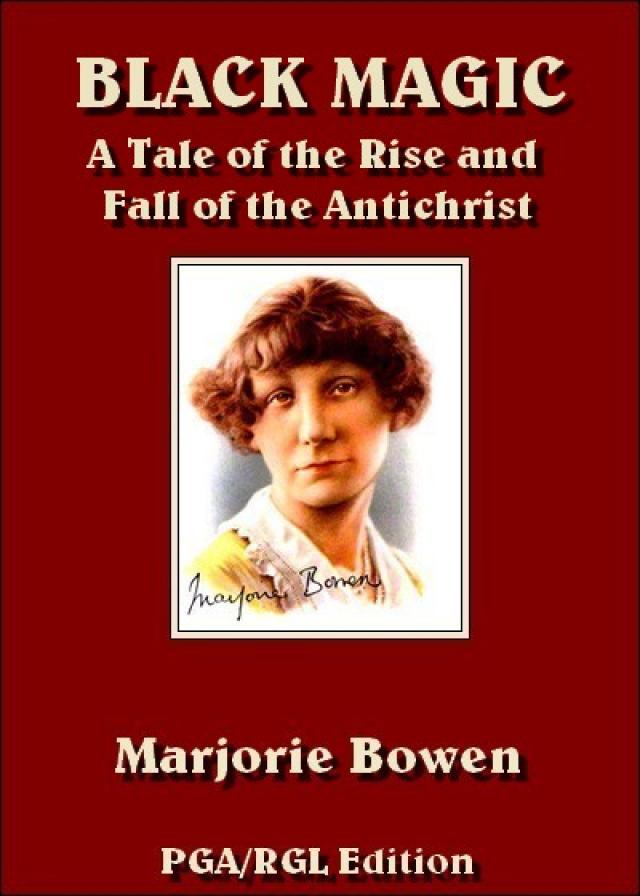
MARJORIE BOWEN
BLACK MAGIC
A TALE OF THE RISE AND FALL OF THE ANTICHRIST
Click here to see more cover images
First published by Alston Rivers Ltd., London, 1909
* * *
TABLE OF CONTENTS
Part I.—The Nun
Chapter I
Sunshine
Chapter II
The Students
Chapter III
The Experiment
Chapter IV
The Departure
Chapter V
Comrades
Chapter VI
The Lady
Chapter VII
Spells
Chapter VIII
The Castle
Chapter IX
Sebastian
Chapter X
The Saint
Chapter XI
The Witch
Chapter XII
Ysabeau
Chapter XIII
The Snaring Of Jacobea
Chapter XIV
The Snaring Of Theirry
Chapter XV
Melchoir Of Brabant
Chapter XVI
The Quarrel
Chapter XVII
The Murder
Chapter XVIII
The Pursuit Of Jacobea
Chapter XIX
Sybilla
Chapter XX
Hugh Of Rooselaare
Chapter XXI
Betrayed
Chapter XXII
Blaise
Part II—The Pope
Chapter I
Cardinal Luigi Caprarola
Chapter II
The Confession
Chapter III
The Empress
Chapter IV
The Dancer In Orange
Chapter V
The Pope
Chapter VI
San Giovanni In Laterano
Chapter VII
The Vengeance Of Michael II
Chapter VIII
Ursula Of Rooselaare
Chapter IX
Pope And Empress
Chapter X
The Evening Before The Coronation
Chapter XI
The Angels
Chapter XII
In The Vatican
Chapter XIII
The Secret
* * *
PART I.—THE NUN
CHAPTER 1.—SUNSHINE
In the large room of a house in a certain quiet city in Flanders, a man was gilding a devil.
The chamber looked on to the quadrangle round which the house was built; and the sun, just overhead, blazed on the vine leaves clinging to the brick and sent a reflected glow into the sombre spaces of the room.
The devil, rudely cut out of wood, rested by his three tails and his curled-back horns against the wall, and the man sat before him on a low stool.
On the table in front of the open window stood a row of knights in fantastic armour, roughly modelled in clay; beside them was a pile of vellum sheets covered with drawings in brown and green.
By the door a figure of St. Michael leant against a chair, and round his feet were painted glasses of every colour and form.
On the white-washed wall hung a winged picture representing a martyrdom; its vivid hues were the most brilliant thing in the room.
The man was dressed in brown; he had a long dark face and straight dull hair; from the roll of gold leaf on his knee he carefully and slowly gilded the devil.
The place was utterly silent, the perfect stillness enhanced by the dazzle of the blinding sun without; presently the man rose and, crossing to the window, looked out.
He could see the sparse plants bordering the neglected grass-grown paths, the house opposite with its double row of empty windows and the yellowing vine-leaves climbing up the tiled roof that cut the polished blue of the August sky.
In between these windows, that were all closed and glittering in their golden squares, busts of old and weary philosophers were set; they peered out blindly into the unfathomable sunshine, and the dry tendrils of the vine curled across their leanness.
In the centre square of grass was an ancient and broken fountain; some tall white daisies grew there, and the pure gold of their hearts was as bright as the gilding on the devil within. The silence and the blaze of the sun were one and indescribable.
The man at the window rested his elbows on the sill; it was so hot that he felt it burning through his sleeve; he had the air of one habitually alone, the unquestioning calm that comes of long silences; he was young and, in a quiet fashion, well-looking, wide in the brows and long in the jaw, with a smooth pale skin and cloudy dark eyes, his hair hung very straightly, his throat was full and beautiful.
In expression he was reserved and sombre; his lips, well shaped but pale, were resolutely set, and there was a fine curve of strength to his prominent chin.
After a time of expressionless gazing at the sun-filled garden, he turned back into the room, and stood in the centre of the floor, with his teeth set in his forefinger looking ponderingly at the half-gilded devil.
Then he took a bunch of beautifully wrought keys from his belt, and swinging them softly in his hand left the chamber.
The house was built without corridors or passages, each room opened into another and the upper ones were reached by short dark stairways against the walls; there were many apartments, each of a lordly design with the windows in the side facing the quadrangle.
As the man moved lightly from one chamber to the next his footfall displaced dust and his gaze fell on cobwebs and the new nets of spiders, that hung in some places across the very doorways.
Many curious and gorgeous objects were in those deserted rooms; carved presses full of tarnished silver, paintings of holy subjects, furniture covered with rich-hued tapestry, other pieces of arras on the walls, and in one chamber purple silk hangings worked with ladies’ hair in shades of brown and gold.
One room was full of books, piled up on the floor, and in the midst of them stood a table bearing strange goblets of shells set in silver and electrum.
Passing these things without a glance the young man mounted to the upper storey and unlocked a door whose rusty lock took his utmost strength to turn. It was a store-room he entered—lit by low long windows looking on the street and carefully shrouded by linen drawn across them; the chamber was chokingly full of dust and a sickly musty smell.
About the floor lay bales of stuff, scarlet, blue and green, painted tiles, old lanterns, clothes, priests’ garments, wonderfully worked, glasses and little rusty iron coffers.
Before one of these the young man went on his knees and unlocked it.
It contained a number of bits of glass cut to represent gems; he selected two of an equal size and a clear green colour, then, with the same gravity and silence with which he had come, he returned to the workshop. When he saw the devil, half bright gold, half bald wood, he frowned, then set the green glass in the thing’s hollow eye-sockets.
At the twinkling effect of light and life produced by this his frown relaxed; he stood for a while contemplating his handiwork, then washed his brushes and put away his paints and gold leaf.
By now the sun had changed and was shining full into the room casting hot shadows of the vine leaves over the little clay knights, and dazzling in St. Michael’s wet red robe.
For the second time the young man left the room, now to go into the hall and open the door that gave upon the street.
He looked on to an empty market-place surrounded by small houses falling into decay, beyond them the double towers of the Cathedral flying upwards across the gold and blue.
Not long ago the town had been besieged and this part of it devastated; now new quarters had been built and this left neglected.
Grass grew between the cobbles, and there was no soul in sight.
The young man shaded his eyes and gazed across the dazzling dreariness; the shadow of his slack, slim figure was cast into the square of sun thrown across the hall through the open door.
Under the iron bell that hung against the lintel stood a basket of bread, a can of milk and some meat wrapped in a linen cloth; the youth took these in and closed the door.
He traversed a large dining-room, finely furnished, a small ante-chamber, came out into the arcaded end of the courtyard, entered the house by a low door next the pump and so into his workshop again.
There he proceeded to prepare his food; on the wide tiled hearth stood a tripod and an iron pot; he lit a fire under this, filled the pot with water and put the meat in; then he took a great book down off a shelf and bent over it, huddled up on a stool in the corner where the shade still lingered.
It was a book filled with drawings of strange and horrible things, and close writing embellished with blood-red capitals. As the young man read, his face grew hot and flushed where it rested on his hand, and the heavy volume fell cumbrous either side his knee; not Once did he look up or change his twisted position, but with parted lips and absorbed eyes pored over the black lettering.
The sun sank the other side of the house, so that the garden and room were alike in shadow, and the air became cooler; still the young man made no movement.
The flames leapt on the hearth and the meat seethed in the pot unheeded.
Outside the vine leaves curled against the brick, and the stone faces looked down at the broken fountain, the struggling grass and the tall white daisies; still the young man, bending lower, his heated cheek pressed into his palm, his hair touching the page, bent over the great tome on his knee.
Not the devil with his green eyes staring before him, not St. Michael in his red robe by the door, not the martyr in the bright winged picture were more still than he, crouched upon his wooden stool.
Then, without prelude or warning, the heavy clang of a bell woke the silence into trembling echoes.
The young man dropped the book and sprang to his feet; red and white chased across his face, he stood panting, bewildered, with one hand on his heart, and dazed eyes.
Again the bell sounded.
It could only be that which hung at the front door; not for years had one rung it; he picked up the book, put it back on the shelf, and stood irresolute.
For a third time the iron clang, insistent, impatient, rang through the quiet.
The young man frowned, pushed back the hair from his hot forehead and went, with a light and cautious step, across the courtyard, through the dark dining-chamber into the hall.
Here for a second he hesitated, then drew back the bolt and opened the door.
Two men stood without.
One was most gorgeously attired, the other wore a dark cloak and carried his hat in his hand. “You cannot want me,” said the youth, surveying them. “And there is no one else here.” His voice fell full and low, of a soft quality, but the tone was sombre and cold.
The splendidly-dressed stranger answered—“If you are Master Dirk Renswoude, we are most desirous to see and speak with you.”
The young man opened the door a little wider. “I am Dirk Renswoude, but I know neither of you!”
“I did not think so,” the other answered. “Still, we have a matter to ask you of. I am Balthasar of Courtrai and this is my friend, whom you may call Theirry, born of Dendermonde.” “Balthasar of Courtrai!” repeated the youth softly; he stood aside and motioned them to enter. When they had passed into the hall he carefully bolted the door; then turned to them with a grave absorbed manner.
“Will you follow me?” he said, and went before them to his workroom.
The sun had left chamber and garden now, but the air was golden warm with it, and a sense of great heat still lay over the grass and vines seen through the open window.
Dirk Renswoude moved St. Michael from the chair and tossed a pile of parchments off a stool. He offered these seats to his guests, who accepted them in silence.
“You must needs wait till the supper is prepared,” he said, and with that placed himself on the stool by the pot, and, while he stirred it with an iron spoon, openly studied the two men.
Balthasar of Courtrai was gorgeous; his age might be perhaps twenty-six or seven; he was of a large make, florid in the face with a high red colour and blunt features; his brows were straight and over fair, his eyes deep blue and expressionless; his heavy yellow hair was cut low on his forehead and fell straightly on to his neck.
He wore a flat orange hat, slashed and cut, fastened by purple cords to the shoulder of a gold doublet that opened on a shirt of fine lawn; his sleeves were enormous, fantastic, puffed and gathered; round his waist was a linked belt into which were thrust numerous daggers and a short sword.
His breeches, of a most vivid blue, were beruffled with knots and tassels, his riding-boots, that came to his knees, stained with the summer dust, showed a small foot decorated with gilt spurs. He sat with one hand on his hip, and in the other held his leathern gloves.
Such the picture, Master Dirk Renswoude, considering him coldly, formed of Balthasar of Courtrai.
His companion was younger; dressed sombrely in black and violet, but as well-looking as a man may be; he was neither dark nor fair, but of a clear brown hue, and his eyes were hazel, swift and brilliant; his mouth was set smilingly, yet the whole face expressed reserve and some disdain; he had laid his hat on the floor beside him, and with an interested glance was observing the room.
But Balthasar of Courtrai returned Master Dirk Renswoude’s steady gaze.
“You have heard of me?” he said suddenly.
“Yes,” was the instant answer.
“Then, belike, you know what I am here for?”
“No,” said Master Dirk, frowning.
Balthasar glanced at his companion, who gave no heed to either of them, but stared at the half-gilded devil with interest and some wonder; seeing this, Balthasar answered for himself, in a manner half defiant and wholly arrogant.
“My father is Margrave of East Flanders, and the Emperor knighted me when I was fifteen. Now I am tired of Courtrai, of the castle, of my father. I have taken the road.”
Master Dirk lifted the iron pot from the fire to the hearth.
“The road to—where?” he asked.
Balthasar made a large gesture with his right hand.
“To Cologne, perhaps to Rome, to Constantinople…to Turkey or Hungary.”
“Knight errant,” said Master Dirk.
Balthasar tossed his fine head.
“By the Rood, no. I have ambitions.”
Master Dirk laughed.
“And your friend?” he asked.
“A wandering scholar,” smiled Balthasar. “Also weary of the town of Courtrai. He dreams of fame.”
Theirry looked round at this.
“I am going to the Universities,” he said quietly. “To Paris, Basle, Padua—you have heard of them?”
The youth’s cloudy eyes gleamed.
“Ah, I have heard of them,” he replied upon a quick breath.
“I have a great desire for learning,” said Theirry.
Balthasar made an impatient movement that shook the tassels and ribbons on his sleeves. “God help us, yes! And I for other things.”
Master Dirk was moving about setting the supper. He placed the little clay knights on the window-sill, and flung, without any ado, drawings, paints and brushes on to the floor.
Silence fell on them; the young host’s bearing did not encourage comment, and the atmosphere of the room was languid and remote, not conducive to talk.
Master Dirk, composed and aloof, opened a press in the wall, and took thence a fine cloth that he laid smoothly on the rough table; then he set on it earthenware dishes and plates, drinking-glasses painted in bright colours, and forks with agate handles.
They were well served for food, even though it might not be the princely fare the Margrave’s son was used to; honey in a silver jar, shining apples lying among their leaves, wheaten cakes in a plaited basket, grapes on a gold salver, lettuces and radishes fragrantly wet; these Master Dirk brought from the press and set on the table. Then he helped his guests to meat, and Balthasar spoke.
“You live strangely here—so much alone.”
“I have no desire for company. I work and take pleasure in it. They buy my work, pictures, carvings, sculptures for churches—very readily.”
“You are a good craftsman,” said Theirry. “Who taught you?”
“Old Master Lukas, born of Ghent, and taught in Italy. When he died he left me this house and all it holds.”
Again their speech sank into silence; Balthasar ate heavily, but with elegance; Dirk, seated next the window, rested his chin on his palm and stared out at the bright yet fading blue of the sky, at the row of closed windows opposite, and the daisies waving round the broken fountain; he ate very little. Theirry, placed opposite, was of the same mind and, paying little heed to Balthasar, who seemed not to interest him in the least, kept curious eyes on Dirk’s strange, grave face.
After a while the Margrave’s son asked shamelessly for wine, and the youth rose languidly and brought it; tall bottles, white, red and yellow in wicker cases, and an amber-hued beer such as the peasants drank.
The placing of these before Balthasar seemed to rouse him from his apathy.
“Why have you come here?” he demanded.
Balthasar laughed easily.
“I am married,” he said as a prelude, and lifted his glass in a large, well-made hand. At that Master Dirk frowned.
“So are many men.”
Balthasar surveyed the tilting wine through half-closed eyes.
“It is about my wife, Master, that I am here now.”
Dirk Renswoude leant forward in his chair.
“I know of your wife.”
“Tell me of her,” said Balthasar of Courtrai. “I have come here for that.”
Dirk slightly smiled.
“Should I know more than you?”
The Margrave’s son flushed.
“What you do know?—tell me.”






