Hope, p.1
Hope, page 1


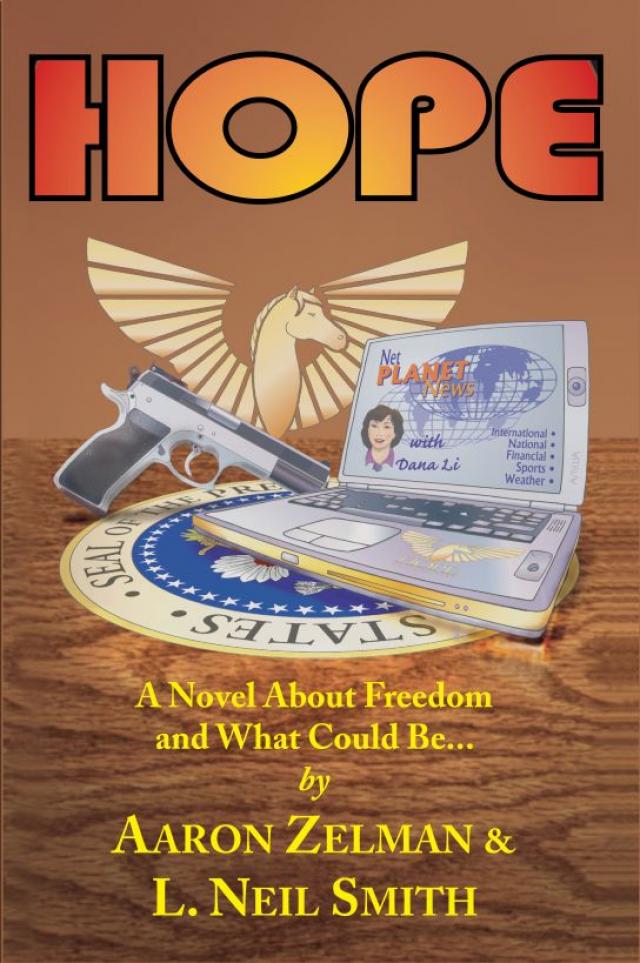
H O P E
Aaron Zelman
& L. Neil Smith
Phoenix Pick
An Imprint of Arc Manor
Hope copyright © 2001 Aaron Zelman & L. Neil Smith. All rights reserved. This book may not be copied or reproduced, in whole or in part, by any means, electronic, mechanical or otherwise without written permission from the publisher except by a reviewer who may quote brief passages in a review. Words (and music, too) to “I Will Be Free” (see Chapter Fifteen) by L. Neil Smith, copyright 1984. Cover art copyright © 2001 L. Neil Smith & Aaron Zelman. Used with permission.
Tarikian, TARK Classic Fiction, Arc Manor, Arc Manor Classic Reprints, Phoenix Pick, Phoenix Rider, Manor Thrift and logos associated with those imprints are trademarks or registered trademarks of Arc Manor Publishers, Rockville, Maryland. All other trademarks and trademarked names are properties of their respective owners.
This book is presented as is, without any warranties (implied or otherwise) as to the accuracy of the production, text or translation.
This is a work of fiction. Names, characters, places, and incidents either are the product of the author’s imagination or are used fictitiously. Any resemblance to actual events, locales, organizations, or persons, living or dead, is entirely coincidental and beyond the intent of either the author or the publisher.
Smashwords Edition
ISBN (Smashwords Edition): 978-1-60450-265-7
ISBN (Paper Edition): 978-1-60450-293-0
Library of Congress Cataloging-in-Publication Data (Paper Edition)
Smith, L. Neil
Hope / by L. Neil Smith and Aaron Zelman.
p. cm.
ISBN 978-1-60450-293-0 (alk. paper)
1. Presidents--United States--Fiction. 2. Third parties (United States
politics)--Fiction. 3. United States. Constitution 1st-10th Amendments--Fiction.
4. Liberty--Fiction. 5. Political fiction. I. Zelman, Aaron S., 1946- II. Title.
PS3569.M537555H66 2009
813’.54--dc22
2008046053
***
www.PhoenixPick.com
Great Science Fiction at Great Prices
Visit the L. Neil Smith’s website at:
http://www.lneilsmith.org
Aaron Zelman is a founding member of
Jews for the Preservation of Firearms Ownership (JPFO)
Visit the JPFO website at:
http://www.jpfo.org
Published by Phoenix Pick
an imprint of Arc Manor
P. O. Box 10339
Rockville, MD 20849-0339
www.ArcManor.com
***
This book is dedicated to all those Americans over the past two and a half centuries who have cared enough—and been brave enough—to defend individual liberty wherever and whenever it was threatened. Our special acknowledgement to James Bovard, who has inspired so many people to embrace the Bill of Rights.
***
Our sincere thanks to David Anderson, Scott Bieser, Tom Creasing, Ken Holder, Rex May, Roger L. Smith, Rylla Smith, Richard Stevens, John Taylor, Garn Turner, Claire Wolfe, and especially Frank Ney, without whose cheerful help this effort might have been considerably less interesting. And to our muse, Jan Gan Boyd, wherever you are.
***
Do you hear the people sing? Singing a song of angry men? It is the music of a people Who will not be slaves again! When the beating of your heart Echoes the beating of the drums, There is a life about to start When tomorrow comes!
—Herbert Kretzmer, Les Miserables
***
CHAPTER ONE: SHEILA HENSLEY
Painful as it may be to hear it, there’s nothing special about the people of this country that sets them apart from the other people of the world. It is the Bill of Rights, and only the Bill of Rights, that keeps us from becoming the world’s biggest banana republic. The moment we forget that, the American Dream is over.—Alexander Hope, Looking Forward
High above the mirror-polished hardwood floor, thickly forested in folding Samsonite chairs, red, white, and blue banners hanging on all four gymnasium walls proclaimed:
hope—for america
“A political rally?” Sheila Hensley proclaimed in disbelief. “You’ve brought me out in this cold and slush to a political rally?” She was a stylishly tall, well-dressed, slender and attractive woman few would have guessed was in her early 60s. It was difficult to see any gray in her ash-blonde hair. The tweed-jacketed man beside her was of about the same age, but he was losing his hair, and was a trifle shorter than she was. “Do you have any idea how many of these I’ve attended over the past 40 years?”
Hundreds of people were milling around the room or visiting in small groups. The air smelled of wet coats and Chicago in November. The flags that hung around the gymnasium were not the familiar 13 stripes and 50 stars of the 21st century United States of America, but the same stripes and the circled 13 stars of the nation’s painful birth years. An enormous blue and white banner over one of the basketball hoops, exhorted:
hope for next year!
and
hope for president 2008
“Plenty would be my guess,” her companion answered amiably as he fondled his unlit briar. Thornton “Kitch” Sinclair was a professor of history at a private college here in Chicago and a lifelong activist of the libertarian persuasion. He knew that Sheila had once been married to one of the state’s Democratic Party movers and shakers. “Although I’d be willing to bet that not one of them was for any third-party candidate.”
“Unless you count the Gene McCarthy campaign in ‘68,” she replied, agreeing with him. Recorded music being played from somewhere up near the front of the big room brightened the atmosphere. She thought she recognized something lively from Les Miserables.
“I don’t count it,” Kitch told her. “McCarthy was running for the Democratic Party’s presidential nomination.”
“About a million years ago,” she sighed.
“About a million years ago,” he agreed.
More and more people seemed to be entering now, mostly young people, chattering, laughing, some of them stopping at a table to the right of the doors to acquire buttons with the candidate’s name and face on them, stickers with winged horses that were somehow associated with the campaign, or little 13-star flags on what looked like teriyaki sticks.
Sheila and Kitch stood just inside and slightly to the left of the two-story double doorway opening onto the recently remodeled gymnasium at St. Gabriel’s—the Church of St. Gabriel Possenti of Isola—located in a rather old, comfortable-feeling middle-class Chicago neighborhood. The mini-convention he’d brought her to was being held across a street full of muddy snow at the Piper Arms Hotel, but there was more room here for the public appearance of the candidate.
“And how many of those years, my dear,” he went on, “have you had the undeniable feeling that this country is ... well, the expression, I believe, is ‘FUBAR’.”
She smiled, brightly-colored memories four decades old crowding into her mind. “’Fouled Up Beyond All Recognition’? Only you didn’t really mean ‘fouled’.”
“You’re right,” he conceded, “I didn’t really mean ‘fouled’. How many, Sheila, how many?”
“About the same million,” she answered thoughtfully. “Or at least for the 40 that I’ve spent going to political rallies. Kitch, you know it’s funny—funny meaning ‘grotesque’—that I’ve always felt that way, starting back when I was a hippie, supporting ‘Clean Gene’ from the streets, continuing when I became the respectable wife of a Democratic Party kingmaker, and even more so, after the divorce, after John died, and I started being, well, something else, I guess, whatever it is.”
He took her hand. “We all started being something else after John died.” John Greenwood had been a lifelong friend to both of them, a classmate of Sheila’s in high school, a classmate of Kitch’s in college, best friend to the latter, the love of her life to the former until—to Sheila’s eternal dismay—he’d found his calling. He’d become a Catholic priest and eventually the monsignor here at St. Gabriel’s. He’d been killed in Israel by terrorists, but not without giving them a fight.
She realized all over again: this had been his church.
Kitch sighed, “Well, I’m sorry for dragging you here, Sheila, but I had a reason.”
“Yeah?” she answered with mock severity. “Well it had better be a good one. I know a place on the lakeshore where we could be eating lobster right now in front of a stone fireplace.”
He sighed and shook his head, pretending—at least partly—to be torn between dinner and politics. “It is, I assure you. There was a time, you know, when people didn’t feel that way, that FUBAR way I mentioned. There must have been a time like that. Maybe it was before we started hearing all these nasty rumors about the vice president. Maybe it was before before the election of 2000. Maybe it was before before Waco, before Watergate, before the War in Vietnam, or before the Kennedy assassination.”
“Maybe it was before both world wars or the Depression or the Federal Reserve Act of 1913,” she grinned, shaking her own head. She’d heard all of theis from him before, many times. But it was one of the reasons she ... she—what did she feel for Kitch, anyway? I won’t think about that now, she ruefully quoted Scarlett O’Hara, I’ll think about that tomorrow.
“Maybe it was before the War between the States,” he went on, startling her. “I don’t know where we went wrong and Sheila, I teach the stuff! But I know there was a time in America when people had greater free dom and a less oppressive life than they do today. A time when the sky seemed to be brighter and the air smelled cleaner and everything, everything tasted sweeter, simply because there was no one to put a tax on it or tell you in minutest detail how it’s bad for you and you shouldn’t have it.”
She started to speak; he went on before she could. “Now there’s your real pollution, Sheila, too blasted many people-per-million are professional busybodies and dogooders who believe that everything tastes better if they piddle in it!”
“Like the sophomore senator from New York—and former First Lady—who wants to be the first female President of the United States?” Sheila asked rhetorically.
Kitch nodded. “The sophomoric senator, a perfect example of the species. Well, Hope’s the fellow to put a stop to it, at least I think he is!”
She arched a cynical eyebrow at him.
“But you couldn’t be more wrong about one thing, Sheila,” he finished softly. “You never were a hippie, never. To me, you always smelled of bathsoap and yellow roses.”
Speechless, Sheila looked heavenward into the rafters of the gymnasium. How could you not love a fellow who was this romantic (and in his 60s, no less) and was as cute as a hobbit—which he greatly resembled—besides? Without waiting for any reply from Sheila, Kitch touched her elbow gently and they headed toward a small knot of individuals gathered around a folding table, still at the back of the enormous room, where he thought that he’d glimpsed somebody familiar.
“Father Joseph?” Kitch tapped on a shoulder.
A small, wiry, bearded man in his 30s, wearing a black jacket, shirt, and priest’s collar turned toward them. Kitch had always thought he looked rather like Al Pacino. He held up a small plastic cup. “Who do I complain to, Kitch? I believe there’s actually punch in this punch!”
CHAPTER TWO: JOSEPH SPAGELLI
Chief Justice Oliver Wendell Holmes was wrong. You have an absolute and perfect right to shout “Fire!” in a crowded theater—and to accept responsibility for the consequences.—Alexander Hope, Looking Forward
I’ll give you punch!” a familiar voice threatened mockingly. It was an old man who raised his hand, only to lower it again and thrust it enthusiastically toward Kitch. Most likely in his 80s, he had a long white beard and a yarmulke. The heavy coat he wore had analmost military look to it.
“Ascher!” Kitch exclaimed, highly delighted, but not especially surprised, to see his two old friends here. How long had it been since this extremely odd couple had gone into “business” together? Could it really be almost a decade?
“You remember Rabbi Liebowitz, don’t you, Sheila?” Ascher, an ardent anti-Nazi partisan during World War II, had once been fired by a Reform congregation for being politically incorrect enough to openly advocate armed self-defense.
“And his comical sidekick, Father Joe,” put in Spagelli. John Greenwood’s former assistant, Spagelli now worked with Ascher for the mysterious and controversial Ralston Foundation, dedicated to teaching effective self-defense—including self-defense with firearms—and a special set of ethics to go with it, to inner-city boys and girls. Although the general crime rate, and gang-shootings in particular, had fallen off sharply in areas where it was active, the foundation had been the subject of extremely hostile treatment by the establishment media over the years.
Old Ascher seemed to thrive on it.
“I remember them well,” she answered. “A priest, a rabbi—all we need now is for a Protestant minister to show up and we’ll have the material for some really classic jokes.”
Kitch was about to point out a particular Lutheran clergyman he was acquainted with, up front, addressing a crisp-looking redheaded 20-something female in a severe gray suit whom he felt he somehow ought to remember, but he was stopped by the rabbi.
“If it’s jokes you’re looking for, young woman,” Ascher told her, producing a startled expression on her face, “we have all the jokes we need in this coming election!”
“What do you mean, Rabbi?” Kitch asked with counterfeit innocence, knowing exactly what Ascher had meant.
“It’s actually a religious event—the Second Coming of Bozo! To begin with, we’ve got a possible sexual scandal deeply involving the Republican frontrunner, Vice President Chesley Chambers. (You know, it’s too bad the old vice president had to resign and go back home to Wyoming; I rather liked him.) And—dismayingly far ahead in the polls at the moment—an inexplicably charismatic former First Lady whose Senate voting record makes Diane Feinstein resemble a John Bircher, and who now openly promises to take America all the way down the Marxist drain!”
“So much for Socialist Party ‘A’ and Socialist Party ‘B’,” Kitch grinned. Maybe that’s where America went wrong, he thought to himself, when political parties—the Federalists and anti-Federalists—began to form. Many historians thought so. Then again, how could such a thing have been prevented in a free society?
“Well the election’s still a year away, and we’ve got Hope,” said Father Joseph. “No pun intended, of course. A very decent, highly principled guy whose chances of being elected approach those of the proverbial cellophane snowball in a locale that the theologically sophisticated claim not to believe in any more.” He finished with a Russian accent, “What a country!”
“Do you believe in Hell, Father Joseph?” Ascher asked.
“Yes I do, Rabbi, I’ve been there many times.”
“What,” Sheila asked, “no rimshot?”
“The man’s platform,” Kitch said, mostly to Sheila and attempting to ignore the theological horseplay, “is shockingly simple. ‘Hope for America’ consists of no more than one man’s promise to stringently enforce the Bill of Rights—exactly like the highest law of the land it happens to be.”
“A policy,” Sheila replied, her guard up now at the thought of yet another political hero—in a lifetime full of them—inevitably with feet of clay. “A policy you clearly believe will put us back on the ‘right track’.”
Kitch turned to Sheila, almost pleading. “I think I might weep if such a man could be elected. It’s exactly what we were just talking about. Everybody—right, left, and middle—knows that there’s something terribly wrong with this country of ours. And that in itself should tell us something.”
“Like?” She was frowning at him. Why was this funny little man so easily capable of changing her mind—and turning her head?
“Like maybe,” he told her, “it’s true. Like maybe it’s something really deep and fundamental that went wrong a long time ago, right at the country’s beginning. Hope’s a history professor like I am, Sheila, only instead of specializing in Middle Eastern literature like I did, his field is American history, which is about as academically popular these days as planetary astronomy.”
Pretending indifference, she said, “I’m afraid you’ve lost me, darling.”
“As an historian, Hope ‘remembers’ a time when you could start your own business by hanging out your shingle, without getting a fistful of permits. When you could write a book that criticized the government and no thug-agency would threaten the retailers who sold it. When you could lock your door and say you wanted to be left alone, without the SWAT team blasting you and your house to bits. When you could dig a hole—even fill one in—in your own back yard without even once seeing helicopters and machineguns sent by the Environmental Protection Agency.”
“And as a consequence, he believes that vigorously enforcing the Bill of Rights will go a long way toward fixing everything that’s wrong with America?” Still skeptical, Sheila looked Kitch deep in the eyes. “And you agree?”
“My dear, I remember a time like that, myself, although admittedly I was very young. Why, you could leave your front door unlocked, buy unwrapped candy, and let your kindergartner walk to school without an escort because nobody would even dare think of molesting her. And you certainly didn’t need a license from the government to exercise your Constitutional rights.” He nodded his certainty. “Yes, Sheila, I agree with him.”