

The trials of lila dalto.., p.1
The Trials of Lila Dalton, page 1
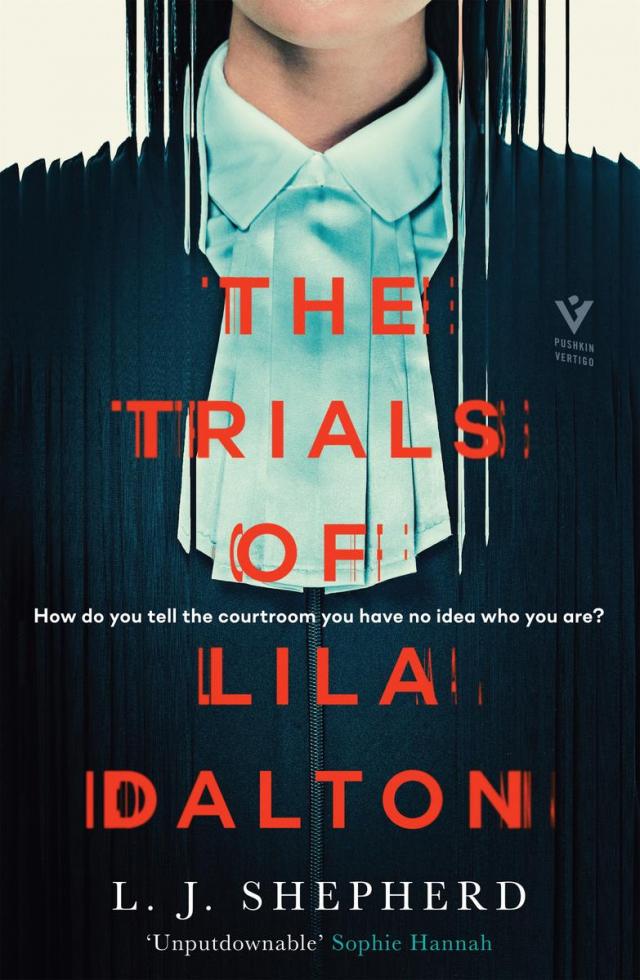


Contents
Title Page
1
2
3
4
5
6
7
8
9
10
11
12
13
14
15
16
17
18
19
20
21
22
23
24
25
26
27
28
29
30
31
32
33
34
35
36
37
38
39
40
41
42
43
Epilogue
Available and Coming Soon from Pushkin Vertigo
Copyright
1
I look up to find twelve strangers staring back at me: six in the front row, six in the back. They seem expectant, like an audience waiting for a comedian to deliver the punchline.
I realize I’m the one they’re waiting for. Now would be a good time to tell a joke, just to ease the tension, or fill the silence at the very least, but I can’t think of anything to say. My mind has gone blank.
I don’t know where I am, or how I got here. I’m not even sure where ‘here’ is.
It’s an old-fashioned place. The twelve strangers are sitting in a wooden box—like pews in a church, except the back row is higher than the front, so more like seats in a theatre. Sort of. Everything from the skirting board to eye level is oak-panelled.
‘Miss Dalton?’
I look around for whoever said that and, at the front of the room, staring down at me from an elevated bench, is a man robed in scarlet and black. A judge. His eyebrows rise to meet his wig. I quickly decide that it’s a good job I didn’t deliver any funny lines. It doesn’t look like he’d appreciate them.
The presence of a judge tells me this must be a courtroom. That’s why everything looks so strange, why the walls are made of wood. Wait, am I on trial? What have I been accused of?
‘Miss Dalton?’ says the judge again.
I guess that’s me. Dalton… Dalton… The name means nothing to me.
‘I think the jury were hoping you might tell them which witnesses you’ll be calling for the defence.’
I repeat the phrase several times, but quietly, so that only I can hear. With each repetition, my head pounds and brings with it a wave of tinnitus. Witnesses… jury… defence.
It doesn’t matter how many times the words slosh around my pitching ship of a brain, I can’t think of anything to say. I feel sick with dread. Everyone is expecting me to know the answer, but I couldn’t even tell them what day it is. There’s been some sort of mistake. A horrible mistake.
Needing to feel my skin, just to check that there’s some fleshy casing for my broken mind, I raise a hand to my temple, and my fingers brush horsehair curls. I’m also wearing a wig. At least that explains why everyone is looking at me.
I cast around for more clues, even though the list of potential explanations is dwindling by the second. And those seconds are as long as minutes. Each one drags out into eternity while everyone waits for me to speak and I stay silent, though my mind is full of noise.
I turn to see what’s behind me. No longer looking for clues, I’m looking for an exit. In the middle of the courtroom sits a man encased in a glass box. Next to him is a uniformed officer with a pair of handcuffs chained to his belt.
Witnesses for the defence. This must be the defendant. I feel a rush of adrenaline that curdles with the realization that I’m supposed to be defending him.
I cast my mind back. How did I get to court? Did I get the train? I don’t even know what the case is about. Everything that came before is just… Nothing came before. This sends a fresh jolt of panic through me.
‘My Lord, may I trespass on the court’s time for a few more moments and request a short break?’
I have no idea where I learnt to speak like that.
His Lordship’s nostrils flare and he turns to face the twelve strangers. ‘Right. Members of the jury, I do apologize, but I’m afraid I must ask you to return to your room. I’m sorry about all this back and forth. As soon as we get into the trial proper, there’ll be no more games of musical chairs.’
There’s a titter that masks a grumble of impatience. As I sit down, my heart rams into my ribcage.
The judge watches the jury leave one by one. When the door closes, his eyes whip to me. I stand up—not entirely sure why—but I suspect it’s the right thing to do.
‘Ten minutes.’ He gets up to leave.
‘Court, please rise,’ comes a voice from somewhere at the back.
Everyone does as they’re told.
I’ve got to get out of here, find someone who’ll help me. It looks like I’m a barrister, someone who has responsibilities and knowledge and—God help me—legal qualifications. That person, whoever she is, feels as much of a stranger to me as the judge or jury. Who knows what I’m supposed to be doing today, where I’m supposed to be? A word swims out at me from the depths of my non-existent memory. Clerks.
I find that I’m in the very pit of the court, sandwiched between rows of oak pews. The jury box, the judge’s bench and the public gallery all rise around me like an amphitheatre. I go to leave when—
‘Miss Dalton?’
It takes me a moment to remember that’s my name. I turn to see a man wearing a black robe so tattered and worn he looks like a wraith. His wig is the colour of earwax.
‘You’re making the right decision,’ he says. ‘Don’t call your client. It’ll only let his form in.’
The only thing worse than not knowing how to respond is knowing exactly what he’s talking about. He means that calling the defendant to give evidence will cause his previous convictions to go before the jury. How can I possibly know that? I don’t even know my name, my birthday, anything. I can’t picture my face.
‘Take as much time as you need,’ he says, his voice mellifluous. Instinct warns me not to trust him.
I’ve got to get out of here.
He continues muttering behind me, as though my turned back has rendered me deaf. He says something about why I’ve asked for a break. From the tone of his voice, I recognize that he’s telling a joke. Well, good for him. I can’t catch all of it because I’m heading away now, and don’t want him to know I’m eavesdropping.
‘… her hemline will get higher with every day of this trial… His Lordship will be… pleased.’
I look down at my skirt. It’s straight and black and hits my calf just below my knee. What does he mean, ‘His Lordship will be pleased’? My cheeks flush. What sort of person is renowned for the length of their skirt? Perhaps I use my body, my ‘feminine wiles’, to get my own way in the courtroom. But that doesn’t seem like me. I know that’s not me.
I almost laugh; how should I know what I’m like? I’m the last person to be an authority on that subject.
But the shame brought on by his comment lingers, a weight that hangs around my neck. I don’t need to remember my past to know I’ve been spoken to like that or looked down on every day of my life.
I get away from the row of benches as fast as I can, glancing up at the poor sap in the dock. It looks like I’m his only hope. God help him.
There’s barely anyone in the public gallery. A couple of hacks sit in the press benches. I head for a pair of double doors at the back of the court with dusky-pink curtains shielding the windows.
After climbing a flight of stairs, I find myself staring at a long, low-ceilinged corridor. There are rooms all along the right-hand side like bunkers, and on the left is a windowless wall of glossy brown bricks.
‘Are you OK?’
I nearly jump out of this stranger’s skin. There’s a man standing next to me. Where the hell did he come from?
‘I’m Malcolm,’ he says.
Malcolm is a middle-aged man wearing the black robes and government-issue lanyard of an usher. The only hint of individuality is found in his glasses, which are round and golden. Something about his calm demeanour comforts me.
‘I need to speak to my clerks.’ How I know this is a mystery to me. But that clerks look after barristers is a piece of knowledge I’ve retained, so I clutch at it.
Malcolm smiles politely, ignoring my abruptness. ‘Follow me.’
Rather than going down the long, straight corridor, we turn right and go up another flight of stairs and through another pair of double doors that open out into a hall the size of a small church.
My heels clatter on the black-and-white stone floor. It’s like a chessboard except, rather than squares, hidden beneath tables and chairs are triangles, diamonds and circles. Above me, there are three plaster ceiling roses held up by Doric columns.
Just as I’ve finished taking in the spectacle of the main hall, the clacking of my heels is muffled by red carpet. We’re navigating a maze of rooms and windowless corridors. Or Malcolm is.
Eventually we end up at a door that says ‘Listing’ on a brass plaque below a wired glass window.
Malcolm knocks before poking his head around the frame. ‘Miss Dalton wants to ring her chambers.’
He waves me inside where a woman is already dialling the numbers into a desktop rotary. S
I don’t have enough time to wonder who will answer because after the first ring—
‘Two, Lawn Buildings, Tony speaking.’ Tony has a distinctive South Walean lilt.
‘Hi, Tony.’
‘Lila! How’s you?’
Lila… Lila… Still nothing. I feel the two Ls on my tongue but there’s… nothing. ‘What case am I doing today?’
There’s a wooden desk calendar next to the phone so I check the date. I realize that I don’t even know what year I’m in. 18 November 1996 it says in red letters.
‘Very good.’ Tony laughs nervously. ‘It’s ten-forty. Shouldn’t you be in court?’
‘Seriously, what case am I doing today?’
‘You are joking? This isn’t the time for—this is the biggest case of your career. You’re doing Eades.’
Eades?
‘Eades,’ I repeat back to him.
‘The mass-murderer? Bombed the Home Office building?’
Shit. I’m doing a murder? A mass murder?
‘But…’
‘We had this conversation on Friday… Do you know how many juniors dream of their QCs being in a car crash the week before a trial?’
‘Jesus.’
‘All of that hard graft and there you are, doing it all on your own.’ Tony sounds like a proud father. It makes it harder to disappoint him.
‘But… I can’t.’
‘You can. Don’t doubt yourself now. Pat wouldn’t have chosen you as junior if you weren’t up to it.’
‘When are they coming back? My silk?’
‘Seriously, Lila. What’s wrong with you? Are you having another one of your…?’
Is this something I’ve done before? Am I unbalanced? Does Tony keep tabs on me, making sure I don’t take on too much work in case I burn out?
‘There was a car accident on Friday. Pat’s still in a coma. You know all this.’
‘Oh my god. I’m so sorry… I’ll go now, Tony.’
‘Go get ’em!’
I hang up, thanking the woman who dialled the number, and leave to find the main hall. Thinking over the conversation, I realize three things. First, as with ‘clerks’, I know what the words ‘silk’ and ‘QC’ mean. QCs—Queen’s Counsel—are senior barristers who wear silk gowns and take on only the most difficult cases. Second, I realize that Pat is my QC. Third, I realize he’s not here, so I have to do the case in his stead.
Just reciting these facts makes me feel calmer. But what I still can’t reconcile is my detailed knowledge of the legal world on the one hand and my total lack of knowledge of my own life on the other.
This must be what’s happened: I was so stressed about doing the case without a silk that I spent the weekend working into the small hours. Maybe I mixed caffeine and alcohol. Do I take drugs? Maybe I took drugs. This must be just sleep-deprivation or something. That’s why I can’t remember how I got to court. It’ll come back. I just need to take a few deep breaths, clear my head.
I’m not losing my mind. That’s one thing I know for sure.
I mean, looking at this logically, there’s nothing wrong with my cognitive functioning. Well, if you discount the fact I don’t know who or where I am, or what the last… however many years of my life have involved. Yes, ignoring that, I’m eloquent and methodical and seem to know stuff about the law. It sounds pretty temporary. It could just be stress, which would make sense given this is the biggest case of my career. I can’t give up just yet. What if in a couple of weeks I’m fine and I’ve just thrown away the opportunity of a lifetime? What will the future hold for me then—sitting out my days representing petty shoplifters until retirement?
If I tell people what’s happening, they’ll think I’ve lost the plot, they’ll want to shove me in an institution, and that seems a bit drastic given… Given I’m basically fine. See, perfect example. Just then, when I thought about being sectioned, an image came to me. Not a memory as such, not something I’ve actually experienced, but word association. A sterile corridor, long and white. It looms larger in my mind’s eye.
This thought jolts me back to where I am, where I’m supposed to be going. I’ve been walking along the same corridor for what feels like an age. I turn in the direction of what I’m sure is the main hall only to find that I’m back outside the listing office again.
‘Lost?’ It’s Malcolm. Christ, that man knows how to appear out of thin air.
‘I want to go to the robing room.’
2
I’m not sure where my urge to find the robing room came from. It was an emotional pull: find sanctuary.
Except the robing room I find is nothing like that. It’s all stale cigarette smoke and male body odour. The smell of smoke stirs something in me, a tug at the curtain in the far reaches of my mind. I think it’s a memory fighting to get out. I stop and try to reach for it, but it fades away, leaving me frustrated. Still, the fact that a memory tried to knock at the door gives me hope.
I look around to get my bearings. Everything in this room is either cherry red or cherry wood. The carpet, the wing-backed armchairs, the leather top of the vast oval table that dominates the middle of the room and the velvet lining of the dozen or so chairs that surround it.
Hanging from the domed ceiling is a dusty, cobwebbed chandelier with frosted orbs casting a yellowy glow.
I head for a wall lined by wooden cubbyholes. Wig tins and bible-sized books poke out from the odd open door.
One of the wooden boxes houses a mirror. Tabs hang limply from the compartment below.
When I look at my reflection, a stranger’s eyes stare back at me. They belong to a woman who looks to be in her thirties. I lift a hand to my face and am surprised when the hand in the mirror follows suit.
I remove the wig and run my fingers through my black hair and wince when my nails snag the knots. In this moment, I’m struck by how real I am, how corporeal. This is my body. I touch my stomach, all too aware of its softness, and find it odd to think that there is a whole machine of internal organs inside, working to keep me alive.
I look back at the woman in the mirror; it’s still too strange to think of that person as me. Dark brown eyes stare back at me, framed by thick, well-groomed eyebrows.
That feeling I had earlier—tinnitus—it’s coming back, but it’s stronger now. I bare my teeth against the pain of it.
Constricting my neck is a collarette—a sort of bib with tabs jutting out of the front. I rip it off so I can breathe, and the Velcro snags the hair at the nape of my neck. I wrestle out of the gown, throwing it at one of the chairs. There are too many trappings. I just need to be rid of them all.
A childish thought takes hold: what if I can stay in here and never leave? Hole up among the coat pegs and make a den? The idea is so tempting, I’ve almost made my way over to the rows of pegs when something catches my eye—
A purple trench coat stands out from the tan-coloured macs and charcoal duffel coats.
Was it there before?
I look around and realize that I am not alone. In my panic, I failed to realize that, sitting with her feet on the table, is the only other person in the room. Her wig has been discarded, but her tabs are still in situ. She’s not wearing a collarette. Instead, she wears the tunic shirt and tabs that male barristers wear.
‘Good morning,’ I say, politeness filling in the large hole in my mind where intelligent thoughts should be.
‘Are you feeling all right? You seemed a bit rattled.’ She gestures towards my discarded wig and gown.
I look back at them, embarrassed. ‘I’m just feeling a bit… nervous.’ I join her at the oval table.
She surveys me, waggling her crossed feet which are shod, not in heels, but in patent brogues.
She catches me looking at them. ‘I never wear heels. Torture devices.’
‘No—I wasn’t—I’m jealous, actually.’ I rub the back of my ankle. Already my heels have made red dents in the skin.
We sit in silence. She looks at me like I’m an interesting exhibit while I search for a conversation starter.
‘So, my opponent is a bit of an arsehole,’ I say.
She laughs. The sound is rich and gravelly, earned by Scotch, cigarettes and age. God, how I long to sound like that. ‘They haven’t tried to old-soldier you, have they? Don’t fucking let them.’
‘Well, aside from a sexist remark about my skirt…’
‘How original. You know, I think misogynists would be a lot easier to stomach if they showed a bit of imagination.’






