Higher Gossip: Essays and Criticism

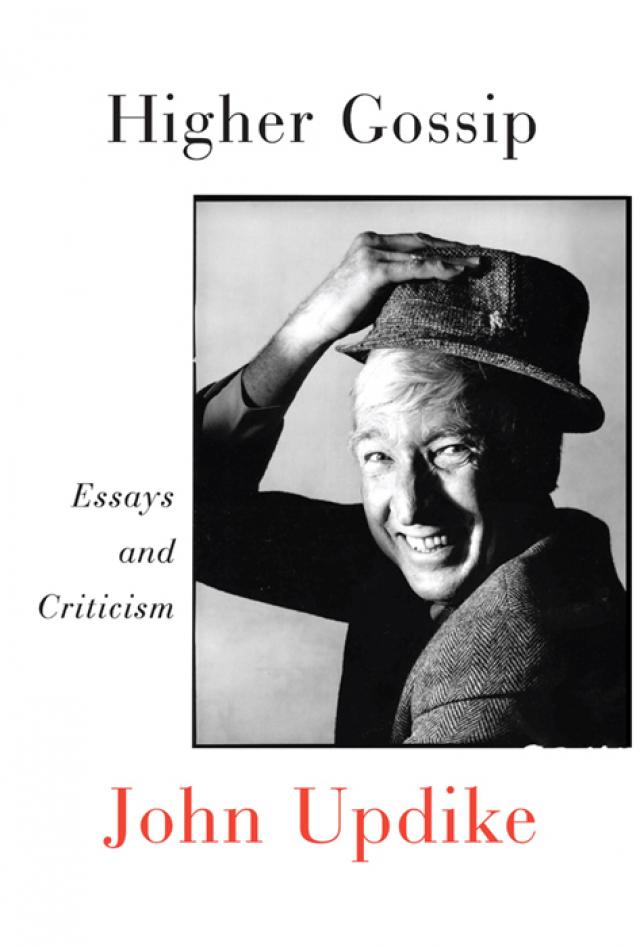
Higher Gossip: Essays and Criticism

John Updike

Fiction

Here is the collection of nonfiction pieces that John Updike was compiling when he died in January 2009. It opens with a self-portrait of the writer in winter, a Prospero who, though he fears his most dazzling performances are behind him, reveals himself in every sentence to be in deep conversation with the sources of his magic. It concludes with a moving meditation on a world without religion, without art, and on the difficulties of faith in a disbelieving age. In between are pieces on Peanuts, Mars, and the songs of Cole Porter, a pageant of scenes from early Massachusetts, and a good deal of Updikean table talk. At the heart of the volume are dozens of book reviews from The New Yorker and illustrated art writings from The New York Review of Books. Updike’s criticism is gossip of the highest sort. We will not hear the likes of it again.
Read online

  • 690
In the Beauty of the Lilies

In the Beauty of the Lilies

John Updike

Fiction

In the Beauty of the Lilies begins in 1910 and traces God’s relation to four generations of American seekers, beginning with Clarence Wilmot, a clergyman in Paterson, New Jersey. He loses his faith but finds solace at the movies, respite from “the bleak facts of life, his life, gutted by God’s withdrawal.” His son, Teddy, becomes a mailman who retreats from American exceptionalism, religious and otherwise, into a life of studied ordinariness. Teddy has a daughter, Esther, who becomes a movie star, an object of worship, an All-American goddess. Her neglected son, Clark, is possessed of a native Christian fervor that brings the story full circle: in the late 1980s he joins a Colorado sect called the Temple, a handful of “God’s elect” hastening the day of reckoning. In following the Wilmots’ collective search for transcendence, John Updike pulls one wandering thread from the tapestry of the American Century and writes perhaps the greatest of his later novels.
Read online
  • 678
The Maples Stories

The Maples Stories

John Updike

Fiction

(Book Jacket Status: Jacketed) Collected together for the first time in hardcover, these eighteen classic stories from across John Updike’s career form a luminous chronicle of the life and times of one marriage in all its rich emotional complexity. In 1956, Updike published a story, “Snowing in Greenwich Village,” about a young couple, Joan and Richard Maple, at the beginning of their marriage. Over the next two decades, he returned to these characters again and again, tracing their years together raising children, finding moments of intermittent happiness, and facing the heartbreak of infidelity and estrangement. Seventeen Maples stories were collected in 1979 in a paperback edition titled Too Far to Go, prompted by a television adaptation. Now those stories appear in hardcover for the first time, with the addition of a later story, “Grandparenting,” which returns us to the Maples’s lives long after their wrenching divorce. From the Hardcover edition.
Read online
  • 676
Hub Fans Bid Kid Adieu: John Updike on Ted Williams

Hub Fans Bid Kid Adieu: John Updike on Ted Williams

John Updike

Fiction

On September 28, 1960-a day that will live forever in the hearts of fans-Red Sox slugger Ted Williams stepped up to the plate for his last at-bat in Fenway Park. Seizing the occasion, he belted a solo home run- a storybook ending to a storied career. In the stands that afternoon was 28-year-old John Updike, inspired by the moment to make his lone venture into the field of sports reporting. More than just a matchless account of that fabled final game, Hub Fans Bid Kid Adieu is a brilliant evocation of Williams' competitive spirit, an intensity of dedication that still "crowds the throat with joy." Now, on the 50th anniversary of the dramatic exit of baseball's greatest hitter, The Library of America presents a commemorative edition of Hub Fans, prepared by the author just months before his death. To the classic final version of the essay, long out-of-print, Updike added an autobiographical preface and a substantial new afterword. Here is a baseball book for the ages, a fan's notes of the very highest order.
Read online
  • 618
My Father's Tears and Other Stories

My Father's Tears and Other Stories

John Updike

Fiction

John Updike’s first collection of new short fiction since the year 2000, My Father’s Tears finds the author in a valedictory mood as he mingles narratives of his native Pennsylvania with stories of New England suburbia and of foreign travel. “Personal Archaeology” considers life as a sequence of half-buried layers, and “The Full Glass” distills a lifetime’s happiness into one brimming moment of an old man’s bedtime routine. High-school class reunions, in “The Walk with Elizanne” and “The Road Home,” restore their hero to youth’s commonwealth where, as the narrator of the title story confides, “the self I value is stored, however infrequently I check on its condition.” Exotic locales encountered in the journeys of adulthood include Morocco, Florida, Spain, Italy, and India. The territory of childhood, with its fundamental, formative mysteries, is explored in “The Guardians,” “The Laughter of the Gods,” and “Kinderszenen.” Love’s fumblings among the bourgeoisie yield the tart comedy of “Free,” “Delicate Wives,” “The Apparition,” and “Outage.” In sum, American experience from the Depression to the aftermath of 9/11 finds reflection in these glittering pieces of observation, remembrance, and imagination.
Read online
  • 610
Collected Poems, 1953-1993

Collected Poems, 1953-1993

John Updike

Fiction

“The idea of verse, of poetry, has always, during forty years spent working primarily in prose, stood at my elbow, as a standing invitation to the highest kind of verbal exercise—the most satisfying, the most archaic, the most elusive of critical control.  In hotel rooms and airplanes, on beaches and Sundays, at junctures of personal happiness or its opposite, poetry has comforted me with its hope of permanence, its packaging of flux.”                 Thus John Updike writes in introducing his Collected Poems.  The earliest poems here date from 1953, when Updike was twenty-one, and the last were written after he turned sixty.  Almost all of those published in his five previous collections are included, with some revisions.  Arranged in chronological order, the poems constitute, as he says, “the thread backside of my life’s fading tapestry.”  An ample set of notes at the back of the book discusses some of the hidden threads, and expatiates upon a number of fine points.                 Nature—tenderly intricate, ruthlessly impervious—is a constant and ambiguous presence in these poems, along with the social observation one would expect in a novelist.  No occasion is too modest or too daily to excite metaphysical wonder, or to provoke a lyrical ingenuity of language.  Yet even the wittiest of the poems are rooted to the ground of experience and fact.  “Seven Odes to Seven Natural Processes” attempt to explicate the physical world with a directness seldom attempted in poetry.  Several longer poems—“Leaving Church Early,” “Midpoint”—use autobiography to proclaim the basic strangeness of existence.
Read online
  • 608
The Widows of Eastwick

The Widows of Eastwick

John Updike

Fiction

More than three decades have passed since the events described in John Updike’s The Witches of Eastwick. The three divorcées—Alexandra, Jane, and Sukie—have left town, remarried, and become widows. They cope with their grief and solitude as widows do: they travel the world, to such foreign lands as Canada, Egypt, and China, and renew old acquaintance. Why not, Sukie and Jane ask Alexandra, go back to Eastwick for the summer? The old Rhode Island seaside town, where they indulged in wicked mischief under the influence of the diabolical Darryl Van Horne, is still magical for them. Now Darryl is gone, and their lovers of the time have aged or died, but enchantment remains in the familiar streets and scenery of the village, where they enjoyed their lusty primes as free and empowered women. And, among the local citizenry, there are still those who remember them, and wish them ill. How they cope with the lingering traces of their evil deeds, the shocks of a mysterious counterspell, and the advancing inroads of old age, form the burden of Updike’s delightful, ominous sequel.
Read online
  • 598
Odd Jobs: Essays and Criticism

Odd Jobs: Essays and Criticism

John Updike

Fiction

John Updike's fourth collection of nonfiction is his biggest and richest yet. The years have brought to him an increasing number of odd jobs, to which he has wittily responded. Here he contemplates our national monuments, the female body, the Fourth of July, the Gospel of Matthew, other writers, moralists, aspects of science, and more.
Read online
  • 495
Rabbit, Run

Rabbit, Run

John Updike

Fiction

Rabbit, Run is the book that established John Updike as one of the major American novelists of his—or any other—generation. Its hero is Harry “Rabbit” Angstrom, a onetime high-school basketball star who on an impulse deserts his wife and son. He is twenty-six years old, a man-child caught in a struggle between instinct and thought, self and society, sexual gratification and family duty—even, in a sense, human hard-heartedness and divine Grace. Though his flight from home traces a zigzag of evasion, he holds to the faith that he is on the right path, an invisible line toward his own salvation as straight as a ruler’s edge.
Read online
  • 472
The Early Stories: 1953-1975

The Early Stories: 1953-1975

John Updike

Fiction

Winner of the PEN/Faulkner Award for Fiction   A harvest and not a winnowing, this volume collects 103 stories, almost all of the short fiction that John Updike wrote between 1953 and 1975. “How rarely it can be said of any of our great American writers that they have been equally gifted in both long and short forms,” reads the citation composed for John Updike upon his winning the 2006 Rea Award for the Short Story. “Contemplating John Updike’s monumental achievement in the short story, one is moved to think of Nathaniel Hawthorne, Henry James, Ernest Hemingway, and perhaps William Faulkner—writers whose reputations would be as considerable, or nearly, if short stories had been all that they had written. From [his] remarkable early short story collections . . . through his beautifully nuanced stories of family life [and] the bittersweet humors of middle age and beyond . . . John Updike has created a body of work in the notoriously difficult form of the short story to set beside those of these distinguished American predecessors. Congratulations and heartfelt thanks are due to John Updike for having brought such pleasure and such illumination to so many readers for so many years.”
Read online
  • 471
Rabbit Redux

Rabbit Redux

John Updike

Fiction

In this sequel to Rabbit, Run, John Updike resumes the spiritual quest of his anxious Everyman, Harry “Rabbit” Angstrom. Ten years have passed; the impulsive former athlete has become a paunchy thirty-six-year-old conservative, and Eisenhower’s becalmed America has become 1969’s lurid turmoil of technology, fantasy, drugs, and violence. Rabbit is abandoned by his family, his home invaded by a runaway and a radical, his past reduced to a ruined inner landscape; still he clings to semblances of decency and responsibility, and yearns to belong and to believe.
Read online
  • 469
Rich in Russia

Rich in Russia

John Updike

Fiction

In these two short stories, Updike’s brilliant observational acuity is matched by a light, comic touch. The writer Henry Bech travels to Europe on a hapless cultural exchange, first to Russia, where he struggles to spend his money when everything – from his meals to his bugged hotel room – is already paid for, and then to Rumania This book includes Rich In Russia, Foreword, Bech in Rumania, Appendix A and Appendix B.
Read online
  • 449
Assorted Prose

Assorted Prose

John Updike

Fiction

John Updike’s first collection of nonfiction pieces, published in 1965 when the author was thirty-three, is a diverting and illuminating gambol through midcentury America and the writer’s youth. It opens with a choice selection of parodies, casuals, and “Talk of the Town” reports, the fruits of Updike’s boyish ambition to follow in the footsteps of Thurber and White. These jeux d’esprit are followed by “Hub Fans Bid Kid Adieu,” an immortal account of Ted Williams’s last at-bat in Fenway Park; “The Dogwood Tree,” a Wordsworthian evocation of one Pennsylvania childhood; and five autobiographical essays and stories. Rounding out the volume are classic considerations of Nabokov, Salinger, Spark, Beckett, and others, the earliest efforts of the book reviewer who would go on to become, in The New York Times’s estimation, “the pre-eminent critic of his generation.” Updike called this collection “motley but not unshapely.” Some would call it a classic of its kind.
Read online
  • 387
Toward the End of Time

Toward the End of Time

John Updike

Fiction

Set in the near future of 2020, this disconcerting philosophical fantasy depicts an America devastated by a war with China that has left its populace decimated, its government a shambles, and its natural resources tainted. The hero is Ben Turnbull, a sixty-six-year-old retired investment counselor, who, like Thoreau, sticks close to home and traces the course of one Massachusetts year in his journal. Something of a science buff, he finds that his disrupted personal history has been warped by the disjunctions and vagaries of the “many-worlds” hypothesis derived from the indeterminacy of quantum theory. His identity branches into variants extending back through the past and forward into the evolution of the universe, as both it and his own mortal, nature-haunted existence move toward the end of time.
Read online
  • 299
183