
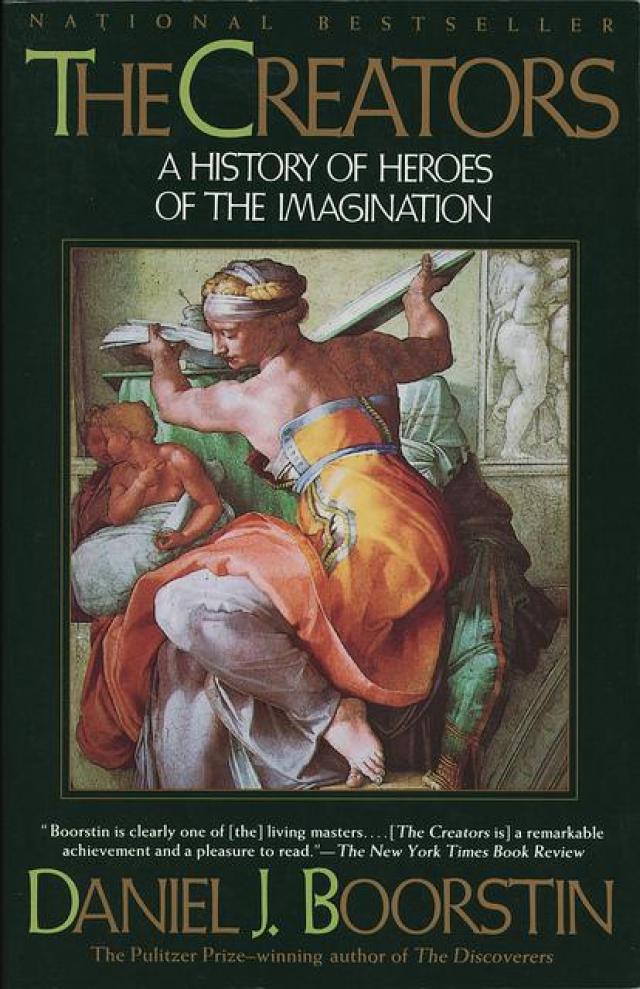
The Creators: A History of Heroes of the Imagination

The Creators: A History of Heroes of the Imagination

DANIEL J. BOORSTIN

DANIEL J. BOORSTIN

By piecing the lives of selected individuals into a grand mosaic, Pulitzer Prize-winning historian Daniel J. Boorstin explores the development of artistic innovation over 3,000 years. A hugely ambitious chronicle of the arts that Boorstin delivers with the scope that made his Discoverers a national bestseller.Amazon.com ReviewHistorian Daniel J. Boorstin brings his customary depth and range to this compelling book on Western art, taking on everything from European megaliths (Stonehenge, for example) to Benjamin Franklin's autobiography ("the first American addition to world literature"). Boorstin does not aim at being comprehensive--he much prefers to linger over certain "heroes of the imagination" as he surveys human accomplishment in the fields of architecture, music, painting, sculpting, and writing--yet The Creators certainly feels comprehensive, as Boorstin carefully places everything he describes within a grand tradition of aesthetic achievement. Boorstin knows that good history demands good writing, and his prose makes this big book easy to absorb. "This is a story," he writes, "of how creators in all the arts have enlarged, embellished, fantasized, and filigreed our experience"--an apt description of the role art plays in our life and an equally apt description of the way Boorstin interprets it for readers. (The Creators also is the second volume of a trilogy that starts with The Discoverers and concludes with The Seekers, although none of these books requires any knowledge of the others.) --John J. MillerFrom Publishers WeeklyIn an ambitious companion volume to The Discoverers, Boorstin undertakes an interpretative history of creativity in Western civilization encompassing all the arts. Creativity, he suggests, is a relatively recent phenomenon with Judeo-Christian roots: the Jews' covenant with Yahweh "sealed . . . man's capacity to imitate God as a creator," and Christianity, by turning our gaze to the future, "played a leading role in the discovery of our powers to create." In the eminent historian's Eurocentric scenario, the Buddha "aimed at Un-Creation" and intimated the existence of a supreme power who was "no model for man the creator." Likewise, Boorstin presents Islamic religion as "the inhibitor of the arts," and his chapter-length forays into Chinese painting and Japanese architecture are unsatisfying, leaving the impression that the truly great creative endeavors are the province of the West. Nevertheless, this is an enormously stimulating volume, an epic work of immeasurable riches. Boorstin contemplates architects' attempts to conquer time and outlast the brief span of human life through prehistoric megaliths, Egypt's pyramids, Greek temples, the Roman Pantheon and modern-day skyscrapers. He offers wonderfully attuned readings of varied versions of the human comedy from Boccaccio and Chaucer to Balzac. Modern writers, he asserts, created the self by probing "the wilderness within," as chapters here on Melville, Dostoyevski, Kafka, Joyce and Virginia Woolf attest. Highly opinionated and quirky, Boorstin says virtually nothing about Mozart's unique triumphs of the spirit, yet he exalts Beethoven as a "prophet and pioneer." Packed with shrewd, pithy judgments and entertaining biographical profiles of Dante, Da Vinci, Goethe, Ben Franklin, Picasso and dozens more, this eloquent, remarkable synthesis sets the achievements of individual creative geniuses into a coherent narrative framework of humanity's advance from darkness and ignorance. First serial to U.S. News & World Report; BOMC main selection. (Sept.) .Copyright 1992 Reed Business Information, Inc.
Read online
  • 68
THE SEEKERS

THE SEEKERS

DANIEL J. BOORSTIN

DANIEL J. BOORSTIN

Throughout history, from the time of creation to our own modern age, the human race has sought the answers to fundamental questions of life: Who are we? Why are we here? "The Seekers" offers a history of our great Western heritage of ideas, as told through the lives of those who still speak to us, from Moses and Plato to Emerson and Einstein.
Read online
  • 44
The Image

The Image

DANIEL J. BOORSTIN

DANIEL J. BOORSTIN

First published in 1962, this wonderfully provocative book introduced the notion of "pseudo-events" -- events such as press conferences and presidential debates, which are manufactured solely in order to be reported -- and the contemporary definition of celebrity as "a person who is known for his well-knownness." Since then Daniel J. Boorstin's prophetic vision of an America inundated by its own illusions has become an essential resource for any reader who wants to distinguish the manifold deceptions of our culture from its few enduring truths.
Read online
  • 36
The Seekers: The Story of Man's Continuing Quest to Understand His World

The Seekers: The Story of Man's Continuing Quest to Understand His World

DANIEL J. BOORSTIN

DANIEL J. BOORSTIN

Throughout history, from the time of Socrates to our own modern age, the human race has sought the answers to fundamental questions of life: Who are we?  Why are we here?In his previous national bestsellers, The Discoverers and The Creators , Daniel J. Boorstin first told brilliantly how e discovered the reality of our world, and then he celebrated man's achievements in the arts.  He now turns to the great figures in history who sought meaning and purpose in our existence.Boorstin says our Western culture has seen three grand epics of Seeking.  First there was the heroic way of prophets and philosophers--men like Moses or Job or Socrates, Plato, and Aristotle, as well as those in the communities of the early church universities and the Protestant Reformation--seeking salvation or truth from the god above or the reason within each of us.Then came an age of communal seeking, with people like Thucydides and Thomas More and Machiavelli and Voltaire pursuing  civilization and the liberal spirit.Finally, there was an age of the social sciences, when man seemed ruled by the forces of history.  Here are the absorbing stories of exceptional men such as Marx, Spengler, and Toynbee, Carlyle and Emerson, and Malraux, Bergson, and Einstein.These great thinkers still have the power to speak to us, not always so much for their answers as for their way of asking the questions that never cease either to intrigue or to obsess us.In this impressive climax to a monumental trilogy, Daniel J. Boorstin once again shows that his ability to present challenging ideas, coupled with sharp portraits of great writers and thinkers, remains unparalleled.From the Hardcover edition.Amazon.com ReviewRenowned historian Daniel J. Boorstin completes the trilogy he began with The Discoverers and The Creators. The first volume covered explorers, scientists, and historians in their quest for raw knowledge, while the second book describes writers, painters, and composers in their pursuit of inspiring art; The Seekers describes people searching for an understanding of human existence--"Man is the asking animal," notes Boorstin. It's a big, bold theme, and although The Seekers is the shortest work in the trilogy, it's still vintage Boorstin: incredibly learned, richly anecdotal, and casually profound. It begins with the prophets of the Holy Land and the philosophers of ancient Greece, continues through the Renaissance, and concludes with the modern era of the social sciences. "In this long quest [for understanding], Western culture has turned from seeking the end or purpose to seeking causes--from the Why to the How," writes Boorstin. That's a neat summary of Western intellectual development over several thousand years. What other author could put it so succinctly? Boorstin is generally stronger with material that is more recent and more secular, but this is an accomplished book and a worthy capstone to an outstanding three-volume effort. --John J. MillerFrom Publishers WeeklyIn The Discoverers (1983), Boorstin introduced readers to scientists, explorers, historians and other pursuers of knowledge. Ten years later, The Creators did the same for innovators in art. "We glory in their discoveries and creations," he writes in the introduction to his latest, "But we are all Seekers. We all want to know why." Starting from that perhaps overbroad premise, Boorstin begins with an examination of Hebrew prophets and Greek philosophers?those who seek from a higher authority and those who seek from within. From this point on there are rather few religious seekers; instead most are philosophers of systems, of systems for discovering truth (the reason of Descartes, the empiricism of Locke, the individual experience of Kierkegaard) or for describing it (the encyclopedia of Diderot, the cultural cycles of Spengler, Hegel's World-Spirit). Certain subjects seem rather out of place, and chapters like that on H.G. Wells and John Reed, another on Oliver Wendell Holmes and E.O. Wilson; and individual chapters on Samuel Beckett, Lord Acton and Andre Malraux, have the feel of an insatiable polymath's chapbook. There are many movements, many people and many big ideas here, all expounded with Boorstin's characteristic enthusiasm and breadth of knowledge. It's perhaps inevitable that in such a broad survey some simplification would slip in?e.g., identifying 13th-century universities as centers for training gentlemen, rather than for offering professional training in theology, law and medicine. But what Boorstin does so well is bring together many ideas that fertilize and cross-fertilize the reader's imagination and curiosity. Author tour. Copyright 1998 Reed Business Information, Inc.
Read online
  • 6
183