

Black duck, p.1
Black Duck, page 1


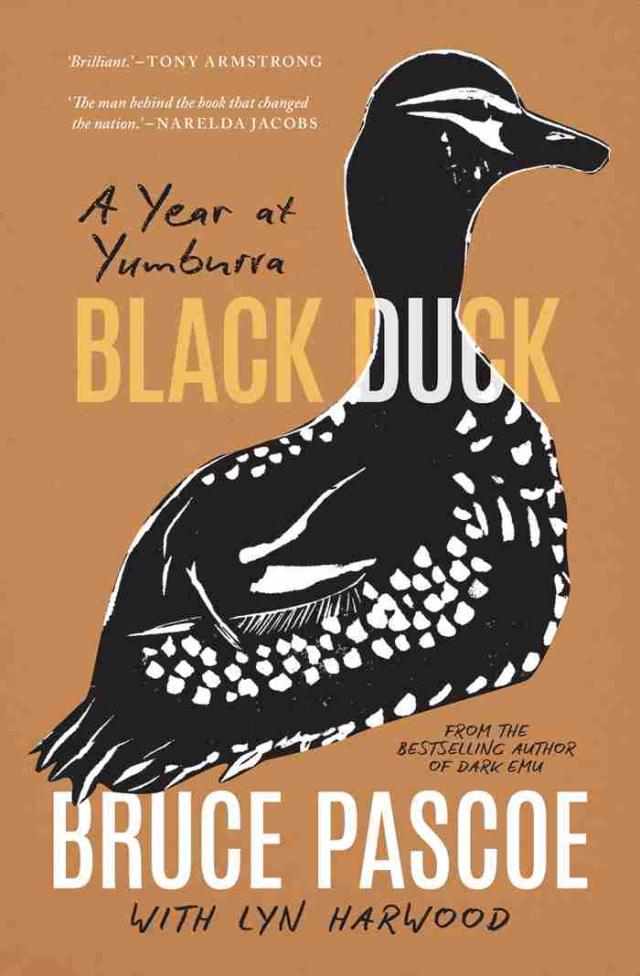
‘Sometimes you need to repeat something a hundred times before a bell rings in the colony.’
From the bestselling author Bruce Pascoe comes a deeply personal story about the consequences and responsibility of disrupting Australia’s history.
When Dark Emu was adopted by Australia like a new anthem, Bruce found himself at the centre of a national debate that often focussed on the wrong part of the story. But through all the noise came Black Duck Foods, a blueprint for traditional food growing and land management processes based on very old practices.
Bruce Pascoe and Lyn Harwood invite us to imagine a different future for Australia, one where we can honour our relationship with nature and improve agriculture and forestry. Where we can develop a uniquely Australian cuisine that will reduce carbon emissions, preserve scarce water resources and rebuild our soil. Bruce and Lyn show us that you don’t just work Country, you look, listen and care. It’s not Black Duck magic, it’s the result of simply treating Australia like herself.
From the aftermath of devastating bushfires and the impact of an elder’s death to rebuilding a marriage and counting the personal cost of starting a movement, Black Duck is a remarkable glimpse into a year of finding strength in Country at Yumburra.
‘Bruce’s love of Country is resoundingly evident. I get the sense that this book and his work with the Black Duck team has been profoundly cleansing for a man who has faced numerous challenges in his life after Dark Emu. His connection to place, land and Country is at the core of his remarkable resilience. Bruce gets right into the belly of the land and storytelling, a medicine this country needs.’
—Stephen Page
‘Bruce invites us onto the land that changed the man behind the book that changed the nation.’
—Narelda Jacobs
‘This brilliant book gives a real insight into the minds and lives of Bruce and Lyn and the impact Dark Emu had on both of them.’
—Tony Armstrong
‘Bruce and Lyn so eloquently bring us into intimate contact with the land and our beautiful culture – reminding us all of the rich history that Australia holds.’
—Allira Potter
Bruce Pascoe and Lyn Harwood have lived and worked in the area of the Three Salt Rivers for decades and are grateful to Country and the chance to honour her in words, photos, drawings and ceremony.
This book is dedicated to
Grandmother and Grandfather,
Mother and Father.
Contents
Yumburra farm map
The Black Duck
An Introduction to Our Country
Late Summer
Gipsy Point
Bunjil
Grasses
Yumburra
Boats
Uncle Max
Dogs
Harvest
Snakes
Covid
Harvests and Cuckoos
Birran Durran Durran
Gamelan
Summer Flowers, Butcherbirds and Herons
Family
Smoke
Yambulla
Life’s Rich Tapestry, or Threadbare Carpet?
The Hot Days of Early February
Stones and Homes
Googar
Rain and Rivers
Autumn
Nothing Like a Good Flood
Democracy’s Slow Wheel
The Wood Grub Philosophy
Rain and Pigeons
Forest Dusk and Last Chances
Autumn in the East
Spider Eggs
Aboriginal Food and Family
Ceremony for Uncle
More Dramas
Lord Howe
Elections and Gardens
Language on Fire
Winter
Light in the Forest
Following the Whale
Vagrant Jesus
Blackfellas
Hens and Dogs and the Pugilism of Kangaroos
A Beer at Genoa
Painting the Desert
So, Here’s the Dream
The Currawong Grid and the Whale Pattern
Early Spring
Birran Durran Durran Brings the Spring
Goomera, the Possum
Yellow-faced Honeyeater
Lightning and Thunder
Fly West, Drive North
Australia’s First Miners
Possum Skin
The Starling
Spring
Red in Tooth and Claw
Boats
Binyaroo and Bitheega
Cleaning the Fridge
Emus, Old Brass and Fire
Early Summer
Queensberry Rules
The Family Christmas
Brave New Year
Language Glossary
Acknowledgements
YUMBURRA FARM MAP, 2020
Map illustration by Chris Solazzini
Yumburra, Black Duck
The Black Duck
At Yumburra, on Yuin Country close to Mallacoota, Aboriginal peoples cultivate the traditional Aboriginal grasses and tubers. Black Duck grows over forty Aboriginal foods with the goal of redeveloping traditional food growing and country management processes for the economic benefit of Aboriginal peoples and Country.
‘We want to tell the story of our lands. For a long time, the story of traditional agriculture was buried. Stories from elders across the country were ignored. We respect the keepers of these stories and acknowledge their resilience. Our stories come from a time when stories began, and we are now transforming these stories into new opportunities for Aboriginal people as part of the journey towards food sovereignty.’
—Black Duck Foods
An Introduction to Our Country
An Owlet-nightjar is more butterfly than bird, more spirit than being, less weight than a handful of grapes. Pale fairy of the night.
I hear their soft churring almost every night but can count the times I have seen one on the fingers of two hands. It is like seeing a large moth fluttering silently in the dark. Our people say they hold the woman spirit. Their eyes are huge, doe-like, but that description belies their huge responsibility.
I turned the corner onto the Gipsy Point Road on a September day at three in the morning and there she was on the road in front of me, those huge eyes questioning my appearance at that hour, the hour of true dreams or restless wakefulness. I stopped and considered my response.
You’re back, she said. And that’s how it felt. I opened the door a fraction so that she could hear the click and it was enough for her to flutter into the Melaleucas beside the road.
I shut the door and drove on carefully to make sure I could avoid a collision with any startled roo or wallaby. At the end of the road the little town nestled against the dark water where three great salt rivers meet. Wallagaraugh, Jinoor and Maramingo. Is it a town if it’s without a shop of any kind? The sleeping houses were unconcerned by semantics.
On the bank of the river there were thirty or more kangaroos. I nodded, yes, that’s about how I remembered it. I thought the property would be on my right and so I parked the car and stepped out to prove the theory.
I was anxious to see if the old jetty was still there and yes, there it was. A Night Heron was dozing on the handrail. The land was sold in that instant.
The moon over the jetty at Gipsy Point
Grief
When our son seemed destined for university in the city I could see Lyn get twitchy, rattled, cups jittered precariously in her hands, her eyes were distracted. It was grief.
She is a natural architect, forever conscious of light and warmth and comforting spaces. I suggested we begin the search for land on which to build a holiday house. Her holiday house. We only had enough for a cheap block. Remoteness made blocks cheap.
We tried Tasmania but the cost of travel to and from the island was prohibitive. We were speechless at the cost of properties on the Glenelg River, dismayed by the winds of South Australia, the ugly clutter that the Queensland coast had become. Then Lyn found a block for sale at Gipsy Point. I looked closely at the dim photograph and figured I knew exactly where the block was located. On the Jinoor River, site of the best pub in Australia, although the photo managed to avoid inclusion of either the pub or the river. The selling point seemed to be the stump of a fallen wattle.
I picked up the car keys and swag and stuffed two t-shirts and a pair of undies in a plastic bag and headed east. It was a ten-hour drive from where we lived in the Otways, so I had to swag it in a bush rest stop near Stratford. I woke at midnight and stirred up the old Subaru and drove on. I had lived in the district of Gipsy Point in the seventies and early eighties. After my uncle showed the place to me in 1963, I promised myself I would return there one day. On Country.
I made it back in 1973 but with a daughter and unhappy wife. In Paradise. I had never seen a place so beautiful, never felt so at home, so viscerally attached to the land. The marriage didn’t last, couldn’t have, and I lost the land. Dragged myself to Melbourne but knew I couldn’t survive inside paling fences.
I met Lyn, or rather heard her laughter in a stairwell, and realised I hadn’t laughed in a long while. We exchanged observations of birds and leaves and not much later stood together watching horses in a paddock. She invited me to pull up a concrete slab in her backyard and I accepted because it was the best offer I’d had in years.
We visited the Otway Coast and I watched in amazement as she crawled through the tea tree bowers searching for orchids. This is different, I thought. Someone connected to
Jack was soon on the way. But in the blink of an eye seventeen years had passed and Lyn was fumbling cups and tea towels and not quite closing doors. I know, I thought, I’ll keep her busy.
Gipsy Point isn’t busy but it’s warm. One day I was drilling screws into galvanised beams to fix decking timbers, sweat was dripping onto my father’s old Black & Decker drill. I knocked off and went down to the jetty, stripped off my sodden shirt and dived into the river. Halfway through the dive I thought, Hang on, it’s August.
Gipsy is warm, Cape Otway is not.
But Cape Otway had a lot of Lomandra and that’s what the old ladies wanted, the weavers. Men and women came from all over the western district to collect Lomandra leaves and have a cup of tea, sometimes more tea leaves than weaving leaves. But eventually I’d be dragooned into the harvest of the tough leaves the women would soak and dry, soak and dry to make them pliable enough for basket and eel trap making.
Elders from the district needed help with cultural protection and they couldn’t be too fussy about where that help came from.
They’d heard stories about my family. They’d told me stories of theirs but they were alarmed by my ignorance. Despite this their patience was limitless. Aunty Joyce predicted accurately that I would find some family in Tasmania and Aunty Bunta, even more accurately, thought that family would be connected to Victorians. For both women the reverse had been true. Uncle Ivan listened and listened, a thoroughly decent man, but warned me that before looking for family I had to learn the real history of the country, the black history. Uncle Banjo insisted that pale-skinned Aboriginal people had a role in community, after all, no one had ever been found to be half pregnant; you either were or you weren’t. No fence-sitting.
They sent me back to the library with tantalising suggestions of the Eumeralla war, the militias based at Pirron Yallock, the fastnesses of the Stony Rises, the many murders and massacres everywhere, including Cape Otway.
The Wathaurong asked me to take over the research for the Dictionary of Wathawoorroong because the incumbent researcher had accepted a promotion to National Parks; the fate of so many young and smart Blackfellas; being snatched by government as soon as community had trained them to undertake responsible positions. Aboriginal communities are unofficial and unpaid training institutes. Aunty Zelda insisted she attend my library visits so she could teach me how to use my antennae. We visited almost every library, museum or history association in the western district. She liked the Geelong Historical Records Centre because they had the best cafe across the road. In those days Birregurra was a complete disappointment in that regard so she was careful to pack a thermos.
She trained me to be a jewel thief and a rat detector. She could sense in the first thirty seconds if the staff were going to be uninformed, uncooperative or downright racist. Sadly, more often the latter two.
She would engage all the staff in some search for the athletic exploits of one of her relations in boxing, running, bicycle races or football. Black people dominated Victorian sport up to about 1930. ‘Did you know,’ she would say to a staff member caught like a rabbit in the spotlight, ‘he won that race against all the Olympic champions on a fixed wheel postie’s bike?’
I think the postie’s bike was Aunty Zelda’s invention for dramatic effect but it was certainly fixed wheel and it was reported in the press. ‘And did you know he won that 100-yard dash three times, but they always gave the cup to the first white man to cross the line?’ That also was a true story. ‘And did you know that the trainers at Fitzroy footy club wouldn’t give Doug Nicholls a rub down because they didn’t want to touch black skin?’ Well, it was my father who told me that last story, but it was the sort of thing that Aunty Zelda would use to get the shamed librarian to find the documents she wanted.
Meanwhile, I was free to access the documents she really wanted me to see. She knew the rest like the back of her hand. But she provided cover for my searches. Once at the Public Record Office my search for documents about the Great Victorian War was being hampered by a factotum who thought he was still on the frontier.
‘Oh look,’ Aunt chortled from a corner of the Record Office, ‘here they are, they were here all the time and you must have forgotten.’ She was a bit of a witch in many ways. She pinned those people down until the armpits of their office shirts darkened with suppressed rage.
Once at the Colac Information Centre I was asking about the fort that had been built out beyond Irrewillipe. ‘Oh, no fort ever built here,’ the ruddy-cheeked RSL badge was saying, ‘no, no fort here.’ Aunt spun around and faced him. ‘You know the one, the one with the loopholes for windows.’ I stared at her in amazement. How did she know about loopholes? But when I turned back to old silver-short-back-and-sides, a loyalist’s haircut, I had no doubt he knew what they were and knew exactly what building she was referring to.
I visited that building several times to measure the gun embrasures, the perfect shape within which to swivel a gun. Then I went back to the Information Centre to show the photos to old short-back-and-sides. He tried to bluster about Cobb & Co. horse stables but a horse doesn’t need to swivel to breathe air. We both knew what a gun embrasure was and against whom the guns were pointed.
I wrote a story about those windows in my short story collection, Salt. Travels with Aunty Zelda and company also influenced my books Cape Otway, Convincing Ground and Dark Emu.
The latter two were written in a little office Lyn and I and some mates built beside the Gipsy house that Lyn designed with Johnny Grunden, the best damn double bass player in southern Australia.
Convincing Ground gained a fervent readership, keen to learn what Aunty Zelda and Uncle Ivan knew, but it was Dark Emu that was adopted by Australia like a new anthem. It was obvious a year out from publication that it would sell better than any other of the twenty-five books I had written to that point. At one lecture at the Australian National University the room was full of professors and, while some of the elbow patch brigade wanted to accuse me of sedition, others scribbled down other references I needed to read. Insurrection had been abroad for some time.
Wangarabell (Bell), Spirit dog
The book had me travelling from state to state, county to country, town hall to town hall, but it tested Lyn and me to the limit. It came to a point where she could barely sit in the room when some stranger came to discuss the bloody emu.
We separated in 2017, three years after Dark Emu was published, and live in separate houses to this day. The last of our two shared dogs is dying on the couch as I write these words. The famous Wangarabell, spirit dog of the Bidwell-Maap.
The fracture between Lyn and I was deep, and the momentum of Dark Emu increased the distance despite the fact that we remained best friends and supporters.
In 2021 we went on a holiday together and did all the things we’d always done; beach walks, bird watching, reading and talking around the stove. A few weeks earlier I saw Lyn fall and my reaction was very telling. I thought she had done herself some real damage. It wrenched my guts and it told me a lot about the depth of our connection. We reaffirmed our bonds a few months later on a lonely beach at Wilsons Promontory.
Lyn hadn’t wanted to have anything to do with the farm at Yumburra, mainly because of the enormous physical and financial drain it would have on us, but I felt I had to buy the farm to show that Yuin people were still connected to our old foods. The Yorta Yorta decision by Justice Olney in 2002 that the people’s culture and rights had been washed away by the tide of history shocked me to the core. Once bakers and restaurateurs had joined the Emu’s bandwagon, I could see a second dispossession racing toward us.
And without a home, I bought the farm. I tried to buy superior land on the highway near Eden, but it was too expensive, so I ended up with Yumburra, a remote farm in a remote district of Far East Gippsland. My workload was ridiculous and Lyn, despite her doubts, helped with the administration and later joined the Black Duck board.






