

Tiger work, p.1
Tiger Work, page 1


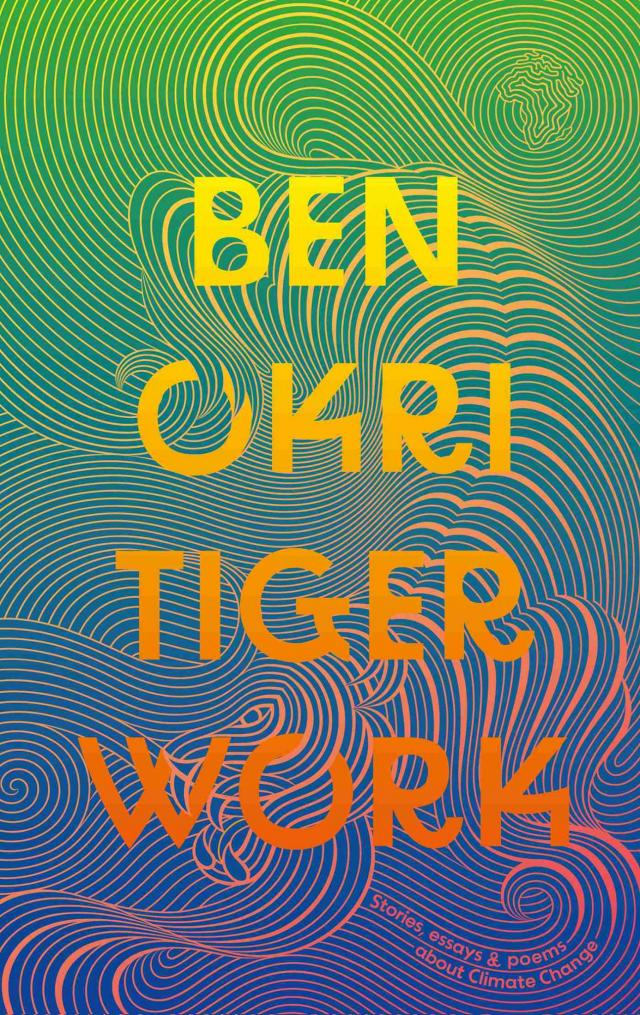
TIGER
WORK
Also by Ben Okri
FICTION
Flowers and Shadows
The Landscapes Within
Incidents at the Shrine
Stars of the New Curfew
The Famished Road
Songs of Enchantment
Astonishing the Gods
Dangerous Love
Infinite Riches
In Arcadia
Starbook
The Comic Destiny
(previously Tales of Freedom)
The Age of Magic
The Magic Lamp
The Freedom Artist
Prayer for the Living
Every Leaf a Hallelujah
The Last Gift of the Master Artists
ESSAYS
Birds of Heaven
A Way of Being Free
The Mystery Feast
A Time for New Dreams
POETRY
An African Elegy
Mental Fight
Wild
Rise Like Lions (Anthology)
A Fire in My Head
PLAYS
The Outsider
Changing Destiny
TIGER
WORK
Stories, essays and poems
about climate change
BEN OKRI
www.headofzeus.com
First published in the UK in 2023 by Head of Zeus Ltd,
part of Bloomsbury Publishing Plc
Copyright © Ben Okri, 2023
The moral right of Ben Okri to be identified as the author of this work has been asserted in accordance with the Copyright, Designs and Patents Act of 1988.
All rights reserved. No part of this publication may be reproduced, stored in a retrieval system, or transmitted in any form or by any means, electronic, mechanical, photocopying, recording, or otherwise, without the prior permission of both the copyright owner and the above publisher of this book.
Parts of this book are works of fiction. Characters, organizations, and events portrayed are either products of the author’s imagination or are used fictitiously.
Poems, stories and essays in this book first appeared in the following: ‘Three Parables About Water’, Kulturaustausch, 2022; ‘The Broken’, part of Writers Rebel event for Extinction Rebellion, London 2021; ‘And Peace Shall Return’, Emergence, 2020; ‘Tiger Work’, part of Writers Rebel event for Extinction Rebellion, London 2020; ‘The House Below’, Concrete & Ink, 2021; ‘The Songbird’s Silence’, Financial Times, 2020; ‘Letter to the Earth’, Letters to the Earth: Writing to a Planet in Crisis, William Collins, 2019 ; ‘Kerze’, exhibition notes, Kerze, Gavin Turk, 2022; ‘After the End’, Emergence, 2022; ‘A Short Interview’, Africa Review, 2021; ‘Existential Creativity’, Guardian, 2021; ‘The Secret Source’, New Yorker, September 2022.
A catalogue record for this book is available from the British Library.
ISBN (HB): 9781804545430
ISBN (E): 9781804545416
Cover design by Yehrin Tong
Head of Zeus Ltd
5–8 Hardwick Street
London EC1R 4RG
WWW.HEADOFZEUS.COM
CONTENTS
Also by Ben Okri
Title Page
Copyright
Dedication
Epigraph
1 Three Parables about Water 1. THIRST
2. KNOWLEDGE
3. LOVE
2 The Broken SECTION 1
SECTION 2
SECTION 3
SECTION 4
SECTION 5
SECTION 6
SECTION 7
3 And Peace Shall Return THE LAST SOLITUDE
CHILDREN’S GAMES
SUDDENLY IN VENICE THE RAVENS SING
THE STATE DEPARTMENT DENIES
THOSE DEEP MINES
AND THE GODS DEPARTED
A VISION ONCE I SAW
4 Tiger Work
5 The House Below
6 Spawn
7 From a Sacred Place
8 The Songbird’s Silence
9 Letter to the Earth
10 Kerze
11 After the End SECTION 1
SECTION 2
SECTION 3
SECTION 4
SECTION 5
SECTION 6
SECTION 7
SECTION 8
SECTION 9
SECTION 10
SECTION 11
12 A Short Interview
13 The Devil’s Fuel or I Sing the Dawn of Bright, Fresh Energy SECTION 1
SECTION 2
SECTION 3
SECTION 4
SECTION 5
SECTION 6
SECTION 7
14 Existential Creativity
15 The Secret Source
16 Some Mysterious Force
17 Anthem
About the Author
An Invitation from the Publisher
For those who love the world enough to fight for it.
‘Tyger, Tyger, burning bright…’
William Blake
Read slowly
THREE PARABLES
ABOUT WATER
1
THIRST
One day a woman had come to see him because she had written to him a few times and he had never replied. They sat on his sofa while she gazed at him.
‘Why haven’t you written to me?’
He looked at her.
‘I came all this way to see you.’
‘What is it you want?’
‘To be your friend.’
‘Do you think it’s possible?’
‘Why shouldn’t it be?’
He looked away.
‘It’s just you don’t say anything.’
He looked at her again, mutely.
‘Your silence drives one crazy.’
At last he spoke.
‘Friendship means everything to me. I can’t do it lightly anymore. It’s like entrusting someone with your heart.’ He paused. ‘If I ripped out my heart and gave it to you to look after, could you?’
He made a ripping motion and presented his heart to her. She stared at his hand.
‘That’s scary.’
‘I know.’
‘Would you do it for me?’ she asked.
‘With my life, if you were my friend.’
‘Do you have many friends?’
‘No.’
‘I see.’
He smiled.
‘My mother told me a story about a lonely prince. Being a prince made it hard for him to find true friends. He asked a wise man for help. The wise man said, “Find out which of your friends, using only their hands, can carry water a long way from the river, without spilling it…” She didn’t finish the story.’
‘What did she mean?’
‘I’m not sure.’
‘I’d like to try it.’
‘Really? Now?’
‘Do you have a bucket?’
‘Yes.’
‘Fill it with water and let’s go outside. I’ll be at one end of the canal and you’ll be halfway down. First I’ll see if I can bring you water with my naked hands. Then you’ll try.’
‘Do I have to?’
‘Yes, this is about your requirement for friendship. I want to meet it.’
‘But it’s not your requirement. It’s mine. You must have your own.’
‘I’m not as wise as your mother. I will adopt yours.’
He got up and fetched water in a bucket. They went out of the house and down the canal.
They found a spot where she could stand. He went off a good distance, till she waved him to stop. A moment later she was walking towards him hurriedly. When she got to him there was a small quantity of water left in her cupped hands.
‘What do you want to do with it?’
‘Let’s pretend I’m dying of thirst, and you’ve brought this for me.’
She lifted her hands to his face, and he drank. Then it was his turn.
When he was a child his mother had taught him how to cup his hands so that water would not escape.
‘You never know when only a few drops of water will save someone’s life,’ his mother had said.
He walked over to the bucket, halfway down the street. When he got there, he cupped his palms and scooped up some water. Then he walked towards the woman. The world shimmered like mirages in a desert. The buildings and the cars and the road were gone. There was only the woman, dying of thirst. He didn’t hurry. His mother had told him to be calm in these situations. He walked steadily. Not a drop leaked from his hands. Neighbours were struck by his trance-like state. Cars went past him. Sweat ran into his eyes, but he did not blink. Then he was before her. She lowered her face and drank. The water seemed to have no end. She drank till her thirst was thoroughly quenched. She saw there was still water left in his hands.
‘Have you finished?’
‘Yes.’
He drank the rest.
‘Where did you learn to do that?’
‘What?’
‘Keep water running through your hands?’
‘It was your thirst.’
‘What about it?’
‘It was a great thirst. You made the little that I brought into a lot.’
‘I was thirsty. You took your time. I could have died by the time you got to me.’
‘I could have rushed and brought you nothing.’
‘You have no idea how hot it was. Like the desert.’
‘Do you know the desert?’
‘Yes,’ she said, looking around.<
2
KNOWLEDGE
The hall was packed. People had been speculating about the talk for weeks. Never before had the university invited such a person to address the academic community. The dean of faculties had hoped, in these atheistic times, that an outsider might provoke a useful debate about the state of knowledge in the world.
When she turned up the dean was surprised that she was younger than he expected. She looked worryingly young. What if her talk were a total disaster? He would be made to look a fool and might be stripped of his position.
But the moment had arrived. He made the most non-committal of introductions and fled the stage. The speaker had made only one request. She did not want a lectern. She wanted only a table with a bowl of water and a transparent glass.
She stepped forth and cast her eyes over the people in the hall. Contempt was written on many faces. The mood was thick with doubt and even a discernible mockery. She smiled.
‘Can everyone see me?’ she asked.
Someone gave a snorting laugh. Otherwise a dull sound of assent travelled across the hall.
‘Good,’ she said. ‘Then you can’t complain afterwards.’
She held up the bowl of water as if to perform a miracle. Then she poured water from the bowl into the glass. Water spilled from the glass as from a gushing tap. There seemed no end to the water in the bowl. Water ran from the glass, to the table and down to the floor. Soon water covered the whole surface of the floor. No one in the audience spoke.
*
They watched first with amusement at her patent stupidity, then with surprise, and finally with alarm. The water spread along the floor and crept towards the wainscoting. There were electrical sockets at floor level. Those in the front seats lifted their feet from the ground. With a serene expression on her face, she went on pouring.
At last a man with a rough beard, from the philosophy department, could bear it no longer.
‘For God’s sake, woman,’ he shouted, ‘can’t you see that you are flooding the room?’
At that moment the woman stopped. Something cleared in the air.
‘What flooding?’ she asked.
The floor about her feet was dry. She put the bowl down, and drank the water in the glass. She stared at the hall that was crowded with the best brains in the academic world. There was incomprehension and thinly veiled wonder on their faces.
She bowed and left the stage. Tremendous applause erupted behind her.
She went through the door, out of the university, and never returned.
The dean who had invited her became master of the college, and two years later was knighted for services to education.
3
LOVE
When I was a kid I used to talk to the river in my hometown.
‘How are you?’ I once asked.
‘Not so good.’
‘Why not?’
‘There was a time when your people used to worship me as a goddess. Back then my water was clean and pure and children loved playing in me and beautiful young girls came to fetch water. The town used to celebrate and make songs about me every year. I was quite a river back then.’
‘What happened? You’re really tiny now.’
‘The factories came and began dumping things in me. I grew sluggish and the mermaids didn’t come anymore to play on my shores. The town stopped making songs about me. Then they forgot about me altogether.’
‘I haven’t. You’re still my friend.’
‘That’s why I’m still here. But I’m moving away. I only delayed going because I was waiting for you to grow up.’
‘Where are you going?’
‘Does it matter? When you’ve been a goddess you don’t want to be a puddle, which is what I am.’
‘But I’ll miss you.’
‘When you think of your childhood in this forgetful town, you will at least always remember me as a real river. I want to leave when that memory is still fresh in one person’s mind.’
‘I’m really sorry to hear it. Tell me where you’re going so I can come and visit you.’
‘I’m going to be free. If something is there, your people take it for granted. They respect things that are not there anymore. They make religions out of them. When your people take something for granted, they do terrible things.’
‘Like what?’
‘They empty their sewers into it. This they call appreciation. It is better for your people if things are no longer there.’
‘Is that why you’re leaving, because you’re not properly honoured? If that’s the case, I could…’
‘Things only stay because they’re loved. I can’t bear indifference. It’s the cause of all I have suffered, all the toxic waste dumped in me. No one hates me. It’s just that they don’t care.’
The river was silent for a while.
‘This is the last time you’ll see me. Our fates are linked. When I’m gone you will never return.’
‘Why is that?’
‘One day your mother and father will pass away. Then what will be left? Just the sense that no one cares about you. I am the only one that could cradle you as I did when you were a child. When I disappear, this town will die.’
I never heard the voice of the river again. I grew up and travelled into the world. The last time I was back, the river had gone. The town had shrunk.
I still seek that river everywhere I go.
THE BROKEN
1
When they asked me
To come up with
Words that could speak
To a world on the verge
Of environmental collapse,
I had a crisis of my own.
Fever runs in the veins
The seasons run on broken groves.
The facts are horrific
The evidence overwhelming
And still we carry on
As if no crisis were looming.
Thunder hovers above our roofs
Earth shakes beneath our floors.
What can one say to those
Who either don’t want to
Hear, or have heard enough?
What can one say
That doesn’t paralyse some
With the sheer scale
Of the problem?
In the end I wrote a poem of two lines
Composed of just twelve words.
The words were photosynthesised
On grass grown on hessian
And floated on the brown river.
Can’t you hear the future weeping?
Our love must save the world
Good Thames, glide gently while I sing this song
Good Thames, we know not for the earth how long
2
This earth that we
Love is in grave danger
Because of us.
We have raped,
Exploited,
Abused, wrecked.
Disembowelled
And destroyed her
We blow her up, we blast
Her apart. We smash her.
We detonate
Atomic bombs on her.
We poison her.
The oceans are acidic
The rising mouths of the sea
Will devour
Men on their lunch breaks
Women at their desks
Children wandering home
From school.
Fumes in the air
Chemicals in the water
Greenhouse emissions,
Throttling time.
Leaking landfills
Batteries and plastic
Hydrocarbons
And cows and sterile
Yields of crops
Will kill millions.
Trees are disappearing.
Forests are becoming legends,
Rare as unicorns.
All over the world
Forests have become
Graveyards of trees.
Nothing there
But the ghosts
And stumps
Of the thousand species.
The earth’s topsoil
Blown away
Turned to dust
Drained and weakened.
And now trees
Have no great depths
To bind their roots
And the sudden storms






