The shadows of empty men.., p.1
The Shadows of Empty Men (Adam Park Thriller Book 3), page 1
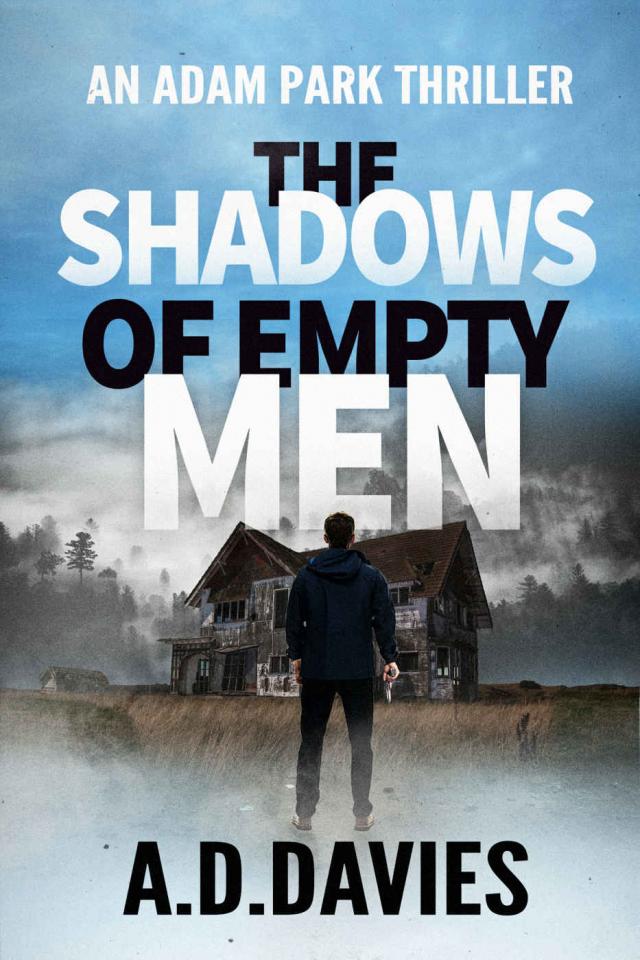


The Shadows of Empty Men
An Adam Park Thriller
A. Davies
Copyright © 2016 A. D. Davies
All rights reserved. No part of this publication may be reproduced, distributed, or transmitted in any form or by any means, including photocopying, recording, or other electronic or mechanical methods, without the prior written permission of the publisher, except in the case of brief quotations embodied in critical reviews and certain other noncommercial uses permitted by copyright law.
www.addavies.com
Contents
Acknowledgments
Novels by A. D. Davies
Prologue
I. GREECE
Chapter 1
Chapter 2
II. GERMANY
Chapter 3
Chapter 4
Chapter 5
III. POLAND
Chapter 6
Chapter 7
Chapter 8
Chapter 9
Chapter 10
Chapter 11
Chapter 12
Chapter 13
Chapter 14
Chapter 15
IV. GERMANY
Chapter 16
Chapter 17
V. POLAND
Chapter 18
Chapter 19
Chapter 20
Chapter 21
Chapter 22
Chapter 23
Chapter 24
Chapter 25
Chapter 26
VI. AUSTRIA
Chapter 27
Chapter 28
Chapter 29
Chapter 30
Chapter 31
Chapter 32
Chapter 33
Chapter 34
VII. GERMANY
Chapter 35
Chapter 36
Chapter 37
Chapter 38
Chapter 39
Chapter 40
VIII. AUSTRIA
Chapter 41
IX. UNITED KINGDOM
Epilogue
Novels by A. D. Davies
Cover by designed by Perie Wolford
Novel edited by Jayne Wolfe
http://www.wolferossediting.com/
Novels by A. D. Davies
Moses and Rock Novels:
Fractured Shadows
No New Purpose
Persecution of Lunacy
Adam Park Thrillers:
The Dead and the Missing
A Desperate Paradise
The Shadows of Empty men
Night at the George Washington Diner
Master the Flame
Under the Long White Cloud
Alicia Friend Investigations:
His First His Second
In Black In White
With Courage With Fear
A Friend in Spirit
To Hide To Seek
A Flood of Bones
To Begin The End
Co-Authored:
Project Return Fire – with Joe Dinicola
Standalone:
Three Years Dead
Rite to Justice
The Sublime Freedom
Shattered: Fear in the Mind
Lost Origins Novels:
Tomb of the First Priest
Secret of the Reaper Seal
Curse of the Eagle Plague
Guardians of the Four Shields
For those haunted by shadows of the past – stay strong
Prologue
There are no ghosts.
That’s what we’re told when our fears burrow too deep. If our friends or children suffer nightmares, we repeat the mantra. There are no ghosts. We know it’s true because everything has a rational explanation.
Except human nature.
Humans are the most illogical beings, full of terror, hate, and urges the worst of people cannot explain, even when it surfaces within themselves. Like those whose profession is death. They, and we, can only guess at what drives them, what allows them to switch off the part of their brain that for most people refuses to kill another; for them, such an act feels as empty as closing a door.
Kill, get paid.
Close the door, keep the draught out.
Same synapses firing, same degree of guilt.
Then there are those who choose their profession for other reasons.
A man once said to be truly happy, you need to become an expert at something you love, because when you are an expert, better than most of the population at any activity, someone will eventually pay you to do it. Computer games, singing, playing a sport. Find your expertise, utilize those skills for your living, and be happy.
The same holds true for murder.
Do you enjoy inflicting pain and death upon your fellow humans? Then do it a lot. Get good at it. Become great at it. And soon, you can earn your living doing what you love.
But if you encounter another who is also adept at killing, yet does not share your pleasure, you will be drawn into conflict. You will be called to account for your actions, and a person like me will do everything humanly possible to stop you striking ever again.
I have learned over the past year that I am able to kill. I gain no pleasure from it, but I am willing. Although I would struggle to justify certain actions to a judge, or even my friends, I sleep fine, and I only regret my mistakes—mistakes primarily concerning not acting quickly enough, allowing bad men to take the lives of innocents around me.
So when a case comes my way, seemingly peaceful, researched-based, I may not be prepared. How can I be? For a job such as this I would not plan on unleashing the bestial side of me. For when a killer of real passion enters my life, I cannot turn away. As ever, when I have no choice, I will act.
There are no ghosts in this world. Except those we make for ourselves.
GREECE
THE ISLAND OF PARAMATRA
Chapter One
Have you ever visited a Greek island in the springtime? The air you breathe is actually sweet. The colors are orange and green, white and red, the sunrises somehow both lazy and fierce. Perhaps that’s why I found it so hard to leave.
Varying my routes throughout the hilly island, my morning runs had grown longer of late, starting earlier thanks to sleeping with my curtains open so I rise via natural light. One grain-based bar and a glass of water, and I am out of the door, returning anywhere between an hour and two hours later, depending on my mood.
This morning saw a two-hour jaunt out to the Acara Ruins, an amphitheater pre-dating the birth of Christ and overlooking a swooping crescent of cliff, pulled apart by some long-forgotten earthquake. The dive-boats were out already.
Thanks to my injection of cash to the Archaeological Society of Paramatra (yep, ASP), small teams were currently exploring the local legend of a vast city that once stood out there, grand and proud, before the same shifting of plates five miles wide swallowed it up along with the coastline. The more excitable of their members were talking about Atlantis, but to date we had only recovered a dozen or so pots, which the big museums fobbed off with the notion that, despite being confirmed as genuine antiques, these items can be found all over the Aegean; they did not constitute evidence of a civilization. I joined them three or four times a week, and because of my financing they tolerated my amateurish enthusiasm every time I surfaced flashing a wide smile through my beard and waving what usually turns out to be a tide-smoothed Coke bottle to which a family of barnacles might have grown rather attached.
I mostly tried to keep out of their way and enjoy the scenery; it’s springtime in the ocean too.
Yeah, I know. Feeling sorry for me yet?
My return route cut through a village stirring to life, and I arrived home by seven-thirty where I showered, trimmed by beard to keep it tight to my face to fend off the prospect of being mistaken for a hobo, and then sat on my house’s second-floor balcony overlooking the rocky bay for a breakfast of bread, meat, yogurt, and fruit. I caught up with the British news via various websites, skipping the more depressing-sounding stories, and briefly checked a couple of US sites in which I held a vague interest. Local news officially confirmed something I already learned from the chief of police: deals between the EU and other countries meant incoming Middle Eastern and African refugees were now processed faster in Turkey with the reduced number of traffickers diverted to islands further west. Paramatra’s intake had reduced to a trickle.
I clicked off the news feeds, and nipped out to meet Eric Jones at the indefinitely-delayed airport construction site, where we planned to fire high-caliber handguns at various targets for a while. He was late, which wasn’t unusual. It was so not-unusual that I’d taken to bringing a book with me for such occasions. After setting up the tin cans and glass bottles I collected from the beach on the way over, I found my current place in John Connolly’s latest, and settled comfortably in the cab of a stalled JCB digger.
Last November, the case that brought me here went on longer than I expected, legal wrangling demanding my continued presence weeks after its conclusion. Instead of returning to the UK, I secured a plush house with a panoramic view, and with my gut still in knots over the actions I took—or didn’t take—I spent Christmas alone. New Year’s Eve saw me hit it off with a retired British Army officer—the afore-mentioned Eric—and we ended up drinking expensive scotch in a bar right on the beach. I did not go home with Eric. I went home with a German blond woman, twenty-two years-old, maki
Eric showed an hour late, hung-over and red in the face. He’d piled on the pounds since his retirement, but he knew his guns. I didn’t want to know guns, but there had been too many incidents lately where I could have used a lot more experience.
I had made enough enemies, after all.
“You look like crap,” I said.
“We can’t all roll outa bed quaffed and groomed like a GQ cover model, oh beautiful one. Here, you need some practice with this.”
He presented me with a Sig-Sauer P229, a compact .40 caliber pistol.
“No Glock today?” I asked.
“You want to be good at firing everything. Just in case, right?”
“Right.”
“So you tell me just in case of what, and I’ll tell you what the best gun is for a given scenario.”
“I honestly hope I never have to fire one at all, but—”
He pressed the Sig into my hand. “Then if you’re not gonna own a firearm, get used to as many different types as possible. This is your bum-gun, the one you got most trouble with.”
Using a Glock 16, I could draw and shoot a tight three-grouping at twenty feet in one smooth motion, but the Sig’s second and third shots went wild. The shift from its initial double-action to single always threw me.
Eric opened a premium-quality camera bag to reveal four mags and two boxes of bullets. “You owe me three hundred euros for the brass. Now get practicing. I’ll be over there in the shade. Shout if you want a hug or something.”
What we were doing here wasn’t exactly legal, but when Eric first moved out here with his wife, he registered himself a gun collector and sportsman, so for a premium import tax he was able to source bullets for his toys. The chief knew of our practice sessions, though, and after what happened here over the winter, he allowed me some leeway. The real reason Eric kept himself so well armed lay in his past, and no amount of alcohol would pry it from his lips. He attempted the same line of questioning on me, and achieved the same wall of silence.
Eventually, we both stopped trying.
I strapped on my holster, donned the ear-protectors, and spent the next hour accounting for the differential in double and single action. Occasionally, Eric popped over to adjust my shoulders or the angle of my elbow and wrists, and when we ran out of inanimate objects to destroy, he drew faces on flat scraps of wood and mounted them on the wall of rubble serving as our range.
Three hundred rounds later, my hands ached, but I thought I had the action down pat.
“Better,” Eric said. “This is almost the same mechanism as the Beretta, so I’ll bring one of those tomorrow. Nine-mil makes the recoil a bit different, and the Beretta doesn’t have a de-cocking hammer.”
“Thanks.” I handed over five hundred Euros—for the bullets and his fee for the week. “Coffee?”
“The posh stuff you bring over from South America?”
“Of course,” I said.
It made a nice change to have a mentor who appreciated the finer side of life for a change. Eric schooled me in instruments of death, while I educated him in fine beans.
Back at my house, I opened the mailbox—an American-style container at the end of the path—and sifted through the usual assortment of junk. Only a single item looked official.
“Another one?” Eric said.
“Yeah.”
I opened it, and read the admonishment from London-based attorneys Dunleavy, Smith, & Clark about how I should not ignore them, and how they were being fair in giving me a chance to respond to their client’s demands for compensation. Roger Gorman, my former partner in Park Avenue Investigations, blamed me for the fire that wiped out the profitable core of the business, and demanded restitution to the tune of ten times my actual wealth, even though the police cleared me of any involvement.
To be fair, the police came to an incorrect conclusion, but to be equally fair, Gorman was still a dick head.
“I’ll sort it somehow.”
Rather than wiping my arse on it and sending it back in a perfumed envelope (which I almost did with the first notification), I folded the papers in half and placed them in my back pocket.
My choices were to stand and fight, or move my money offshore, and migrate to a country with no extradition. It didn’t sit well with me. After I turned eighteen, I lived abroad for a long time, always moving around, finding a new perch to lay my proverbial hat, but that was born from my craving for isolation, for freedom, and simple joy; if I fled this, it would be a prison sentence.
Eric followed me inside and immediately ducked into the downstairs loo, while I continued through the open plan ground floor to my kitchen to recycle the junk mail accompanying Gorman’s missive: limited-offer timeshares, a mayoral election flyer, the former-resident’s pre-approved credit card waiting for her…
“Adam?” It was Eric’s voice.
I scanned around, and found him in my lounge holding the Sig-Sauer on an elderly white man and a miserable-looking black guy in his thirties. The older man wore a quality suit, the younger a leather jacket, white T-shirt, and jeans. Eric must have used the facilities and headed straight for the airy living area, expecting me to deliver a steaming espresso of Fair Trade Guatemalan nectar. Which I would have, if not for this little wrinkle in my day.
“One of ’em’s packing,” Eric said, his shooting stance not wavering an inch. “Wanna guess which?”
I strode across the polished marble toward the two men with their hands behind their heads, slapped open the younger guy’s jacket, and relieved him a make of gun I’d never encountered. I located the safety to ensure it was on and tossed it aside. Faced the older guy. He was in his sixties, or a very healthy seventies.
I said, “I’m guessing you’re the boss, he’s the bodyguard.”
“Correct,” the elderly man replied with an accent. German, I thought, but not pure. Belgian or Swiss, perhaps. “If I may—”
“What you may do is tell me why you’re here. Roger Gorman using scare tactics now?”
“I assure you, I do not know who Roger Gorman is. We are here on an unrelated matter.”
“That forces you to break into my home? The door was locked when I got here.”
The man indicated the couch where an impression suggested he’d been waiting moments earlier. I nodded and he sat, but I waved a hand at Eric to remain alert.
“Who are you?”
“My name,” the man said, “is Herman Prinz. I am a lawyer representing the Kravitz family, and I apologize for giving you a fright.” He mopped his brow with a monogrammed handkerchief. “The guard on your gated street would not allow us to knock, and since you are not listed with a phone company we could not call. My colleague, Francis here, facilitated access.”
“Your colleague’s a burglar?”
“I’m a facilitator,” Francis said with a Canadian twang. “May I sit too?”
“No, you may not,” Eric answered for me. “You may keep your hands on your head and if you move them, you may have your chest ventilated. Clear?”