

Bad patch, p.1
Bad Patch, page 1


BAD PATCH
BY A. BERTRAM CHANDLER
A soft world of clouds and drizzles and weathered hills doesn't build a hard people. And a soft people—well, they may have quite different, quite potent, means to their ends!
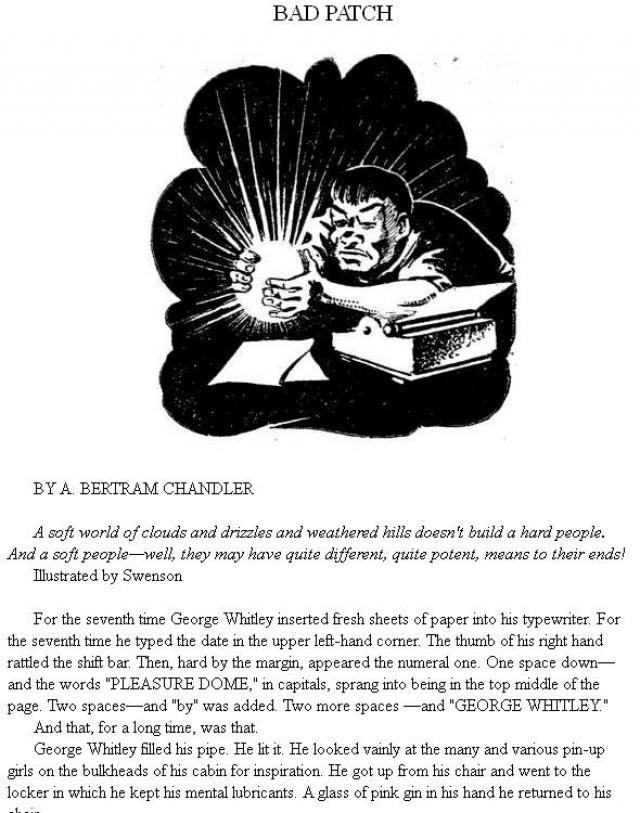
Illustrated by Swenson
For the seventh time George Whitley inserted fresh sheets of paper into his typewriter. For the seventh time he typed the date in the upper left-hand corner. The thumb of his right hand rattled the shift bar. Then, hard by the margin, appeared the numeral one. One space down—and the words "PLEASURE DOME," in capitals, sprang into being in the top middle of the page. Two spaces—and "by" was added. Two more spaces —and "GEORGE WHITLEY."
And that, for a long time, was that.
George Whitley filled his pipe. He lit it. He looked vainly at the many and various pin-up girls on the bulkheads of his cabin for inspiration. He got up from his chair and went to the locker in which he kept his mental lubricants. A glass of pink gin in his hand he returned to his chair.
Ensued an interval devoted to the consumption of gin and relighting of pipes. This was followed by a brief burst of activity, a. sound as of a machine-gun post striving to fight off an attack in overwhelming force. After a brief but spirited resistance the post was overwhelmed and the gunners bayoneted. Whitley read, for the seventh time, the first page of "PLEASURE DOME," tore it from his machine and sent it to join its crumpled predecessors in the wastepaper basket. He lit his pipe again and went out on deck. He looked disapprovingly at the small men-o'-war berthed all around his own ship, looked almost longingly towards the glare of lights in the eastern sky that was Honolulu. He wished that it was not his night aboard, that he was with his fellow officers sampling the dubious delights of that vastly overrated city. The quiet evening of literary endeavor to which he had looked forward had all the earmarks of a failure.
Yet there was a certain stubbornness, a knowledge that he could never hope to be a writer if he were incapable of overcoming such bad patches. Somebody had told him once that if a story refused to get off to a flying start, refused to write itself, the best policy was the abandonment of that story until such time as it, of its own accord, clamored for expression. Somebody else had told him that if you took a bunch of oddly assorted characters and dumped them down in some strange environment a story was bound to grow from the potentialities of such a beginning.
It was possible, thought Whitley, relighting his pipe. It was worth trying. There was nothing to lose—with the exception of a sheet or two of paper. Time was of no consequence. He had nothing better to do. He conveniently forgot the arrears of correspondence that somehow never got made up, took fresh paper from the box on his settee, placed the carbon between the two sheets and began.
Night and day the mists sweep slowly over the surface of Loalon. There is neither sunrise nor sunset and dawn is but a creeping pallor in the eternal overcast, and dusk is a gradual, almost imperceptible diminution of the dim, watery light.
Were Loalon a world of craggy peaks, of tortured rock masses upthrust into the gray vagueness of the sky, the harsh outlines would be softened, the sharp edges and contours would be blunted in appearance if not in actuality by the quivering, saturated air. But there is nothing hard on Loalon. Low, rounded hills rise gently from long beaches that slope down reluctantly to meet the long, low swells of the gray, tideless sea. And the gentle curves of hills and valleys are rendered even more formless, more diffuse, by the feathery gray-green fronds of the luxuriant vegetation that springs from every square inch of solidity, that struggles invisibly, silently, but with a grim ruthlessness for foothold, for life itself.
There was nothing hard on Loalon.
And then the ships of Man dropped down through the mists, the machines of Man blasted and leveled, and around the beachhead of the invader rose the stark, utilitarian outlines of warehouses, administration buildings, living quarters and places of recreation.
And even the soft, humid air could not soften the alien contours. The fecund plant life would have done so—but it was never allowed to spread over roads, over roofing and walls. Within the confines of the settlement it was bullied and regimented into neat, geometrical plots, was forced into hateful proximity to plant life from other worlds. And the works of the aliens stood proud arid aloof, not belonging, hard amidst the all pervading softness.
And to Loalon came Captain Dallon.
A big, hard man was this Dallon—and he was master of a big, hard ship. Not that Draco was unpopular among the men who ranged the space lanes. Dallon was hard—but just. And his ship was run with a smartness, an efficiency, that could not have been surpassed—or even equaled—in the Space Navy. And his officers took pride in the reputation of their captain, of their ship, and gave that little extra effort that means so much, that lesser men could have obtained by neither bullying nor cajolery.
And so Draco dropped down through the mists to Port Munroe, and on the night of her arrival day Captain Dallon, as was customary, dined at the mayor's palace.
"You are hard, you Earthmen," said Lloral. "You are hard. I wonder if you are also brittle?"
Dallon smiled—a bard smile. In his mess uniform—angular, glittering—he looked so much harder than in his customary undress rig. He took a walnut from the bowl on the table and, disdaining the silver crackers; crushed it between his strong, capable hands. The tiny, sharp splintering sound was distinctly audible.
What could have passed for a smile glimmered on the vague, smudgy features of the Loalonian trade commissioner. He, too, reached out to the crystal bowl. The long, soft fingers selected a nut with slow deliberation. And how it was done none of the others at the table ever knew. There was no display of force, no sharp, fast muscular effort. But somehow the two halves of the nut, neatly separated, lay mutely on the soft, moist palm.
These people are the worst I've seen, thought Dallon. It wouldn't be so bad if they weren't humanoid. But their likeness to us mikes them all the more unlike—
He looked across the table at the native, at the soft, flabby body, the effeminate, pale lilac robes of soft, gauzy silk. There was dislike that he could not disguise in his hard, gray eyes. And there was dislike bordering upon hate in the blurred yellow eyes that stared back into his. It was not hate in the sense that it was personal hate for Dallon —but it was hate for all that the man stood for. It was hate for the hard men from the stars, for their hard minds, for the hard exactitudes of their sciences that were made concrete in the hard, harsh outlines of their buildings and machines.
And tension built up inside the room, so that the mayor at the head of his table stirred uneasily, so that the fort commandant felt himself wondering how good his defenses would be if the natives should ever decide to drive the hated strangers from their world, so that the womenfolk, as womenfolk ever do, let their minds dwell uneasily on what would be their fate should the attack come and the defenses and the garrison be found wanting.
"You are hard," said Lloral. He settled back more comfortably in his chair. The pale lilac robes fell into folds that were too soft to be graceful. And still the yellow eyes, glowing balefully, stared into Dallon's face.
The spaceman shifted a little uneasily. The miniature decorations on the left breast of his jacket tinkled ever so faintly—but the elfin tintinabulation was sharply clear. It broke the spell, the soft, gray formlessness that was creeping in from outside the palace, the feeling that the marching mists had breached the defenses, were sweeping down to smother forever this alien rigidity from beyond the stars.
"Yes, we are hard," said Dallon.
And being the man he was he could not hymn the very hardness upon which Man had built his Empire. He could never have sung the harsh scintillance of the stars as seen from the control room of a ship in space, the gleam of light on burnished metal, the austere beauty of straight lines reaching to the sky in Man's great cities. All this was in his mind—and in such matters he was inarticulate. But he found himself thinking how erroneous is the idea that Nature is hard. Nature abhors the straight line. And Nature may work, on occasions, with the harsh, spectacular violence of the earthquake, the hurricane, the levin bolt—but in the main her destructive agents are the tireless, creeping tendrils of her plants, the insidious rootlets that, given time, will bring the proudest construction down to a soft outlined mound of ruin.
Lloral sighed.
It was a soft ghost of a sound. It expressed much—and little. It seemed to be the voice of his world protesting faintly and ineffectually against its violation by these coarse, trampling invaders. It held a querulous note of despair at the trade commissioner's inability ever to understand the alien philosophy of these Outsiders. There could have been contempt in it—and there could have been envy.
And led by the lady mayoress the womenfolk left the table, left the men to one last glass of wine. And it was not long thereafter before Dallon found himself, along with the other guests, watching the latest New York musical, the recording of which had occupied a very small corner of the capacious hold of Draco.
Dallon refused the offer of a car back to his ship.
The walk from the mayor's palace to the spaceport was not a long one —and even if it had been he would have welcomed the opportunity to stretch his legs. He settled his cloak about his shoulders. The night was not cold, but its dampness brought a chill feel to the air. Through the mists the lamps along the straight, long road to the port shone with a diffused glare, each with its iridescent halo. And their radiance was reflected from the wet surface of the road so that it loo ked like a river with lights along its banks. No, not a river—it was too straight. Like a canal it was, a canal stretching from the small busy port which was the brightly lighted hallway of the palace in which the guests were saying their farewells, from which the guests were making their departure. A canal stretching away into the wet mists, away from the warm, friendly world of men.
Dallon shivered.
He was not an imaginative man, but he began to be sorry that he had refused the offer of the° fort commandant to run him back to his ship. He considered going back inside to order a taxi. While he stood hesitant a figure detached itself from the group just inside the lighted doorway. It was Lloral. He came silently, with deceptive swiftness, to stand by the captain's side.
"Captain Dallon, you are walking back to your ship?"
"Yes."
"Would you mind if I accompanied you? The night air is good after being inside. You people love harsh, bright lights, hot, dry air. It is good to breathe the air of Loalon as it should be, to feel the soft caress of the mists, to smell the scent of our growing things."
"I shall be pleased to have your company," lied Dallon.
He would not admit it even to himself—but he was frightened. And he knew that it was an absurd fear. A big, strong man like himself had nothing to fear from the soft, flabby native. It would take at least six like Lloral to best him in a hand to hand encounter—and unless the guard had been criminally lax Lloral was the only one of his race inside the settlement walls. Besides—with a surreptitious movement Dallon made sure that his small caliber blaster was still in the shoulder holster barely concealed by the short mess jacket.
Together—the tall, broad Earthman, the short, flabbily fat Loalonian—they began walking down the long, straight road to the spaceport. The mist brushed their faces like lightly clinging fingers. At times they could see almost the full length of the road, could see the glare of the floodlights by which Draco was discharging her cargo. At times they were in a little world of a few feet of wet road surface, of one lamp standard with the bright globe of its light set in another, vaguer globe of misty iridescence.
"It is a good world," said Lloral slowly and softly. Then— "It was a good world."
"Until we came, you mean?"
"You are blunt, captain. But that is what I do mean."
"You hate us, don't you?"
Lloral said nothing, averted his face so that Dallon could not read the answer on his features.
"Yes, you hate us," continued the captain. "And I'm not sure that I blame you. But—it could be worse. Have you ever heard of the Grakkians?"
"No."
"We don't know where their home world is. It may not even be in this galaxy. But their progress has roughly paralleled ours, kept pace with ours. They have the interstellar drive. And if they had come to this world there would not have been a mere spaceport and trading station. If they had come first your skies would be reflecting the glare from their factories and foundries—and your people would be slaving in those same factories. Every inch of your ground would have been under intensive cultivation—and your people would have been the laborers. When there's a man with a whip standing over you, you either work or fight. And—"
"And we're the kind that would work. You needn't say it captain. I could read your meaning quite easily."
You soft, bitter devil! thought Dallon.
The two walked on in silence. The captain was glad when the mists suddenly lifted, when he saw before him the shining hull of his ship, gleaming in the glare of the floodlights, standing tall and proud like a tower built by some inspired architect. Flimsy, a web spun by a mechanical spider, the conveyor belts ran down from her cargo ports and down them came a stream of bales and cases. The glaring lights, the cheerful bustle, were a welcome antidote to the soft misery of the night.
Dallon paused at the foot of Draco's gangway. He looked down with real but unconscious arrogance at the trade commissioner. FL wanted to thank the other for hi, company and bid him goodnight—but as a shipmaster he was Earth's ambassador. A very real—although unpaid—part of his duties was the extension of courtesies to beings such as this Lloral. When he asked the other to come aboard with him, he hoped that the invitation would be refused—but it was not.
Aboard Draco Dallon felt better. This was his ship. This was his world—and he was king. The smartly uniformed cadet at the gangway head saluted both the captain and his guest—and Dallon noted with approval that there was a barely perceptible touch of condescension in the compliment paid to the visitor. He should not have approved—and he made a mental note to the effect that the cadet would be on the carpet in the morning. But he did approve.
Lloral looked around at the plain, yet comfortable, furnishings of the captain's flat with interest. And there was that in his manner which dispelled Dallon's ease of mind, dissipated his sense of well-being.
It was a condescension far more subtle than that shown by the cadet on duty, it was the impression that here was the representative of an ancient civilization visiting the mud hut of some savage chieftain. Dallon scratched the prospective lecture on etiquette out of his mental notebook.
Nevertheless—as host he had duties.
"Try this Salerian wine," he said. "It is far superior to the brand they keep for export."
"Thank you."
Over the glasses the eyes, hard gray and soft, smoldering yellow, met and struggled. It was not a clash. Rather it was the hampering, the enveloping of a keen steel blade by fold upon smothering fold of soft, amorphous fabric.
The wine was sweet and potent, heavy, a fit potable for a harsh, dry climate, the cold, arid world from which it had come. But in the soft, humid warmth of Loalon it was too heavy. Dallon struggled to keep his eyes open. The vague smear of features that was Lloral's face became even more vague, doubled and then, as the captain blinked, coalesced again. He wished that the native would finish his drink and go. But Lloral reached out for the heavy, fantastically ornamented bottle and refilled both glasses. And Dallon was almost jerked fully awake by his keen resentment. He had become used to the different usages of different worlds, different cultures—but on every world but this hosts and guests kept their places.
To take his mind from the affront —conscious or unconscious he had no means of knowing—he started to talk.
"This is my first time in Loalon," he said slowly. "What are your exports?"
"Toys, captain. Just toys. But they pay."
"Such as?"
Lloral fumbled in the folds of his tunic. His hand came out of the pale lilac silk with a ball. Just a glass ball it was, perhaps four inches in diameter. There was nothing about it in any way outstanding, no luster or play of color. Lloral pulled the center of the dark-blue table cover up so that it made a little mound, and on this he set the little crystal sphere. The whole scene was somehow vaguely familiar. Dallon thought back, remembered how, years ago, he had visited a so-called Psychic Consultant. The quack had used just such a ball as this.
"Who buys these things?" he demanded.
"There is a certain class on your world, captain. They call themselves mediums, clairvoyants. And this is one of the tools of their trade."
"But they are swindlers, fakers."
"Not all. There is power in these little balls. Not the crude power of your machines—but still a very real power. A mind of the right type with one of these as its instrument can reach into the past, can range all over the present, can even see a limited way into the more probable future."
Dallon laughed—a short, harsh sound.
"Trickery!" he asserted flatly. "Trickery. Fit only to deceive silly, neurotic women and drunken spacemen r
"Perhaps there are tricksters. But look into the ball."
It was then that Dallon felt the insane desire to ring for the watch, to order the native thrown off his ship. His strong, square hand hovered over the bell push. But there came a flood of realization into his mind, the knowledge that such an action, even if it had no more serious consequences, would make him the laughingstock of the space-ways. It might well ruin his professional career.
"Look into the ball."
Lloral's voice was soft, insistent. It was the slow dripping of water that would, in time, wear away the hardest stone. It was the marching mists of Loalon that had, in the course of ages, weathered that planet until it was a world of low hills and shallow valleys. It was the insidious softness that will shatter granite.






