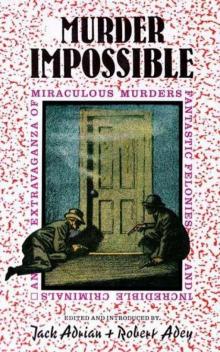
ContentsThe House in Goblin Wood - John Dickson CarrThe Other Side - Hake TalbotThe Courtyard of the Fly - Vincent CornierCoffee Break - Arthur PorgesBullion! - W Hope HodgesonProof of Guilt - Bill PronziniAn Absence of Air - Jacques FutrelleThe Impossible Theft - John F SuterIt's a Dog's Life - John LutzThe Death of Cyrus Pettigrew - Sax RohmerGhost in the Gallery - Joseph CommingsThe Missing Romney - Edgar WallaceThe House of Screams - Gerald FindlerThe Impossible Murder - Edward D HochA Nineteenth Century Debacle - George LockeA Razor in Fleet Street - John Dickson CarrDinner at Garibaldi's - Leonard PruynThe Hanging Rope - Joel Townsley RogersNow You See Her - Jeffrey WallmanThe Blind Spot - Barry PerowneChapter the Last: Merriman Explains - Alex AtkinsonAn Extravaganza of Miraculous Murders Fantastic Felonies & Incredible Despite a few weak items, MURDER IMPOSSIBLE is a "must-have" anthology for all
who enjoy so-called "impossible crimes" fiction. Jack Adrian and Robert Adey
have written short introductions to each of the 21 works (20 stories and a short
radio play) and frequently recommend other works by the authors--works which
many readers will probably try to track down. The editors seem proudest
about including Joel Townsley Rogers' short novel THE HANGING ROPE (1946) and
"The Other Side" (1990) by Hake Talbot (pen name of Henning Nelms). Rogers'
novelette in several respects is a tour de force locked-room murder story
(though I felt its style became obtrusive in a few places); Talbot died in 1986,
and his piece was previously unpublished in English. One of the best
locked-room murder Puzzles in this book is John Dickson Carr's "The House in
Goblin Wood" (1947), which involves a plot gimmick found in many other
stories--Anthony Wynne's "The Gold of Tso-fu" (1926), Agatha Christie's "The
Dream" (1937), Derleth's "The Adventure of the Frightened Baronet" (1945),
Knox's "The Adventure of the First Class Carriage" (1947), Hoch's "The Return of
the Speckled Band" (1987), Kaminsky's "The Man from Capetown" (2001), and
Davies' "The Adventure of the Whitrow Inheritance" (2008). John Lutz's
"It's a Dog's Life" (1982) and Edward D. Hoch's "Captain Leopold and the
Impossible Murder" (1976) are excellent Puzzle stories, respectively involving a
missing weapon and a man found strangled in his car during a traffic jam. Edgar
Wallace's "The Missing Romney" (1919), later incorporated into his novel FOUR
SQUARE JANE, also provides an excellent challenge to the reader's wits. Leonard
Pruyn's "Dinner at Garibaldi's" (1954) poses the problem of how a man who dined
three times a day at a gourmet restaurant died of malnutrition. Arthur Porges's
"Coffee Break" (1964) is a good arm-chair locked-room Puzzle, which most readers
ought to be able to solve. Vincent Cornier's "The Courtyard of the Fly" (1937)
involves the theft of pearls, and its interesting Puzzle fooled me.
William Hope Hodgson's "Bullion!" (1911) is very skillfully written as
far as mood and human psychology are concerned but struck me as a little weak as
a Puzzle story. "The Death of Cyrus Pettigrew" (1909), a murder-on-a-train
Puzzle by Sax Rohmer (pen name of Arthur Henry Ward) is just so-so. John F.
Suter's "The Impossible Theft" (1964) is a fairly good Puzzle but seems to be
based on an old trick used by Houdini when people would strip-search him for
keys and lock-picks. Gerald Findler's "The House of Screams" (1932)
strikes me as implausible, and Jacques Futrelle's "Absence of Air" (1922; aka
"Vacuum"), one of the four stories Futrelle left behind in London when he
boarded the TITANIC and went to his death, seems seriously flawed (Jack Adrian
wisely edited Futrelle's story and put the solution at the end instead of in the
middle). Bill Pronzini's "Proof of Guilt" (1973) also involves a missing murder
weapon but is less plausible than Lutz's story and has a serious plot hole (no
attempt was made by the police to test the suspect's hands or clothing for
evidence that he had fired any gun). John Dickson Carr's radio play "A
Razor in Fleet Street" (1952) seems very lame in many respects. Joseph Commings'
"Ghost in the Gallery" (1949), a Senator Brooks U. Banner mystery, contains some
coincidences and a solution that will probably annoy some readers. The Puzzle of
Jeffrey M. Wallmann's "Now You See Her" (1971) involves the disappearance of a
woman, and I had several doubts about its solution. Two of the bonus
pleasures of this anthology are a pair of Parodies: Alex Atkinson's "Chapter the
Last: Merriman Explains" (1951), which tweaks the nose of John Dickson Carr, and
George Locke's "A Nineteenth Century Debacle" (1979), which does a clever number
on the Holmes and Watson adventures. "The Blind Spot" (1945) by Barry
Perowne (pen name of Philip Atkey) is my least favorite of the selections: it
seems designed as a kind of prank on the reader, and although I was easily able
to foresee its ending, I consider it a gyp; since it has been frequently
anthologized, clearly others disagree with my low opinion.
An Extravaganza of Miraculous Murders Fantastic Felonies & Incredible Despite a few weak items, MURDER IMPOSSIBLE is a "must-have" anthology for all
who enjoy so-called "impossible crimes" fiction. Jack Adrian and Robert Adey
have written short introductions to each of the 21 works (20 stories and a short
radio play) and frequently recommend other works by the authors--works which
many readers will probably try to track down. The editors seem proudest
about including Joel Townsley Rogers' short novel THE HANGING ROPE (1946) and
"The Other Side" (1990) by Hake Talbot (pen name of Henning Nelms). Rogers'
novelette in several respects is a tour de force locked-room murder story
(though I felt its style became obtrusive in a few places); Talbot died in 1986,
and his piece was previously unpublished in English. One of the best
locked-room murder Puzzles in this book is John Dickson Carr's "The House in
Goblin Wood" (1947), which involves a plot gimmick found in many other
stories--Anthony Wynne's "The Gold of Tso-fu" (1926), Agatha Christie's "The
Dream" (1937), Derleth's "The Adventure of the Frightened Baronet" (1945),
Knox's "The Adventure of the First Class Carriage" (1947), Hoch's "The Return of
the Speckled Band" (1987), Kaminsky's "The Man from Capetown" (2001), and
Davies' "The Adventure of the Whitrow Inheritance" (2008). John Lutz's
"It's a Dog's Life" (1982) and Edward D. Hoch's "Captain Leopold and the
Impossible Murder" (1976) are excellent Puzzle stories, respectively involving a
missing weapon and a man found strangled in his car during a traffic jam. Edgar
Wallace's "The Missing Romney" (1919), later incorporated into his novel FOUR
SQUARE JANE, also provides an excellent challenge to the reader's wits. Leonard
Pruyn's "Dinner at Garibaldi's" (1954) poses the problem of how a man who dined
three times a day at a gourmet restaurant died of malnutrition. Arthur Porges's
"Coffee Break" (1964) is a good arm-chair locked-room Puzzle, which most readers
ought to be able to solve. Vincent Cornier's "The Courtyard of the Fly" (1937)
involves the theft of pearls, and its interesting Puzzle fooled me.
William Hope Hodgson's "Bullion!" (1911) is very skillfully written as
far as mood and human psychology are concerned but struck me as a little weak as
a Puzzle story. "The Death of Cyrus Pettigrew" (1909), a murder-on-a-train
Puzzle by Sax Rohmer (pen name of Arthur Henry Ward) is just so-so. John F.
Suter's "The Impossible Theft" (1964) is a fairly good Puzzle but seems to be
based on an old trick used by Houdini when people would strip-search him for
keys and lock-picks. Gerald Findler's "The House of Screams" (1932)
strikes me as implausible, and Jacques Futrelle's "Absence of Air" (1922; aka
"Vacuum"), one of the four stories Futrelle left behind in London when he
boarded the TITANIC and went to his death, seems seriously flawed (Jack Adrian
wisely edited Futrelle's story and put the solution at the end instead of in the
middle). Bill Pronzini's "Proof of Guilt" (1973) also involves a missing murder
weapon but is less plausible than Lutz's story and has a serious plot hole (no
attempt was made by the police to test the suspect's hands or clothing for
evidence that he had fired any gun). John Dickson Carr's radio play "A
Razor in Fleet Street" (1952) seems very lame in many respects. Joseph Commings'
"Ghost in the Gallery" (1949), a Senator Brooks U. Banner mystery, contains some
coincidences and a solution that will probably annoy some readers. The Puzzle of
Jeffrey M. Wallmann's "Now You See Her" (1971) involves the disappearance of a
woman, and I had several doubts about its solution. Two of the bonus
pleasures of this anthology are a pair of Parodies: Alex Atkinson's "Chapter the
Last: Merriman Explains" (1951), which tweaks the nose of John Dickson Carr, and
George Locke's "A Nineteenth Century Debacle" (1979), which does a clever number
on the Holmes and Watson adventures. "The Blind Spot" (1945) by Barry
Perowne (pen name of Philip Atkey) is my least favorite of the selections: it
seems designed as a kind of prank on the reader, and although I was easily able
to foresee its ending, I consider it a gyp; since it has been frequently
anthologized, clearly others disagree with my low opinion.
Read online