

Ghosts of ortona, p.1
Ghosts of Ortona, page 1


Sutherland House
416 Moore Ave., Suite 304
Toronto, ON M4G 1C9
Copyright © 2026 by Ian Cosh
All rights reserved, including the right to reproduce this book or
portions thereof in any form whatsoever. For information on rights and
permissions or to request a special discount for bulk purchases, please
contact Sutherland House at sutherlandhousebooks@gmail.com.
Sutherland House and logo are registered
trademarks of The Sutherland House Inc.
First edition, March 2026
If you are interested in inviting one of our authors to a live event or
media appearance, please contact sranasinghe@sutherlandhousebooks.com
and visit our website at sutherlandhousebooks.com for more information
about our authors and their schedules.
We acknowledge the support of the Government of Canada.
Manufactured in India
Cover designed by Lena Yang
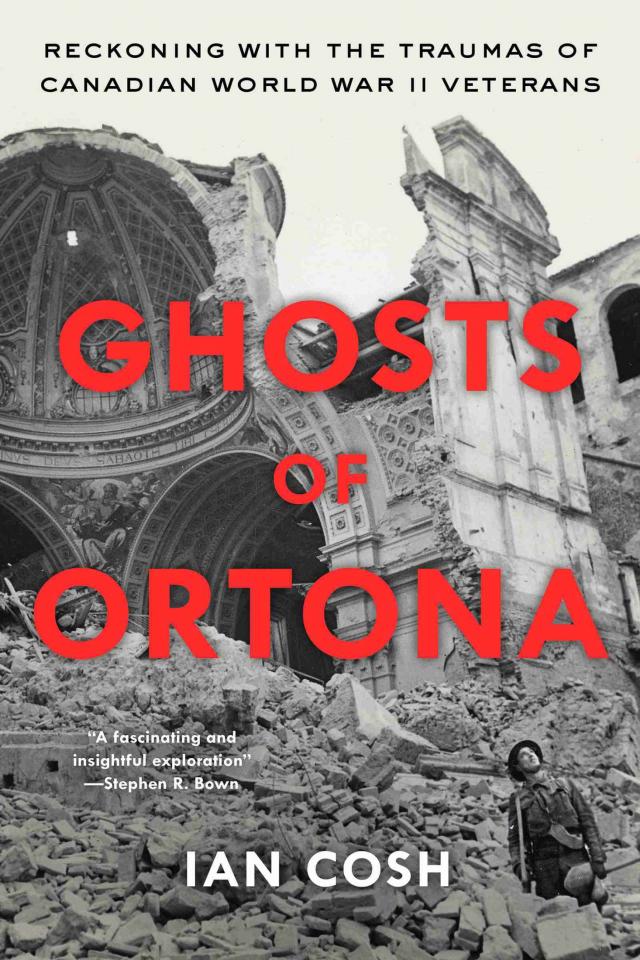
Front cover image: Bill McConville, “All that remains of one of
Ortona’s finest churches.” Imperial War Museum, NA–10389.
Back cover image: Terry Rowe, “Ruins of unidentified church.”
Library and Archives Canada, PA–136308.
Front endpaper: Charles F. Comfort, Via Dolorosa, Ortona.
Canadian War Museum, 19710261-2308.
Back endpaper: Charles F. Comfort, Boschink. Winnipeg Art Gallery,
Gift of Robert and Margaret Hucal, 2005–68.
Book composed by Karl Hunt
Library and Archives Canada Cataloguing in Publication
Title: Ghosts of Ortona : reckoning with the traumas of
Canadian WWII veterans / Ian Cosh.
Names: Cosh, Ian, author.
Description: Includes bibliographical references and index.
Identifiers: Canadiana (print) 20250281619 | Canadiana (ebook) 20250281899 |
ISBN 9781998365968 (hardcover) | ISBN 9781998365975 (EPUB)
Subjects: LCSH: Ortona, Battle of, Ortona, Italy, 1943. | LCSH: World War, 1939-1945—Personal narratives, Canadian. | LCSH: World War, 1939-1945—Psychological aspects. |
LCSH: World War, 1939-1945—Veterans—Canada—Psychology. |
LCSH: World War, 1939-1945—Veterans—Canada. | LCSH: World War,
1939-1945—Veterans—Italy—Ortona. | LCGFT: Personal narratives.
Classification: LCC D763.I82 O77 2026 | DDC 940.54/215713—dc23
ISBN 978-1-998365-96-8
eBook 978-1-998365-97-5
For my parents and my sister
I wish I could explain the desperate sense of isolation, of not belonging to my own past…
—Farley Mowat, in a letter to his parents from San Leonardo,
Italy, December 19, 1943, quoted in And No Birds Sang
Contents
Map
‘Doggerel’
1 Safe Conduct
2 Boots and Souvenirs
3 These Prairie Farmers Are the Men
4 From Harley Church to Dead Horse Square
5 They Said He Was There
6 Weihnacht Means Christmas
7 The Ghost of That Church
8 Something Left Behind
9 A Story He Didn’t Know
10 Dulce et Decorum Est
11 In Another Life
Notes
Bibliography
Image Credits
Acknowledgments
Index
This was unexpected. I was looking for something else.
Far away and in a distant land
And so many years ago,
Canadas youth were asked to engage
A very formidable foe
I’m sitting on the floor beside the box holding these four sheets of lined paper. Hand-printed, all capital letters. It’s a poem by—
“Not a poem.”
That’s right. I remember now.
They’d eaten the dust of Sicily,
Felt the heat of scorching sun,
Marched up the toe of Italy
Always facing the Jerries guns
When he handed me these pages, I saw the title—“Ortona”—followed by lines of rhyming verse. I remarked that he’d written a poem.
“Not a poem,” he said. “Just some doggerel I wrote.”
Rearguard actions they were called,
Although many men had died,
For the German sought the best terrain
Where he could maybe turn the tide
He would make his stand, delay his war
Slow up the bitter attacks
Make sure the enemy pays the price
Stop him dead in his bloody tracks.
Doggerel—I didn’t know the word. I asked him what it meant.
He looked at me, startled.
I was startled that he was startled. Was it so strange that I didn’t know?
Late in the fall the Canadians moved
To blue Adriatics fair shore
Halfway up the Italian boot
Still knocking on Jerries door
Fording rivers high and incessant mud,
They nipped at Tedeschi’s heels,
And on ‘Vino Ridge’ a price was paid
With the fate of brave men sealed.
Eva, his wife, broke the awkward silence. She had been sitting quietly by the door of the study listening to us talk. Now, smiling brightly, she spoke.
“There’s a dictionary on the shelf behind you there,” she said.
Then we all shared a laugh as I reached for the shelf, took out the dictionary, and looked up the word. He had learned it, he said, from a crossword puzzle.
Soon after that lay another town,
Just one of so many they’d seen,
A little port in Decembers cool sun,
Looking placid, quiet serene.
Ortona it’s called, but hold on a minute,
We cant just walk on through,
And a machine gun stutters its greeting now,
Hey Eddy, this ones labelled for you
Every day, he did a crossword. It was his method of self-study. As he’d told me before, he’d quit school at grade nine and hadn’t gone back after the war. His lack of education was a lifelong regret. But he’d found that by doing a daily crossword puzzle he could improve himself bit by bit. When doggerel had come up one day as the answer to a clue, he’d liked the word, reckoned it was useful, and added it to his vocabulary.
“But if a PhD student doesn’t know it,” he sighed, “maybe it’s not so useful as I thought.”
“Over on the left, on the edge of that coulee,
That house. The firings from there,”
“Stretcher bearer”! Someone now called
“Theres wounded men over here”
A tank is sent up and soon got the range,
And blew the house all to the hell,
And that was the start of the Ortona stand,
But the end of some comrades as well.
It’s undated. He must have written it after one of his return trips. Maybe on that first time back when he went there with Eva. They had stopped at the sign on the road, got out of the car, and sat for a while looking across the valley at the town.
The fighting was carried from house to house
Blowing holes in walls to get in
With dynamite, guns and the hand grenade
Both sides were desperate to win.
Blow up my house and Ill blow up yours
Was a game that was soon to be played
And the cost in lives was heavy indeed
Looking now at so many graves.
Painstaking work. Here and there, his lack of formal education shows. But the penmanship is perfect. Four pages. It would take me ages to handwrite anything this long and keep it so neat and clean.
How many drafts did he write before he was done? How many thoughts were put in, didn’t work, and were cut? How many words were looked up and replaced?
I think of his struggle with his stomach—
“But see even now, talking about this, this churns up, any food that I’ve got, churns it up.”
The flip book of pictures in his mind—
“There’s pretty well a constant picture in there. Not one, one picture, but flip to, you know, it’s like one of these things that you flip.”
His crossword companion dictionary beside him as he works.
Back then as you lay on a huge rubble pile
With your rifle loaded and cocked,
Your sights on the dome of Ortonas church
Overlooking the length of the block
San Tomasso the church, was a sniper up there?
Who could see every move that was made
Better not take any chances my friend
And so the tower was sprayed.
The battle continued in terrible force,
Every inch of Ortona saw red
And Hitlers division of parachute troops
Were beaten by the blood that was shed.
They called it the western Stalingrad,
And some history’s say this is so,
This fight that raged through Christmas’es days
Before Jerry was made to let go.
Actually, in his penmanship, he has made one mistake. Near the very end, just seven words from the finish, he’s left out the auxiliary “has.” Then, noticing his error, he’s written the word above the line with a caret below to show its place. A rough fix, but it does the job. God knows, he made it this far—second last line of the page—and didn’t want to do the whole thing over. I can relate.
Ortona today is a peaceful like place,
With its beaches a tourists delight,
Its history likely unknown to all them
Of the armies that came here to fight
But just south of town is a graveyard still,
Filled with markers of boys and of men
Though times endless march has rendered us old
We shall remember them.
At the poem’s end, he’s written three names for the place, including how it appeared on postcards before the war.
Ortona—Ortona a’ Mare—Ortona-by-the-Sea
Not a poem, he said.
It was doggerel.
Trivial or badly written verse.
SOMETIMES I WONDER WHAT might have happened if I’d taken the military historian’s advice. No doubt, this box would be different. My life might be better as a result.
But there’s not much point in wondering. The box is what it is. And that advice wasn’t really for me.
I mean that in both senses. First, I didn’t agree with it—I’d been trained to see things differently. Second—in a manner of speaking—the historian had me mistaken for somebody else.
This tends to happen when people learn that my research involved World War II veterans. For many—experts and non-experts alike—the mere mention of war and veteran is enough: no matter what I say next, my work has already been pegged as military history.
In this case, however, I’d introduced myself as an anthropologist from the start. In my letter, I explained that I was a PhD student in anthropology and that I was planning to interview World War II veterans. I was seeking his advice partly for his expertise on the topic of war, but more so for his experience working with veterans. He was a senior scholar with many demands on his time, so I was pleasantly surprised when he agreed to meet. A few weeks later, when I arrived at his office, I assumed he would remember the context.
He didn’t beat around the bush. Within moments of my taking a seat, he told me I was setting myself up for failure.
“There’s not much value in talking to veterans.”
His message was blunt, but not disrespectful. Having served in the military himself, he clearly didn’t mean to put veterans down. However, perhaps also due to his military background, he wasn’t one for sugarcoating the truth. Especially because I was at a key point in my scholarly career, he wanted me to be forewarned. He pointed out that almost all of the men who’d been officers in World War II were now dead. The veterans still living had mostly served in the army’s junior ranks. As low-ranking and very young soldiers, those guys had rarely had a good grasp of what was going on. Even among the better-informed officers, historians had found memories to be unreliable. Now that the only veterans remaining were basically guys who’d been teenagers and privates, and now that so many more years had passed since the events I planned to ask them about—he was sorry to say, but for scholarly purposes, it was pretty much a waste of time.
He leaned back in his chair with a sigh.
“The guy will be able to tell you, probably very reliably, that old sergeant so-and-so was a mean son of a bitch. But he’ll be hopelessly unreliable in anything he tells you about what he did, where, on what day.”
Looking back now, the historian’s words seem almost prophetic. In the course of my travels and interviews with veterans, I really did hear a lot about a son-of-a-bitch sergeant. And when it came time for me to analyze the men’s stories, I discovered many problems with the facts.
That patrol with Sam, Gus, Rollie, and Bill, for example—was that in Guardiaregia? Vinchiaturo? October the third? Fifth? Eighteenth? Did they take five prisoners, one prisoner, or none? Were these guys even on the same patrol?
Then there was Mel, telling me about shooting the church, while pointing at a photo of the municipal building. Bill’s entire story was off by a day. Ted’s was significantly out of alignment.
And those were just issues that I was able to identify because there were other sources to check the stories against. For most of what the men told me, there were no other sources. Between what actually happened and how they remembered it, there were surely more discrepancies that couldn’t be known.
When I was still sitting across from the historian, I had yet to hear any of the stories. However, I was familiar with the fallibility of memory, and I knew that, for my research, it wasn’t a problem. The historian’s warning was sensible for his own line of work; the aim of most historical research is to reconstruct the past. With that agenda, if you interview someone, you’re aiming to get accurate insight about things that really happened. The subjectivity of the person you’re interviewing, including their personal ways of remembering, is tangential to your purpose. If anything, it’s an encumbrance. You might still want to know about subjective influences on the storytelling, but only insofar as it helps you to separate the “fictive” elements from the facts.
In my work, however, the personal was the purpose.1 My goal was not to reconstruct the past; it was to understand the meanings of the past for the people who had experienced it. My work belonged to a research paradigm that’s interested in how people and societies remember. The basic premise of such work is that the stories people tell about the past, and the manner of their storytelling, shed light on what’s important to them and their relationships to their societies. In this paradigm, it’s still valuable to notice mistakes and contradictions; however, far from regarding these as regrettable symptoms of unreliable memories, the researcher treats them as clues for understanding people’s efforts to find comfort and meaning in the stories of their lives.2
So I wasn’t going to heed the historian’s advice—but that wasn’t something I needed to say. I was there to get his perspective, not to argue for my own. After predicting what I should expect from interviewing veterans, he shifted to suggesting other ways I could pursue my topic. He offered tips for searching the national archives, pointed me to collections in the Canadian War Museum, and explained how some of these primary sources had come into being. It was all useful. He was an expert in the field, and I was getting a valuable orientation to the terrain.
We were about to wrap up the meeting when he asked me, “So who are you working with?”
This caught me a little off guard. We weren’t at my home university, and in contemporary anthropology, there are hardly any household names. I didn’t see how the names of my professors were going to mean anything to him. For some reason, though, he seemed to think that they should. As I recited the names, he began to frown. By the time I was done, he looked absolutely appalled. If there was still any doubt that my answer hadn’t met his expectations, his next words offered more than a clue.
“Who the hell are they?”
I struggled to think for a moment. Why was he so put out?
“Um…Anthropology professors?”
“Anthropology?!”
IN MY DESCRIPTION OF my research paradigm in the paragraphs above, I’ve explained it a fair bit better than I could have done at the time. Back then, I certainly knew the gist of it, but there was still a lot that I had to learn. Moreover, what I did know about narrative and memory was mostly from reading books. It’s one thing to have intellectual knowledge of a subject; it’s very different to have to navigate that subject while it’s coming at you in real life. When you’re sitting in front of a real person, and they are talking to you, or they’ve just gone silent; and you have to discern what they mean, what they want, and whether or not you might be crossing a sensitive line; and meanwhile you’re trying to remember where you’re going and how much time you have; and all of this has to factor into what you decide to say or ask them next—in the midst of all that, it’s easy to forget what you read in the books.3 Even without opening this box here in front of me, I can think of some of my early mistakes.
The first that comes to mind was in my interview with Norman.
It was quiet enough to hear the turning of the tape recorder. From his seat on the opposite sofa, Norman watched me with a look of apprehension. He was a small man in an oversized plaid shirt, well-pressed pants, and thick-cushioned sneakers. He kept clasping and unclasping his hands. Was it nervousness that was making him do it—or just the tremors of age?






